

At the end of the 19th century, the shore of Zaklinskoye Lake was dotted with many beautiful summer houses, and vacationing in these places was considered prestigious. Block and Gippius came here to rest. Together with the Smychkovo estate, these places are associated with the name of the great composer Rimsky-Korsakov (the estate has not survived). Most likely, Rimsky-Korsakov had his eye on the Smychkovo estate as early as 1887, when he rented the Nikolskoye dacha.
In this secluded corner, among the forest-park area stretching along the lake and down the slopes of the hill, in the coolness and gloom of the sprawling crowns of old trees, the difficult summer of 1887 for Rimsky-Korsakov took place. Nature fully corresponded to his heavy mood after the loss of his friend, the composer Porodin. Here Nikolai Andreyevich worked on completing his opera "Prince Igor." Stasov wrote then: "...I had already heard before your letter... how Nikolai Andreyevich works and what he is doing for 'Igor.' Great glory and honor to him! There are few such people in the world, such friends, such artists." The estate of the Khotinsky family on the Luga River, which the Rimsky-Korsakovs rented for the summer season, was not particularly picturesque. The forest was far away, but the house was solid and comfortable. The summer place was found as a replacement for the Glinka-Mavrin estate Golubkovo, in the same Luzhsky district of the St. Petersburg province. Located on the shore of Cheremenetsky Lake, Golubkovo attracted Rimsky-Korsakov with the beauty of the place; the somewhat neglected appearance of the garden and the lack of furniture in the house did not bother the composer. Despite the owner's promises, the house in Golubkovo was unprepared and completely unsuitable for living with a large family by the time the vacationers arrived, so they had to hurriedly change their summer residence. On this matter, Nikolai Andreyevich wrote to Belsky: "We have... bad luck with the dacha: we planned to live in one, but due to its unsuitability, we settled in another."
At Smychkovo, the Rimsky-Korsakov couple celebrated their silver wedding anniversary. On June 30, the day of the 25th anniversary of the wedding of Nikolai Andreyevich and Nadezhda Nikolaevna, they were delighted by a visit from Yastrebtsev. A friend and fanatical admirer of Rimsky-Korsakov's work, Vasily Vasilyevich tried to visit the composer even during the summer holidays, and in St. Petersburg he invariably paid a traditional visit to the composer every Monday. June 30, 1897, also fell on the first day of the week.
"Nikolai Andreyevich, and indeed all of them, including the Akhsharumovs, were very glad of my appearance... Around two o'clock in the afternoon, we were invited to breakfast, after which we drank chocolate. Then the whole company went for a walk first to the picturesque banks of the Luga River, and then to a high hill with a scorched pine tree, from where there was a wonderful view far into the fields, meadows, and a mill. We talked about how in June Nikolai Andreyevich composed 17 new romances, including duets..."
The entire time from late breakfast to dinner was filled with conversations about music and art. Nikolai Andreyevich’s remarks about Dargomyzhsky, Mussorgsky, Cui, Tchaikovsky, Glazunov, Beethoven, Wagner, Liszt, Berlioz, Richard Strauss, and d’Indy remained in Yastrebtsev’s memory and were recorded in his memoirs.
"Thanks to the excellent weather, the table was set in the garden; thus, the very dinner with ice cream, appetizers, and champagne, lasting from six to half-past seven in the evening, was very cheerful and lively. After dinner, the whole company moved to the hall, where Nikolai Andreyevich, at our request, performed all his 'June romances' and duets in several sittings, except for the composed but not yet completely finished ballad 'Svitezyanka'...". Among the performed pieces was the romance dedicated to Nadezhda Nikolaevna, "A Stormy Day Has Faded," set to Pushkin’s verses. "In the intervals between the performances of the romances, we talked about the writer Vladimir Korolenko and his delightful stories... Around midnight, we all went to our rooms: I was sent upstairs to Andrey (instead of Volodya), the Akhsharumovs to Nikolai Andreyevich’s study, and Volodya to the hall."
Thus ended this summer day — one of many happy days of their life together, which began on June 30, 1872, with the wedding in the Church of the Holy Apostles Peter and Paul in Shuvalovsky Park near Pargolovo. The family grew and strengthened over the years. Every few years, the parents rejoiced at the addition to the family. The firstborn Mikhail was named after the hero of the first opera "The Pskovite" — Mikhailo Tuchi. The eldest daughter Sofia was named after the composer's mother, Sofia Vasilievna. The middle son of the composer was named after Nikolai Andreyevich’s father, Andrey Petrovich Rimsky-Korsakov, and Vladimir, born four years later, was named after the beloved uncle "Oh!", Vladimir Fedorovich Purgold — uncle of Nadezhda Nikolaevna. The daughter was named Nadezhda in honor of the composer's wife. They were called Nadezhda Nikolaevna the elder and Nadezhda Nikolaevna the younger. The fate of the last two children was tragic. The sixth child in the family, daughter Masha, lived only five years. Despite all the family's efforts, the child could not be saved; at that time, tuberculosis was still incurable. The youngest son, Slavchik, was destined to live less than a year. How much strength the whole family needed to endure these losses! In total, Nikolai Andreyevich and Nadezhda Nikolaevna were granted almost 36 years of married life by fate. And after her husband's passing, Nadezhda Nikolaevna lived as if still together with Nikolai Andreyevich, finding comfort in memories, preserving everything related to the creative and family circle, sorting and rereading letters again and again.
How did Nikolai Andreyevich and Nadezhda Nikolaevna most often address each other in letters — by names, inventing affectionate diminutives, or using only nicknames known within the family circle? "My darling," "Dear, my beloved Nika," "Dear, my beloved Nikusha," "My soul," "My dear, my darling and Golden Fish," "My dear, my little darling, Nadyushonok," "My friend Nadyushonok, darling, my dear," "My darling, Nadyushonok, dear, Nadyonok, dear, beloved"… Such lengthy affectionate addresses abound in the letters, which even after many years convey love and warmth from their pages to us.
Even while still in the city, before leaving for the summer period in Golubkovo and then Smychkovo, the children took care of a gift for their parents and decided to make a joint photograph. This photo is well known and has been published many times in various editions, including museum publications.
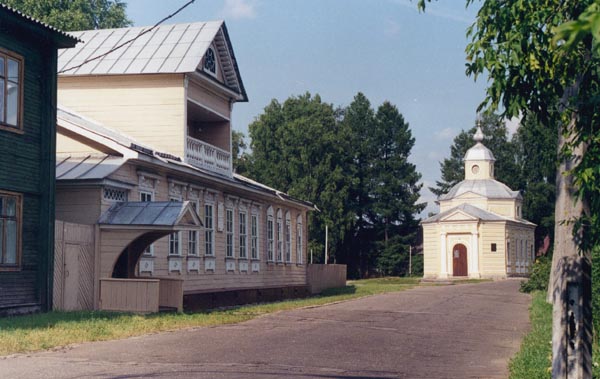
Today, a memorial plaque installed on the main building of the holiday house, built during the Soviet era, commemorates Rimsky-Korsakov’s stay in these places. Due to the new designation, the entire area was replanned and built up with houses for vacationers, staff, laboratories, administration, and utility facilities. The forest massif has been fragmented by a network of paths and divided into zones by linear plantings of pine and spruce.
Sources:
https://theatremuseum.ru/naukpubl/serebranaya_svadbya


Written by Jermaine
Discuss this with the author and others
No comments yet. Be the first to start the conversation.