Work and Residence of Rimsky-Korsakov in the Court Singing Chapel

Bolshaya Konyushennaya St., 11, Saint Petersburg, Russia, 191186

In 1883, Mily Alexeyevich Balakirev was appointed director of the Court Singing Chapel, and his assistant was confirmed as Nikolai Andreyevich Rimsky-Korsakov. The latter taught the orchestral class at the music school and managed it so well that gradually the school's graduates became the leading musicians of the orchestra. The joint work of Balakirev and Rimsky-Korsakov over 10 years was an entire era in the development of performance, educational, and training activities in the Chapel.

In 1883, Mily Alexeyevich Balakirev was appointed manager of the Court Singing Chapel, and Nikolai Andreyevich Rimsky-Korsakov was confirmed as his assistant. The latter taught the orchestral class at the music school and organized it so well that gradually the school's graduates became leading musicians of the orchestra. The joint work of Balakirev and Rimsky-Korsakov over 10 years was an entire era in the development of performance, educational, and nurturing work in the Chapel.

From 1887 to 1889, the entire complex of the chapel buildings underwent reconstruction. Architects Sultanov, Shreter, and Benois submitted their projects for this work. The project by the latter was accepted, which preserved the U-shaped facade of the main building. According to Benois's design, a fence was installed in front of the main entrance, a royal pavilion was added to the concert hall, and the facade finishes were changed. Their artistic decoration was done by plasterer Dylev and locksmith master Weber. In the central part of the facade, commemorative plaques with the names of musicians associated with the chapel were placed. An organ from the Dutch Church was installed in the concert hall. The inner territory of the site was built up with residential houses. The architect recalled: "The courtyard facades of the side wings, in my opinion, turned out well, but the facade of the concert hall is somewhat stunted. The parapets came out somewhat programmatically academic. The royal pavilion is not bad but complex. Inside, especially the vestibule and staircase, succeeded. I believe that they, as well as the round foyer, are among my successful decorations."

At the same time, Benois built house No. 11 on Bolshaya Konyushennaya Street. It housed the singers and teachers of the chapel.


Among them was the assistant manager Sergey Mikhailovich Lyapunov. From 1889 to 1893, composer Nikolai Andreyevich Rimsky-Korsakov, who was then acting as assistant manager of the chapel, lived here. The family of composer Nikolai Andreyevich celebrated their housewarming in apartment No. 66 on the third floor in the autumn of 1889. His guests often included Glazunov, Lyadov, Tchaikovsky, and Stasov. The materials of the exhibition hall of the memorial museum-apartment of Rimsky-Korsakov provide an idea of his multifaceted activities—as a composer, teacher, and conductor serving in the Court Singing Chapel.

Sources:

http://www.rimskykorsakov.ru/121205.html

https://walkspb.ru/istoriya-peterburga/zd/moyka20

https://www.molbertgallery.ru/gallery/history/

https://capella-spb.ru/ru/o-kapelle/istoriya-kapelly
Follow us on social media

More stories from Great Composers: Nikolai Andreyevich Rimsky-Korsakov

Place of birth of Nikolai Andreyevich Rimsky-Korsakov

12 Rimsky-Korsakov St., Tikhvin, Leningrad Region, Russia, 187552

Tikhvin is the birthplace of the great Russian composer Nikolai Andreyevich Rimsky-Korsakov. He was born here, and here he took his first steps in music. Nikolai Andreyevich spent only 12 years in Tikhvin. But these were his early childhood years, when a person, often without realizing it, absorbs everything he sees, hears, and touches, when tastes, views, and character are formed... Much of what he saw and heard in Tikhvin later found reflection in his work – an interest in folk rituals and customs, in folk musical creativity, certain features of historical and fairy-tale works, maritime and starry themes, and unsurpassed soundscapes – all originating from his Tikhvin childhood.

Studies at the Naval Cadet Corps

Lieutenant Schmidt Embankment, 17, Saint Petersburg, Russia, 199034

In the noble family of the Rimsky-Korsakovs, naval service was a tradition – the boy’s great-great-grandfather was a rear admiral under Empress Elizabeth Petrovna, his uncle was a rear admiral, and later his older brother became one as well. And little Nika, who aspired to emulate him, entered the Naval Cadet Corps in Petersburg in 1956 at the age of 12. He studied with pleasure, easily, and tried to have grades no lower than 10 points (the maximum being 12 points).

The Mighty Handful

Nevsky Prospect, 33, St. Petersburg, Russia, 191186

In the building that once housed the City Duma and now hosts the Rimsky-Korsakov Music School, meetings of the Balakirev Circle—a fellowship of Russian composers founded by Mily Balakirev—were held in the 1860s. Later, thanks to an article by music critic Vladimir Stasov, the circle was renamed the "Mighty Handful": "How much poetry, feeling, talent, and skill there is in this small but already mighty handful of Russian musicians." The center of the musical and educational activities of this group of young composers was the Free Music School they established, the successor of which is the modern educational institution.

Professor at the Saint Petersburg Conservatory

Teatralnaya Square, 2, Saint Petersburg, Russia, 190000

In 1871, Nikolai Rimsky-Korsakov received an invitation to teach from the director of the Azanchevsky Conservatory and became a professor at the Saint Petersburg Conservatory, which would later bear his name. He taught classes in practical composition, theory of composition, and orchestration, and was the head of the orchestral class (1871–1908); a first-degree professor (1881), and an honored professor (1904–1908). During these years, he also began teaching at the Free Music School, which had been organized, and in 1874 he became its director. However, he soon realized that he lacked the knowledge necessary for teaching. Rimsky-Korsakov recalled: "What helped me was that none of my students at first could imagine that I knew nothing, and by the time they could start to figure me out, I had already learned quite a bit."

The Wedding Ceremony of Nadezhda Purgold and Nikolai Rimsky-Korsakov

37HX+F3 Vyborgsky District, Saint Petersburg, Russia

The wedding of Nadezhda Purgold and Nikolai Rimsky-Korsakov took place on June 30 (now this date can be remembered as July 12, according to the new style) 1872 in the Church of the Holy Apostles Peter and Paul, located in a picturesque spot — on a hill by a pond, in Shuvalov Park near Pargolovo. Architect Bryullov designed the building in the Gothic style, unusual for an Orthodox church. The elegant structure, whose construction took 10 years and was completed in 1841, was crowned with an openwork copper spire. It was lost during the Soviet era, along with much of the appearance of this remarkable church, cherished by the entire Rimsky-Korsakov family.

Smychkovo Estate - The Story of One Photograph

PXM4+FC Holiday Home "Luga", Leningrad Region, Russia

Silver Wedding Anniversary, or the Story of One Photograph

Museum-Apartment of N.A. Rimsky-Korsakov

Zagorodny Prospekt, 28, Saint Petersburg, Russia, 191002

The Rimsky-Korsakov Apartment Museum is currently the only composer’s museum in Saint Petersburg. The museum is located in the five-story courtyard wing of house 28, apartment 39, where Rimsky-Korsakov lived with his family from 1893 until his final days in 1908. Here, 11 of the composer’s 15 operas were created, including *Sadko*, *The Tale of Tsar Saltan*, and *The Tsar’s Bride*.

The Memorial Museum-Estate of Rimsky-Korsakov consists of two estates – Vechasha

9HRJ+QP Lyubensk, Pskov Oblast, Russia

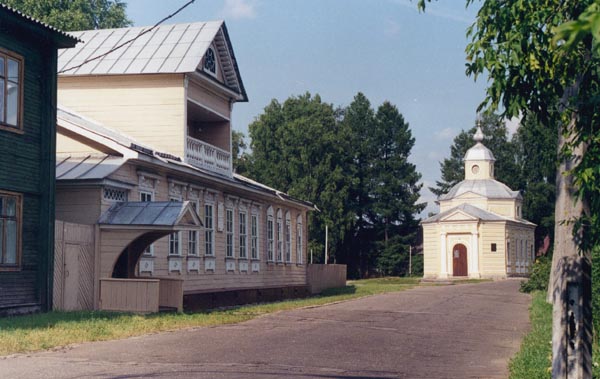
The Memorial Museum-Estate of Rimsky-Korsakov consists of two estates – Vechasha and Lyubensk – and represents a corner of wonderful Russian nature, inseparably connected with the life and work of one of the geniuses of Russian culture of the 19th-20th centuries, Nikolai Andreyevich Rimsky-Korsakov. Vechasha is located 14 km from the Plyussa railway station, 6 km from the Saint Petersburg–Kiev highway (at the 186th km from Saint Petersburg).

The Memorial Museum-Estate of Rimsky-Korsakov consists of two estates – Lyubensk

CJ23+84 Lyubensk, Pskov Oblast, Russia

The Lyubensk Estate is located 15 km from the Plyussa railway station. It is now the main memorial complex of the Rimsky-Korsakov Museum-Reserve. Rimsky-Korsakov first came to Lyubensk with his family for the summer in 1907, when he was 63 years old. They rented a house from Alexandra Viktorovna Bukharova, who by that time was considering selling the estate. This charming little place was loved by all family members. A typical small modest Russian estate with wooden residential houses and outbuildings (except for the stable, built from rough stone), it was established in the mid-19th century.

Grave of Nikolai Andreyevich Rimsky-Korsakov

pl. Alexander Nevsky, 1zh, Saint Petersburg, Russia, 191167

Marble cross with relief modeled after Novgorod tombstones. Artist Roerich, sculptor Andreoletti. The ashes and monument were transferred from the Novodevichy Cemetery in 1936.