

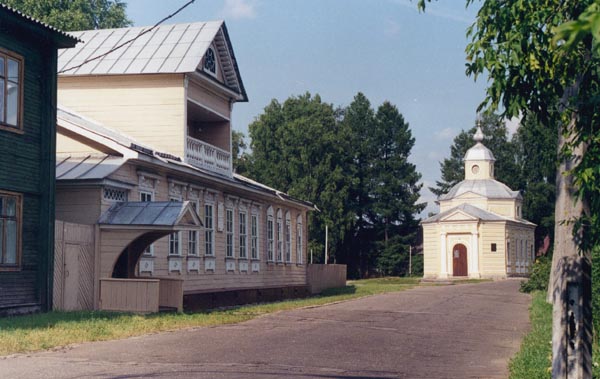
The Lyubensk Estate is located 15 km from the Plyussa railway station. It is now the main memorial complex of the Rimsky-Korsakov Museum-Reserve. Rimsky-Korsakov first came to Lyubensk with his family for the summer in 1907, when he was 63 years old. They rented a house from Alexandra Viktorovna Bukharova, who by that time was considering selling the estate. This charming place was very much liked by all family members. A typical small modest Russian estate with wooden residential houses and outbuildings (except for the stable building made of rough stone) was established in the mid-19th century.
By the end of the summer, the composer had agreed with the owner to purchase the estate. For 13,500 rubles, the Rimsky-Korsakov family acquired the house and 8 hectares of land. The following year, the composer's family came to their own summer residence. On this occasion, Nikolai Andreyevich wrote: “Mother and the children are busy with the household, and I watch and rejoice: how pleasant it is to have property, and such a wonderful one at that. No rented summer house can compare to one’s own!”
Its location on a high spot (more than 30 m above Lake Pesno) on a south-facing slope and the presence of trees of various species, including larches, lindens, and centuries-old oaks, allowed over 100 years ago the creation of a picturesque estate complex.
The compactly grouped Large House, Dacha, Family House, Stable, Aviary, Barn, Small House, and Icehouse formed part of the estate with a farmyard and an acacia circle with a surrounding path leading to the porch of the Large House. Three ponds — Oval, Mirror, and Small Lake — add to the picturesque charm of the entire estate.
The central composition consists of the Large House located at the highest point, the spacious flower garden spreading out before it, framed by gently curved alleys of lilac and acacia, and the Oval Pond with groups of oaks on the sides, down which the flower garden descends. On the same compositional axis, on the other side of the Large House, are the Main Gates of the estate and the acacia circle.
Local park compositions by the Mirror Pond with a bridge made of birch trunks over the stream flowing from the pond, a gazebo under an old linden tree, flower beds near the Dacha and the Small House — all these gave a special charm and coziness to the entire estate. The composer wrote: “The house stands on a relatively high place, a wonderful view of the lake, a huge garden, lilacs in abundance, and at this moment jasmine and fragrant peonies are blooming luxuriously.”
The Rimsky-Korsakov family dreamed of acquiring something similar for themselves so they would not have to look for a summer house every year. Nikolai Andreyevich, like Nadezhda Nikolaevna, had no inherited estates or capital. But after more than 40 years of intense work in music, Nikolai Andreyevich could afford to buy a small estate. Bukharova was in financial difficulty and wanted to sell her estate with a small piece of land. By the end of the summer, the composer agreed with the owner to buy the estate in the name of his younger children — Andrei, Vladimir, and Nadezhda. For 13,500 rubles, the Rimsky-Korsakovs received the house and 8 hectares of land. The following year, the composer's family already came to their own summer residence. On this occasion, Nikolai Andreyevich wrote: “Mother and the children are busy with the household, and I watch and rejoice: how pleasant it is to have property, and such a wonderful one at that. No rented summer house can compare to one’s own!”
The summer of 1907, spent by Nikolai Andreyevich in Lyubensk, was marked by an unusually intense composition of “The Golden Cockerel.” It was the last brilliant surge of his genius. The work proceeded feverishly fast, as if he feared not finishing it in time. His poor health, undermined by many years of intense work, forced him to hurry.
He completed his opera in Lyubensk, but he did not get to enjoy his estate for long. Moving there the following spring after a severe attack of cardiac asthma, Nikolai Andreyevich, despite the wonderful air and complete rest, never recovered from his illness. After a heart attack on the night of June 8 (21), 1908, Rimsky-Korsakov died in his house in Lyubensk. After the composer's death, the families of his children lived here, improving and preserving this place as a memory of their father and the great musician.
The main group of buildings of the Lyubensk estate includes: the Large House, the family house, the stable with a carriage house, and the icehouse. The interiors of the study, living room, and dining room have been recreated in the Large House. The Large House is located on a high spot, offering a magnificent panorama of Lake Pesno. In front of the house is a spacious parterre with a flower garden descending to the pond. The parterre paths are bordered by peony bushes, with a large central flower bed of fragrant tobacco. Three ponds — Oval, Mirror, and Small Lake — add to the picturesque garden-park composition. Around the Oval Pond grow 200-300-year-old oaks. Alleys of lilac and acacia border the parterre on both sides. Beyond the alleys lies a huge apple orchard.
Until 1920, Lyubensk was owned by the composer's family, but in the winter of 1920, the land of Lyubensk was taken over by a state farm: the alleys were cut down and partially uprooted, the house burned twice. Many houses were later dismantled, and the old park was also greatly damaged. The residential houses in Lyubensk were inhabited by the families of state farm workers, but there was no maintenance of the buildings.
The greatest damage to Lyubensk was inflicted at the end of the war from 1941 to 1944, when, upon the retreat of German troops from these areas, all the estate buildings were burned down. Only the stone stable and, fortunately, the foundations of almost all wooden structures survived in the estate.
The decision of the Ministry of Culture of the Russian Federation to create a unified Museum-Reserve on the territories of Lyubensk appeared more than 30 years ago (April 1967). Restoration of Lyubensk began only in 1980, when general project-restoration works for the Vekshacha-Lyubensk Museum-Reserve started, and over several years, projects for the restoration of all buildings and the estate park were developed.
The basis for these projects was documents from the Rimsky-Korsakov family archive, including more than a hundred photographs of Lyubensk from 1907-1913, as well as drawings made from memory by family members who remembered Lyubensk well, even down to small details of the exterior appearance of the houses, their interiors, and the park composition. The estate park was aimed to be preserved as it was during Nikolai Andreyevich’s time.
Interestingly, it was in Lyubensk and Vechasha that Pavel Lungin filmed his “Lilac Branch” about Rachmaninoff in 2006, and here in 2007 Igor Zaitsev shot scenes for the TV series “Saboteur. End of the War” (episode 4).

In July 2022, a fire broke out in Lyubensk during roof repairs. About half of the material valuables in the museum were saved. The building is currently sealed off and inaccessible.
Sources:
https://pskovkid.ru/muzej-usadba-n-a-rimskogo-korsakova/
https://museumpskov.ru/locations?slug=muzej_usadba_rimskogo-korsakova
https://ru.wikipedia.org/wiki/Memorial_Museum-Reserve_of_N._A._Rimsky-Korsakov


Written by Jermaine
Discuss this with the author and others
No comments yet. Be the first to start the conversation.