

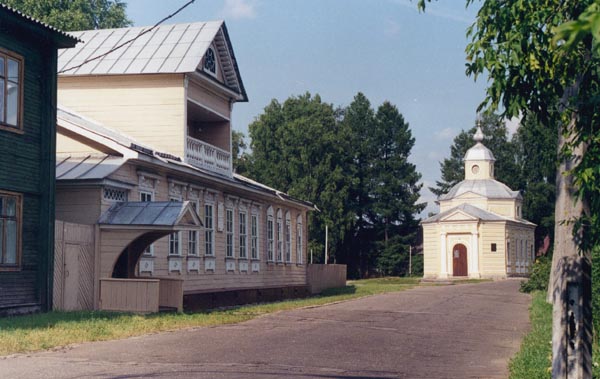
At the beginning of the summer of 1908, news of the death of composer Nikolai Andreyevich Rimsky-Korsakov spread throughout Russia. He died at his estate Lyubensk on a stormy night on June 8th old style (June 21st new style). In those days, the lingering cold suddenly gave way to warmth, and the estate garden was filled with the colors and scents of blooming apple trees, lilacs, acacias, and peonies. Before that fateful night, Nikolai Andreyevich admired this splendor of nature from the balcony overlooking the garden, walked around all his favorite corners of the estate (he was said to be saying goodbye to everything — local peasants later recounted), and in the evening sat for a long time on a bench among the birches of the driveway alley, watching the sunset. From Lyubensk, located 12 versts from the Plyussa station on the Warsaw railway, Nikolai Andreyevich’s ashes were transported to Petersburg and, after a funeral service at the conservatory church, laid to rest at the Novo-Devichy Cemetery. The simple wooden cross placed on his grave was, at the wish and expense of the composer’s widow, Nadezhda Nikolaevna, replaced in 1912 by a monument in the form of an ancient Novgorod cross, carved from white marble according to a design by Nikolai Konstantinovich Roerich.
In the autumn of 1910, Roerich created the first sketch of the tombstone, which envisaged the installation of an authentic ancient Novgorod cross (Tikhvin, where the composer was born, belonged to the Novgorod province). Nadezhda Nikolaevna traveled to Novgorod accompanied by her son, Vladimir Nikolaevich, to purchase such a cross. But it turned out to be too simple and small in size. “After this trip,” Vladimir Nikolaevich wrote in his diary, “at a meeting with Roerich it was decided to entrust him with sketching a tomb cross in the Novgorod style, but to give it a more artistic design, increase its size, and commission the sculptor Andreoletti to make the monument out of clay, and then order it to be carved from marble, which was carried out.”
As a result, Roerich made a wonderful sketch; on the front side of the cross he placed a whole series of holy faces, and around the cross, which was to stand on the top of a mound, he designed a fence made of marble slabs with an inscription in ancient script. Everything turned out very well, original, and simple. Roerich personally supervised the installation of the cross and took great care to give the monument an antique character. The slabs were intentionally arranged somewhat unevenly, some corners were chipped, gaps were left between the slabs so that soil could fill them and grass could grow. He coated all the marble with oil so that it would not be too white but would appear darkened by time. Indeed, the result was a cross-monument unlike any other.” The hill symbolizing the mound at the foot of the cross was sown with lawn and framed by a “wreath” of low-growing blue lobelias that bloomed all summer (blue was the composer’s favorite color), which greatly enlivened the entire composition. The artist-thinker was fascinated by this form of the cross within a circle, symbolizing “the universality of its light, spreading in all directions.” The closest prototype for the stylized cross made according to Roerich’s sketch is considered to be the so-called Borovichi cross of the 13th century, located in the Russian Museum. The carving of the cross in marble was carried out by Andreoletti, who taught at the School of the Society for the Encouragement of the Arts, of which Roerich was director. The workshop “A. Barinov” installed the cross at the Novo-Devichy Cemetery in October 1911, with all work completed by May 1912. The tombstone was made at the expense of the composer’s family for 1900 rubles.
In 1919, Nadezhda Nikolaevna also passed away. Refusing to be vaccinated, she died of smallpox and was initially buried separately from Nikolai Andreyevich. Eight years later, her ashes were moved to the same crypt under the monument where her husband’s ashes rested. It was unthinkable to alter the artistic inscription on the fence. Therefore, the monument’s composition was supplemented by two marble slabs of archaic appearance placed on the lawn of the mound. One repeats the text about Nikolai Andreyevich carved on the fence, and the other bears an inscription about Nadezhda Nikolaevna.
Like the burials of many other outstanding people connected to the arts, Rimsky-Korsakov’s grave was subject to relocation to the Tikhvin Cemetery of the Alexander Nevsky Lavra, where a Necropolis of Masters of Arts was being established. The news greatly upset Nikolai Andreyevich’s children. They were not only concerned about the preservation of the highly artistic tombstone but also insisted on transferring Nadezhda Nikolaevna’s ashes to the new site, with the construction of similar crypts there. After long disputes, this demand was met, and on July 22, 1936, the dismantling of the cross began.
“I cannot help but say,” Vladimir Nikolaevich wrote, “that it was an extremely sad sight. It was so regrettable to dismantle a monument that had stood for 24 years and was so beautifully made. In any case, the cozy atmosphere created by the grown trees — the birch behind the cross and two fir trees, which I personally bought from Regel, brought by a cabman (which I clearly remember) and planted under my supervision — that will no longer be.”
Present at the dismantling of the monument were Nikolai Andreyevich’s sons — Mikhail, Andrei, and Vladimir Nikolaevich — and their longtime friends — Nikolai Ivanovich Richter and Stepan Stepanovich Mitusov. The dismantling of the cross proved to be very difficult and took about four hours. Especially moving for the composer’s sons present was the opening of the crypts, especially since there could have been water there, as was found in the nearby Stravinsky crypt. Fortunately, the fears were unfounded; the crypts were dry. “The first impression was striking,” Vladimir Nikolaevich continued his entry. “Despite 28 years since death, the wonderful oak coffin was completely intact. Even palm leaves and dried bouquets of flowers nailed to the coffin lid were preserved. The silver tassels, although fallen off, lay nearby intact, and the metal handles were still so strong that they could be used for carrying. At half past three, two carts moved from the former Novo-Devichy Monastery cemetery and by five o’clock were at the Tikhvin Cemetery in the Lavra. We waited until the vaults of the crypt were being made, and then left. Thus ended the historic transfer of the ashes of father and mother. A few days later, the entire monument was rebuilt.”
Unfortunately, Vladimir Nikolaevich’s words that the new location would lack the comfort that had formed at the Novo-Devichy Cemetery were confirmed. Previously, the bright cross stood out advantageously against the greenery, but here there is no greenery behind the cross, as the tree crowns have grown far above, and the somewhat darkened marble of the monument blends with the gray background of the wall against which the grave is placed. Moreover, the monument itself never acquired the proper appearance during the 60 years it stood in the Necropolis. Only recently was the earth at the foot of the cross shaped into a mound, but there is no lawn cover, nor the “wreath” of lobelias. All this creates an impression of gloom over the entire scene.
The preservation of the cross is also cause for concern. The very beautiful marble veins are flaking, and to halt this process, the cross should be covered with a case for the winter (as sculptures in the Summer Garden are), which was done while the grave was at the old site and under the supervision of the Rimsky-Korsakov family members. However, here this requirement is not observed on the grounds that only sculptures of the 18th century are covered for the winter. But in this case, the important factor is not the time the monument was created but the need to ensure the preservation of such a unique work of art as the tombstone, made according to Roerich’s design in memory of the great Russian musician.
The grave is now located in the Necropolis of Masters of Arts on the Composers’ Path. The tomb monument is a white marble cross with spreading crescent-shaped lobes inscribed in a circle, on an earthen mound surrounded around the perimeter by slabs with carved inscriptions in raised letters, stylized in ancient Russian script. On the front side of the cross, in relief, are depicted Jesus Christ (in the center) with the Virgin Mary and Saint Nicholas the Wonderworker standing before Him, the archangels Gabriel and Michael, and four unknown saints. On the base are two rectangular marble slabs with inscriptions in raised letters.
Inscription around the perimeter of the mound: Nikolai Andreyevich Rimsky-Korsakov born March 6, 1844 – June 8, 1908.
On the right slab: Nikolai Andreyevich / Rimsky-Korsakov / March 6, 1844 – June 8, 1908.
On the left slab: Nadezhda Nikolaevna / Rimskaya-Korsakova / October 19, 1848 – May 11, 1919.
Sources:
https://lavraspb.ru/nekropol/view/item/id/407/catid/3
https://lomonosov.org/russia/russia915.html


Written by Jermaine
Discuss this with the author and others
No comments yet. Be the first to start the conversation.