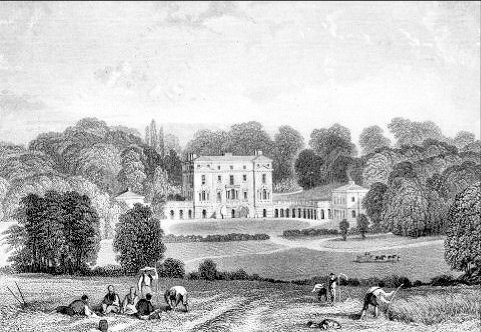
Woodcote Park, situated on Wilmerhatch Lane near Epsom, Surrey, England, is a Grade II* listed stately home with a rich history of changing hands among various noble families. Originally part of the estate of Horton Manor, owned by the Abbey of Chertsey in 1086 according to the Domesday Book, the land would pass through the Merston and Mynne families. In 1679, Elizabeth Evelyn inherited both Horton Manor and Woodcote Park from her husband Richard Evelyn. Richard had built the main mansion house on the estate. Elizabeth's bequest of both lands to Charles Calvert, 3rd Baron Baltimore, set off a chain of events involving the Barons Baltimore and Woodcote Park.
Lord Baltimore's time as proprietary governor of the colony of Maryland was marked by the Protestant Revolution of 1689, which led to him losing control of the province. The third Lord Baltimore died in 1715, and Woodcote was inherited by Benedict Calvert, the 4th Baron Baltimore. On Benedict’s death, Woodcote was passed on to the fifteen-year-old Charles Calvert, 5th Baron Baltimore, who made many changes to the house, including adding a Palladian facade by John Vardy.
These changes, however, were controversial and were criticized by Charles's brothers. On Charles’s death in 1751, his son, Frederick Calvert, the 6th Baron Baltimore, inherited the estate. Frederick spent large sums of money making the interior of the house 'tawdry' and 'ridiculous' in what Calvert called the 'French' style. The estate was eventually passed to different owners, including Mr. Monk and Mr. Nelson. Woodcote was purchased by Louis Tessier in 1788, then in 1913 by the Royal Automobile Club.
The Royal Automobile Club would remove most of the fine interiors commissioned by the Calverts, with what remained destroyed by fire in 1934. The present appearance of the house dates from its restoration in 1936. However, the interior of one of the original drawing rooms still survives in the Museum of Fine Arts at Boston, Massachusetts.
Sources: Wikipedia, OpenStreetMap, Wikidata, Wikimedia Commons
Written by Nicolo Ciampini
Discuss this with the author and others
No comments yet. Be the first to start the conversation.