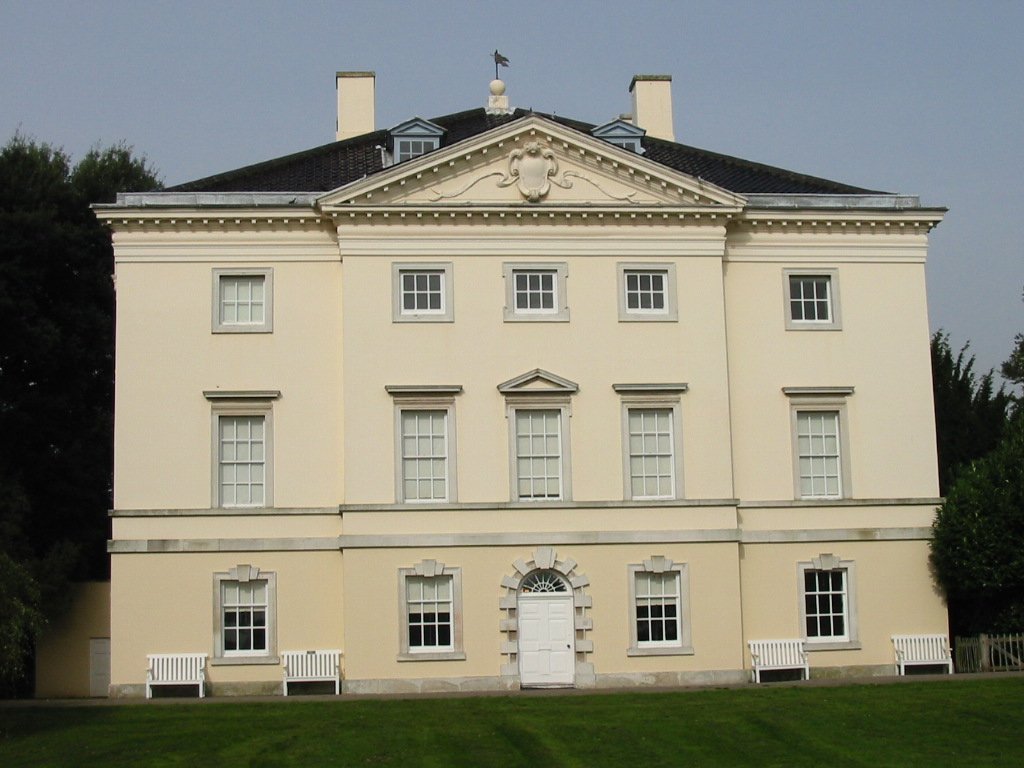

Marble Hill House, a Neo-Palladian villa, was erected in Twickenham, London, between 1724 and 1729 by Henrietta Howard, the Countess of Suffolk. The compact design was a trailblazer, setting a standard for the Georgian English villa and plantation houses in the American colonies. The architects behind the project were Roger Morris and Henry Herbert, the 9th Earl of Pembroke, who based the design to a large degree on Andrea Palladio's 1553 Villa Cornaro in Piombino Dese, Italy.
This house was later acquired by the London County Council in 1903, who made it accessible to the public, making it the first eighteenth-century house in England to be preserved by a public body. The Greater London Council (GLC) initiated the house's restoration in 1965. After the dissolution of the GLC, the freehold of the house and estate transferred to English Heritage.
In the late 18th century, the house was rented by the Prince Regent, the future George IV, for his mistress, Maria Fitzherbert, so the two could continue to meet in private. The house was set in 66 acres of parkland known as Marble Hill Park and contains a Great Room with lavishly gilded decoration and five capricci paintings by Giovanni Paolo Pannini.
In 2017, an archaeological investigation found evidence of what has been described as a bowling alley next to the house. However, it is likely that the game resembled boules as much as bowling and the area - better described as a depression in the ground - does not resemble the modern concept of a bowling alley. The main evidence that the area was used for some sort of bowling rests on contemporary plans.
Sources: Wikipedia, OpenStreetMap, Wikidata, Wikimedia Commons


Written by Nicolo Ciampini
Discuss this with the author and others
No comments yet. Be the first to start the conversation.