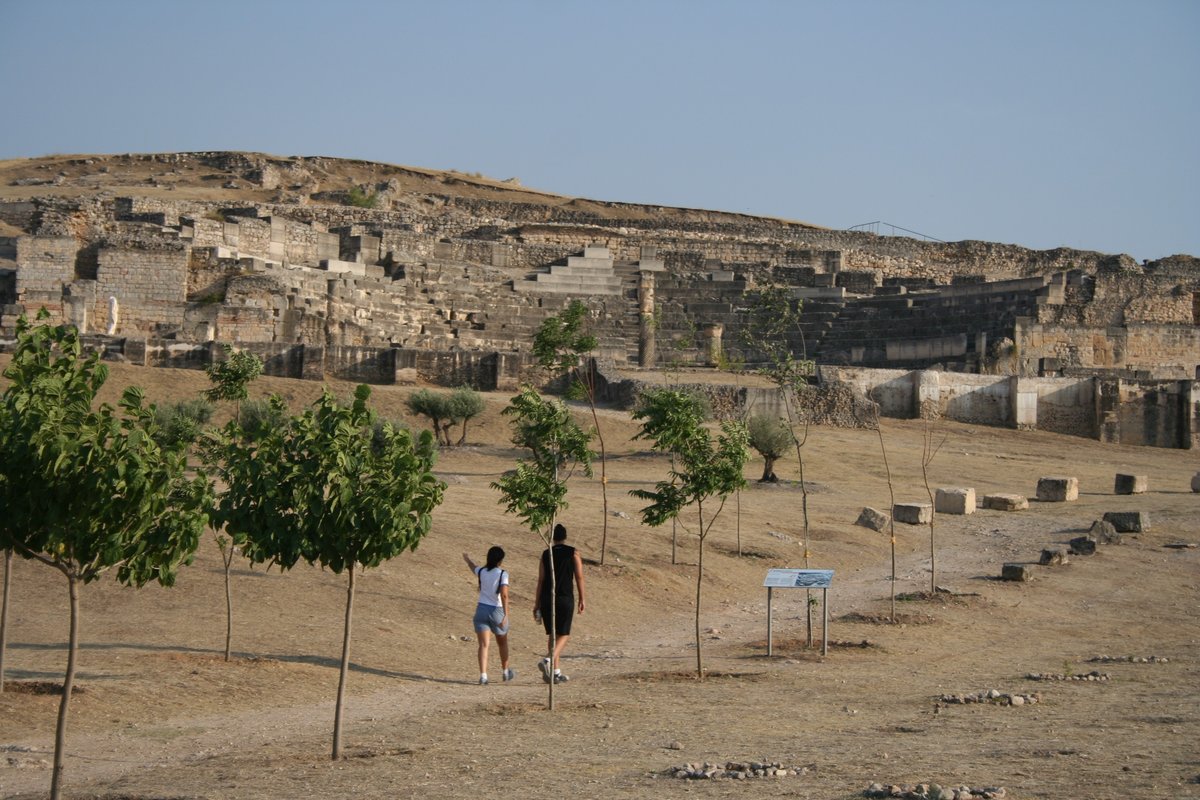

The name Segóbriga actually translates to something like "Victory City" or "Triumphant Fortress." It was the head of the Celtiberian territory, a place of transition and a boundary between the Celtiberians and the Carpetanis. The name originates from two terms of the Celtiberian language, with Sego- meaning victory and -briga meaning city or fortress.
Pliny the Elder tells us that an important part of the Segóbriga economy was the exploitation of lapis specularis. This was a variety of translucent gypsum much appreciated for the manufacture of window glass, with the most translucent stone obtained near the city from deep wells. It was a busy center for trade and communications, eventually becoming a municipium under Augustus and sparking a building boom of monuments and public leisure spaces that lasted towards the Flavian epoch.
There is a bit of dark humor in the local history. The Roman writer Frontinus describes a rebel leader, Viriathus, who arranged his troops in ambush and turned back into unsuspecting Segobrigenses when most were busy at their sacrifice. He sent some men to steal cattle from the locals, who fled from the attackers.
Today, the site is an archaeological park on the hill of Cabeza de Griego. It is a National Monument, protected and preserved in a way that is quite impressive compared to other ruins in the region. You can still see the walls and the layout of the old city, which survived the centuries fairly well.
Sources: Wikipedia, OpenStreetMap, Wikidata, Wikimedia Commons
Written by Nicolo Ciampini
Discuss this with the author and others
No comments yet. Be the first to start the conversation.