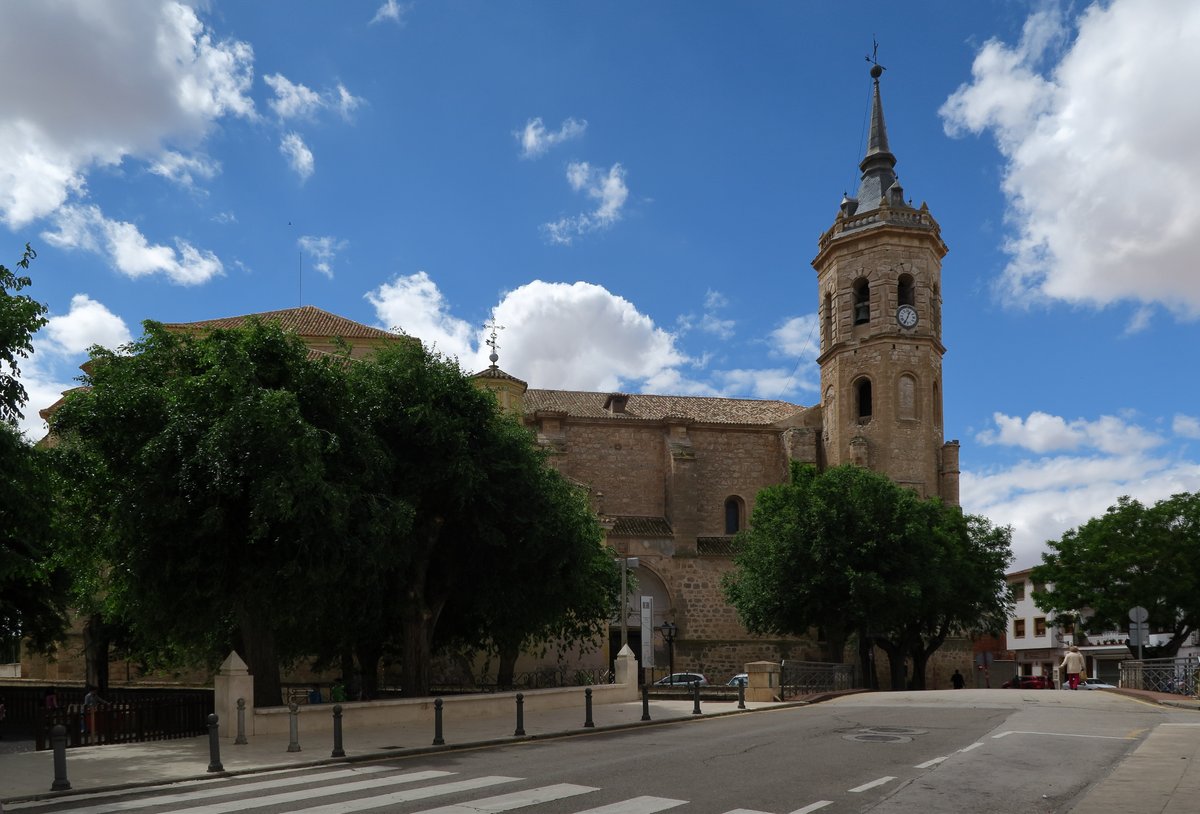

The Church of Nuestra Señora de la Asunción, nestled in the town of Tembleque, Spain, is a 16th-century temple that combines Gothic and Renaissance styles. Commissioned by Cardinal Cisneros as a show of gratitude for the million maravedíes and the company of soldiers provided by the town {@link fact}, the temple's construction was also aided by the generous donations of the Priors of San Juan and the local residents of Tembleque. While the temple was mainly built during the first half of the 16th century, modifications were made between 1582 and 1596 under the supervision of Nicolás Vergara the Mozo {@link Fact, logic}.
The church boasts a single nave of considerable height and a polygonal cabecera. The supports, both Gothic pillars and Renaissance columns, separate the nave's tracts, and its roof presents an expansive, intricate cruciform structure. The Baptistry, San Ramón, and Christ of the Mercy Chapels are Gothic in style, while two other chapels were transformed during the 18th century. The monumental Jesús de Nazareno and Virgen del Rosario Chapels were built in 1765 and 1756 respectively.
Antonio Fernández de Alejo, a knight of the Order of Santiago, donated the Virgen del Rosario Chapel. The church's exterior fountain is made of stone and features powerful buttresses, while the interior support structures are a mix of Gothic pillars and Renaissance columns. The Baptistry, San Ramón, and Christ of the Mercy Chapels exhibit a distinctly Gothic style. The magnificent Jesús de Nazareno and Virgen del Rosario Chapels, however, suffered from deterioration before their preservation via extensive renovations carried out between 2011 and 2015.
Sources: Wikipedia, OpenStreetMap, Wikidata, Wikimedia Commons
Written by Nik Frost
Discuss this with the author and others
No comments yet. Be the first to start the conversation.