


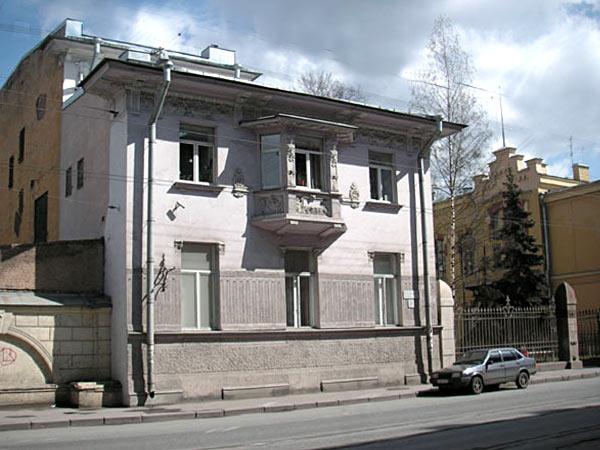
The 1876 mansion in the neoclassical style was built by Swedish architect Karl Anderson. According to the design, the building was a two-story yellow mansion with red architectural details, modeled after an Italian Renaissance palazzo. The house served as a refuge for the large Nobel family and simultaneously as the office of the factory: the "Ludwig Nobel" mechanical plant, which produced cannons and their carriages, underwater mines, and artillery shells. The enterprise used inventions by Alfred Nobel.
Until 1910, the building also housed the Management Board of the Nobel Brothers' Petroleum Production Partnership, where the famous Alfred Nobel—a board member of the Partnership—often visited.
In March 1917, after the February Revolution, Gustav Mannerheim hid in the house.
After the revolution, the Nobel family, like many other industrialists of Petersburg, left Russia. The "Ludwig Nobel" Mechanical Plant was nationalized in 1918, and the mansion building became simultaneously a factory club with an assembly hall, a library, and the factory administration.
The mansion survived intact through the Civil War and the Great Patriotic War. But in the 1990s, the impoverished factory could no longer afford to maintain such a grand building, and the mansion was abandoned. More than 20 years later, part of the roof deteriorated, the building was disconnected from utilities, and now it stands abandoned and deserted. It is easy to enter and see old dilapidated furniture, a Becker brand piano, a collapsed attic, a once magnificent ballroom decorated in blue, and an antique fireplace. Another interesting find here is a plaster head of Lenin, leaning against the wall in one of the halls. A symbolic detail that reminds us that the Nobel mansion survived two great eras but could not withstand timelessness and indifference.
Sources:
https://gid.expert/russia/санкт-петербург/достопримечательности/особняк-людвига-нобеля
https://www.citywalls.ru/house6282.html



Written by Jermaine
Discuss this with the author and others
No comments yet. Be the first to start the conversation.