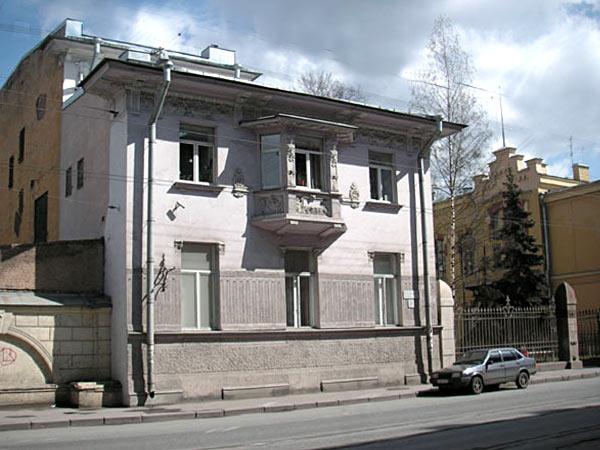
The People's House of Emmanuel Nobel

Lesnoy Ave, 19, Saint Petersburg, Russia, 196642

The People's House or the Hall for Public Readings of Emmanuel Ludwigovich Nobel – a community center of the production-residential complex of the mechanical plant "Ludwig Nobel." This cultural and educational institution for all laborers and intellectual employees of the plant was established on the initiative and with the funds of the industrialist Emmanuel Nobel.

The People's House or the Hall for Public Readings of Emmanuel Ludwigovich Nobel was a community center of the production-residential complex of the mechanical plant "Ludwig Nobel." This cultural and educational institution for all laborers and intellectual employees of the plant was established on the initiative and with the funds of industrialist Emmanuel Nobel (1859–1932).
The Nobel People's House was opened on September 30, 1901. It is a two-story building with a hall on the first floor that could accommodate 600–700 people, and an even larger hall with a stage and choir lofts on the second floor. Additionally, there were numerous rooms for a library, meetings, and in the semi-basement, a cloakroom, restrooms, and other amenities.
The construction of the two-story building in the early Art Nouveau style on Nyustadtskaya Street (now Lesnoy Prospect, 19), designed by architect Meltzer, began in 1897. The opening took place on September 30, 1901. The interiors featured original artistic decoration. The semi-basement housed the cloakroom and other conveniences. On the first floor were a meeting and evening hall, a reading room, a library, and a dining room for workers' children. The second floor had a large auditorium with a stage, a lectern for the speaker, a projection apparatus, and a screen for showing "shadow pictures." The hall, decorated with paintings on industrial themes, was also intended for playing lawn tennis: the asphalt-covered floor was marked with red lines. Concerts and celebrations for workers' children were also held here. There were rooms for meetings, a billiard room, and spaces for clubs. The house was surrounded by a large garden with a tennis court, which was made available to the workers' children. In winter, it was used as an ice rink and for an ice hill.
Initially, the readings were managed by the director of the Prince Oldenburg Shelter, Sidorov. The topics of the readings were diverse, and they were eagerly attended not only by workers but also by their wives and children, so the number of listeners often reached 600–700 people. From January 1905, the organization of lectures was transferred to the Commission of Public Readings, established by the highest authority. The lectures, accompanied by light pictures and various demonstrations, took on a more serious character, approaching the program of people's universities, covering not only Russian history and natural phenomena but also chemistry, physics, botany, and more.
The Sampsonievsky People's Choir existed at the People's House, giving free concerts of brass music. Performances by professional theater troupes were held (for example, Ibsen's play "Brand" was staged with great success by the Art Theater).

The house also hosted meetings of the administrators of the "Brothers Nobel" Partnership, as well as mass gatherings of workers' organizations, including meetings of the Social Democratic Party.
On November 15, 1906, Nobel opened a library in the People's House with 2,650 volumes. Employees and workers of the plant were issued Russian and translated fiction, books of spiritual content, and works on natural, technical, and social sciences. At the request of readers, a section of books in German, French, Finnish, and Estonian was created. In 1908/1909, the library had 715 readers.
In October 1909, a children's library was opened, mainly used by current and former students of the Nobel school. By the end of the first reporting year, the library held 600 books and was subsequently replenished with new books according to the interests of subscribers.
With the outbreak of World War I, the People's House building was arranged as a "Hospital for the Wounded of the Brothers Nobel Partnership" for the lower ranks. It was headed by Dr. Martha Ludwigovna Nobel-Oleynikova, who had previously organized and maintained at her own expense a colony for weakened children of workers. In the hospital, alongside regular medical practice, she conducted scientific research and implemented new treatment methods. The first wounded were admitted to the hospital on November 5, 1914; the official opening took place on November 16. Wards were set up in the halls, the billiard room was converted into an operating room, and the library became a dining room. The wounded were taught literacy, shoemaking, and basket weaving.
In the 1920s, the premises of the People's House and the neighboring mansion were occupied by the Plekhanov Youth Enlightenment House and a library. Since 1931, these buildings were transferred to the Children's House of Culture, later to the Pioneer House, and then to a design institute.

Sources:
http://www.encspb.ru/object/2860380153?lc=ru
www.citywalls.ru/house1072.html

Follow us on social media

More stories from Great Businessmen and Inventors: The Nobel Family

M. A. Gorchakov Mansion - House of the Oil Production Partnership "Brothers Nobel"

Griboedov Canal Embankment, 2 lit. A, Saint Petersburg, Russia, 191186

The famous architect Fyodor Lidval actively collaborated with the Nobel family, designing and remodeling buildings of various purposes at their request. And this collaboration began with the building of the House of the Petroleum Production Partnership "Brothers Nobel."

E. L. Nobel Mansion - M. L. Oleynikova Mansion

Lesnoy Ave., 21-1, Saint Petersburg, Russia, 194044

The mansion was built between 1902 and 1904 by architect Melzer Robert-Friedrich (Roman Fyodorovich) and military engineer Melzer Ernest Fyodorovich, and was rebuilt in 1910 by architect Lidval Fyodor Ivanovich.

Income House of Emmanuel Ludwigovich Nobel

Bolshoy Sampsoniyevsky Ave., 27, Saint Petersburg, Russia, 194044

The Income House of Emmanuel Ludwigovich Nobel is an architectural monument and is part of the Residential Complex for employees of Ludwig Emmanuelovich Nobel's factory. The house was built in 1910–1911. The large gray house in Art Nouveau style closes off the Residential Complex of the "Ludwig Nobel" factory from the side of Lesnoy Avenue.

Residential town of the "Ludwig Nobel" factory

Lesnoy Ave., 20 building 1, Saint Petersburg, Russia, 194044

The famous Nobel Town in Saint Petersburg was built for the workers of the "Ludwig Nobel" factory. Ludwig Nobel was the elder brother of Alfred Nobel, the founder of the Nobel Prize. The architects of the town's buildings were R. F. Meltzer, V. A. Shreter, and F. I. Lidval. The years of construction were 1893-1916.

Alakirjola - the Nobel family country estate

GM5X+6R Landyshevka, Leningrad Oblast, Russia

Alakirjola - the Baltic estate of the Nobel family. Settlement. Until 1939, the village of Kirjola was part of the Johannes parish of the Vyborg province (Finland). The village was also called Alakirjola. Its name translates as "Lower Kirjola." Its history dates back to the 15th century. Today, this estate is located within the territory of the modern village of Landyshevka in the Vyborg district.

Nobel Family Mansion and the Management Office of the "Ludwig Nobel" Mechanical Plant

Pirogovskaya Embankment, 19, Saint Petersburg, Russia, 194044

The mansion from 1876 in the neoclassical style was built by the Swedish architect Karl Anderson. According to the design, the building was a two-story yellow mansion with red architectural details, modeled after an Italian Renaissance palazzo. The house served as a refuge for the large Nobel family and simultaneously as the office for the factory: the mechanical plant "Ludwig Nobel," which produced cannons and their carriages, underwater mines, and artillery shells. The enterprise utilized the inventions of Alfred Nobel.

The grave of the Nobili family at the Smolensk Lutheran Cemetery

4 Dekabristov Lane, Saint Petersburg, Russia, 199178

Swedish and Russian engineer, inventor, entrepreneur, and philanthropist, elder brother and business partner of the founder of the Nobel Prize, Alfred Nobel. Merchant of the 1st guild in Saint Petersburg. The first chairman of the Scandinavian charitable society in St. Petersburg. Member of the Russian Technical Society. Buried at the Smolensky Lutheran Cemetery in Saint Petersburg, plot: 56

Monument to Alfred Nobel - Tree of Life

Pinsky Lane, 1, Saint Petersburg, Russia, 197046

The sculptural composition represents a futuristic-fantastic iron tree, whose twisted branches symbolize a peaceful explosion (the invention of dynamite was intended for peaceful purposes – for mining, blasting, and earthworks).

The first house of the Nobel family in Saint Petersburg

20 Petrogradskaya Embankment, Saint Petersburg, Russia, 197046

It is believed that Emmanuel Nobel lived in this very house at 20 Petrogradskaya Embankment, near the factory he founded, together with his sons — including the later famous Alfred Nobel, the inventor of dynamite and founder of the Nobel Prize.

Mechanical Plant "Ludwig Nobel" ("Russian Diesel") the core of the Nobel empire in Russia

30 Bolshoy Sampsoniyevsky Ave, Saint Petersburg, Russia, 194044

The Ludwig Nobel Mechanical Plant, renamed "Russian Diesel" in 1919, was a machine-building factory in Saint Petersburg that specialized in the production of diesel engines in the 20th century. It was founded by Ludwig Nobel and managed by him, and later by his heirs.

Villa Petrolea - Nobel Brothers House Museum in Baku

9VHV+XGR, Baku, Azerbaijan

Villa Petrolea — a residential settlement built by the Nobel brothers at the end of the 19th century for the employees of their company on the border of the Black City in the suburbs of Baku. The name is also used in relation to the residence of the Nobel brothers located here.

Nobel Brothers Shipyard in Rybinsk

60 Pyatiletki St., Rybinsk, Yaroslavl Oblast, Russia, 152909

The enterprise was founded by the "Nobel Brothers Petroleum Production Partnership" ("Branobel"). To maintain the fleet in good condition, the management of the "Branobel" Partnership decided to build ship repair workshops in Rybinsk. It was here in 1904 that the installation of the first engineering structure in Russia for lifting and launching ships into the water – a slipway – began, and by 1907, a ship was lifted ashore for the first time.

The building of the former office of the Nobel Brothers Partnership in Perm

Sovetskaya St., 26, Perm, Perm Krai, Russia, 614045

The Perm oil storage was one of the largest in Russia. None of the Nobel brothers, famous worldwide, had ever been to Perm.

Nobel Museum in Rybinsk

Volzhskaya Embankment St., 53, Rybinsk, Yaroslavl Oblast, Russia, 152901

The Nobel Museum is a truly unique attraction in Rybinsk. It is hard to imagine that in a provincial town there is a memorial complex dedicated to one of the most famous figures in world science and entrepreneurship — Ludwig Nobel. But it is so. Indeed, since 2003, the city of Rybinsk has had a museum dedicated to the life and work of the world-famous Swedish family. The Nobel brothers deserve it: at the beginning of the 20th century, they made a significant contribution to the development of Rybinsk and the Russian Empire.

Monument to Ludwig Nobel and the Russian Nobel Prize

Bolshaya Kazanskaya St., 44, Rybinsk, Yaroslavl Oblast, Russia, 152901

The first monument in Russia to the industrialist, public figure, and philanthropist Ludwig Nobel was unveiled in Rybinsk on July 26. The monument was created by the Moscow sculptor Yaroslav Borodin. The sculptural composition installed in Rybinsk consists of a bronze bust of Ludwig Nobel on a column and two granite steles resembling the leaves of opening gates, with bronze bas-reliefs of Ludwig Nobel’s main inventions — diesel engines, tankers, and oil rigs. Everyone knows about the prestigious international Nobel Prize, established by Alfred Nobel according to his will. But few know that seven years before that, a Nobel Prize was also established in Russia — the Ludwig Nobel Prize, named after Alfred’s older brother. It was established in St. Petersburg in 1888 after his death by the "Partnership of the Nobel Brothers."

The Nobel Empire in Samara

84 Kuibysheva St., Samara, Samara Oblast, Russia, 443099

130 years ago, on July 13, 1883, Alexander Ivanovich Werner, the trusted representative of the Oil Production Partnership "Brothers Nobel," submitted a petition to the Samara City Administration requesting a site on the banks of the Volga River for the installation of oil tanks. This marked the beginning of the oil company's development of the Samara market.