

In the mid-19th century, an entire family of Swedes named Nobel settled in St. Petersburg. The first to arrive was its head, named Emmanuel. He was originally from the town of Gävle near Stockholm, but his ancestors lived in the southern province of Sweden (Skåne), and their surname was spelled "Nobelius." On his mother's side, Emmanuel had a great ancestor, Olaf Rudbeck, a 17th-century technical genius: an architect, doctor, artist, and botanist all in one.
At fifteen, Emmanuel Nobel enlisted as a sailor on a round-the-world voyage, but at eighteen he returned, having acquired many professions. At that time, Sweden elected a new king, Charles XIV, and Emmanuel Nobel proposed to greet him with a Triumphal Arch, which he himself erected. The king was touched and became a sponsor of the talented young man's technical education. Emmanuel Nobel married very early by Swedish standards, at 24, to Andriette-Caroline, a girl from a solid bourgeois family: it was important for him to receive a dowry from his bride, as money was needed to implement the many technical ideas that simply overwhelmed the young inventor. He made discoveries in various fields of technology, but his special passion was a laboratory of underwater mines, which he set up right in the basement of their family home, where three boys, his sons Robert, Ludwig, and Alfred, were already growing up.
Emmanuel cared least of all about safety techniques. Disaster was not long in coming: in 1837, a fire broke out in the laboratory. Nobel went bankrupt and fled from creditors to Åbo, now Turku, in Finland, which had recently become part of Russia, making him unreachable for Swedish creditors. There he also did not waste time and by 1842 was demonstrating underwater explosions to a high-ranking Russian official!
Being versatile, Emmanuel Nobel personally captured the meeting in a watercolor, the inscription under which states that the explosion was demonstrated to the Tsar himself! The result was immediate: Russia was engaged in endless wars with Turkey, and such specialists were needed. Nobel received a loan of 25,000 rubles and a copper-iron foundry in St. Petersburg, on the shore of the Bolshaya Nevka opposite the Vyborg side. Military orders and the Crimean War enriched Emmanuel Nobel. His enterprise produced cannons, shells, carriages, mechanisms for steamships, but most importantly—in huge quantities—those very underwater mines!

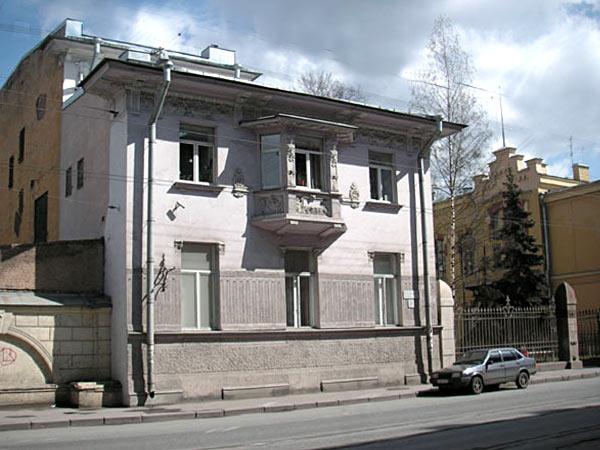
Working passionately, Emmanuel did not forget the family he left behind in Sweden and called them to St. Petersburg in 1842. Their home became a wooden house with a mezzanine, facing Bolshaya Vulfova Street (now Chapaeva Street, 15). The accidentally preserved, heavily rebuilt wooden house No. 24 on the Petrograd Embankment gives us some idea of the life of the Nobel family, where everyone was happy. They lived like true bourgeois: they had a house with a garden near the flourishing enterprise of the head of the family. Tutors came to the children, sons aged 13, 11, and 9. Here, in this "house with a mezzanine," the most important years of Robert, Ludwig, and Alfred Nobel’s lives passed—their youth. Moreover, another son, Emil, was born into the happy family. The sons grew up, the older ones helped their father at the factory. Robert, together with his father, traveled to Kronstadt for mining the raid, which helped stop the squadron of English ships during the Crimean War.
Alfred had a remarkable teacher, the outstanding Russian chemist Nikolai Nikolaevich Zinin. He was the first to discover the brilliant abilities of the future inventor of dynamite and convinced the father of the necessity to continue education in Europe. Meanwhile, Tsar Nicholas I died, and the Crimean War ended ingloriously. Emmanuel’s enterprise, which produced exclusively military products, was on the brink of bankruptcy (1859). Unable to cope with the crisis, the head of the family took a familiar step:
He fled again, this time to his historic homeland, with his wife and the youngest son born in St. Petersburg. The liquidation of the father’s business fell to 28-year-old Ludwig.
Creditors did not allow the father’s enterprise to go bankrupt, demanding debt repayment. They had to leave the "house with a mezzanine" and move to the factory Vyborg side, to a small, almost village-like house, opposite which was a small mechanical plant of the Englishman Sherwood (Johnson) "with a forge and dock." It was possible to rent it, and then buy it, actively producing castings, fittings, and tooling for the Izhevsk rifle factory. At the same time, Ludwig sought new sites for orders. These were Moscow, Rybinsk, Izhevsk, Borovichi in Novgorod province, at a unique deposit of refractory clays. The efforts were crowned with success: Ludwig managed to eliminate his father’s debts and firmly stand on his own feet. The factory on the Vyborg side became known as "LUDWIG NOBEL" and produced civilian products (cast iron and bronze castings, pipelines, carriage springs) of excellent quality, for which it received the right to depict the Russian coat of arms on its advertising and signage. The Swedish architect Anderson built in 1873 on Vyborg Embankment, 19, the "house and office" of the factory, where along with the office was the apartment of Ludwig’s large family: from two marriages he had 10 children. (https://reveal.world/story/osobnyak-sem-i-nobel-i-zavodoupravlenie-mehanicheskogo-zavoda-lyudvig-nobel). The eldest brother Robert, who then lived in Finland, returned to St. Petersburg after 1861 and joined Ludwig. Ludwig entrusted his brother with a trip to the Caucasus in search of walnut wood for rifle stocks. (At the Izhevsk rifle factory, Nobel improved Berdan’s rifle). Along the way, Robert visited the Absheron Peninsula, where he was struck by the wild oil extraction conducted by the English in Baku. Robert was able to assess the gigantic prospects, and soon the Nobel brothers founded progressive oil production. And the "Ludwig Nobel" factory began producing tanks and tankers, as well as steam boilers with nozzles for the rational use of fuel. Another sign appeared on the factory management building: "Branobel Company." All three brothers were its founders. The main rules of the Nobels were: impeccable product quality, sufficient quantity, affordable prices.

Ludwig Nobel’s merit was the founding in 1866 of the Russian Technical Society, whose principles were "technological capability, equipment, inventiveness," and whose goal was to train qualified personnel among Russian workers, for which the first vocational schools were established. The RTS also contributed to the introduction of the metric system in Russia. Ludwig Nobel donated huge sums (more than 600 thousand from personal funds) to the development of science. To encourage factory workers and employees, instead of the planned 6% of profits, he allocated 40%, which almost undermined the business.
A true workaholic, Ludwig managed to manage the Baku oil fields and the factory in St. Petersburg. There was never time for rest. At the insistence of his family, he went to improve his health on the French Riviera, in Cannes, where he died on March 31, 1888, at the age of 57.
Western journalists confused the brothers’ names in obituaries: Ludwig was mainly known only in Russia, while Alfred was already the "king of dynamite." Ludwig’s body was transported to St. Petersburg, a funeral service was held at the Swedish Church in two languages, and he was buried in the Lutheran part of the Smolensk Cemetery (https://reveal.world/ru/story/mogila-sem-i-nobilej-na-smolenskom-lyuteranskom-kladbishche).
In 1870, at the All-Russian Manufactory Exhibition, Ludwig Nobel received the highest award—the right to depict the state coat of arms on his products. In the early years, the enterprise produced military weapons, carriages, shells, and mines. After the Russo-Turkish War and the signing of the Paris Peace Treaty, the Russian government transferred state orders abroad, and Ludwig Nobel’s enterprise began producing civilian products: tanks, drilling tools, wagons, steam pumps, and boilers, mainly supplying the Nobel oil production. After Ludwig Nobel’s death, the factory was inherited by his son Karl, but he died young, and the factory passed to his older brother Emmanuel. At the turn of the century, Emmanuel built a residential area east of the factory for workers, with a library and school. These buildings are now located on both sides of Nobel Lane.
To perpetuate Ludwig Nobel’s memory, the Russian Technical Society in 1889 established a special Prize and Gold Medal for achievements in metallurgy and the oil industry among Russian specialists. The Ludwig Nobel Prize was awarded three times in pre-revolutionary Russia and had great authority. D. I. Mendeleev was part of this first-ever "Nobel Committee." Named scholarships were established for students of Mining and Technological schools, including in Baku.
The worthy successor of the father’s business was Ludwig’s eldest son, Emmanuel (1859–1932). Named after his grandfather, born the year of his grandfather’s flight from Russia, Emmanuel inherited the best traits of his ancestors and himself possessed modern marketing thinking. He and "Uncle Robert" bought the patent from Rudolf Diesel and began producing his engines at their factory. Among the factory’s products were already pumps, boilers with oil burners, and the country’s first gas stations.
At the end of the 19th century, Emmanuel Nobel acquired a license from Rudolf Diesel to produce diesel engines. Not satisfied with producing the finished model, before the revolution, engineer Gustav Vasilievich Trinkler created dozens of new types of diesel engines with original designs at the factory. In 1899, the first diesel engine in the world running on crude oil appeared here; abroad it became known as the "Russian diesel." In 1908, the factory created the world’s first diesel engine with direct crankshaft reverse. In 1911, the factory built a V-shaped 8-cylinder engine for submarines with a record low specific engine weight. The factory supplied engines to the world’s first diesel ship "Vandal" and Russia’s first diesel submarine "Minoga." Engines like those on "Minoga" were installed on the gunboats "Kars" and "Ardahan." From 1900 to 1912, the factory produced 540 diesel engines, including 87 marine ones.

The factory retained the creative atmosphere that existed under Ludwig. It contributed to the businesslike attitude of workers during the 1905 revolution and helped avoid strikes. After his father’s death, Emmanuel was the first (and only) in the family to accept Russian citizenship. For extensive charitable activities, he was awarded the Order of St. Anna, 3rd class, and later the Order of St. Stanislaus, 1st class. In 1909, the company celebrated its anniversary: 50 years without bankruptcy! All the Nobel brothers of both generations participated in the factory’s work: Emmanuel, Rolf, Ludwig Jr., Karl—up to the 1917 revolution.
The Nobels were pioneers of socially oriented business in Russia. By the beginning of the century, the factory was the first in the city to establish a 12-hour, and then a 10-hour working day. Competent production organization was combined with advanced social policy. The factory was located between the Bolshaya Nevka and Bolshoy Sampsoniyevsky Prospect. The city purchased land up to Nyustatskaya Street (now Lesnoy Prospect) and beyond, up to the line of the Finnish railway. In 1893, construction began on a residential quarter for workers. The first houses there were built by the famous architect, founder of the "brick style," Viktor Schröter. On the factory territory, he also built a mechanical workshop. Another prominent architect, Roman Meltzer, built two residential houses for employees in the workers’ town (https://reveal.world/ru/story/zhiloj-gorodok-zavoda-lyudvig-nobel), an elementary school, and the so-called People’s House (https://reveal.world/ru/story/narodnyj-dom-emmanuelya-nobelya). Considering the limited budget of such construction, one can only admire the laconic beauty of the architecture of the erected buildings. The Nobel residential town, lying between Sampsoniyevsky and Lesnoy Prospects, is traversed by a narrow passage, until recently unnamed, now Nobel Lane. This is the first toponymic memory of the Nobels after a long break, appearing only in 2014. The lane ends in an arched passage under the huge veterans’ home of the "Ludwig Nobel" factory. It was built by the prominent St. Petersburg architect of Swedish origin, Lidval. The modern address: Lesnoy Prospect, 20. The Nobel People’s House (Lesnoy Prospect, 21) is the second Swedish cultural center in the capital (the first is on Malaya Konyushennaya, at St. Catherine’s Church). People’s Houses were popular; they were predecessors of Culture Houses. Their purpose: "to accustom workers to reasonable leisure." The sign said that a "Hall for People’s Readings" was open here, implying the presence of a library; creative circles worked; the workers’ choir was very popular. Alcohol was "completely excluded"!
After the Bolshevik revolution, the factory was practically stopped. In 1923, production resumed. In 1926, the volume of production exceeded the 1913 level, and by the early 1930s, the factory supplied a third of the needs of Soviet factories, power plants, and river vessels in diesel engines. Under the leadership of designer Vsevolod Vansheidt, the factory focused on producing two-stroke marine engines. "Russian Diesel" supplied engines for the "Cruiser" type submarines.
In the postwar period, the factory became one of the leading suppliers of diesel engines for ships and vessels of the Soviet civilian and military fleets. Despite the cessation of production in the 1990s, "Russian Diesel" engines were still used on 27 ships and vessels of the Russian Navy as of November 2019. These included large landing ships of project 1171, the submarine rescue vessel project 537 "Alagez," tankers of the "Dubna" type, missile ships of project 11661, and others. In the 1980s, a decision was made to expand production by building a branch of "Russian Diesel" in the industrial zone of Vsevolozhsk.
Among the well-known employees of the factory during this period was the science fiction writer Ilya Varshavsky, who worked there as an engineer for over 20 years.
In the 1990s, the factory was corporatized and went bankrupt in 1999. The St. Petersburg factory buildings were sold separately for production and offices; most of the workshops in Vsevolozhsk were occupied by the vodka factory "Liviz" and the Ford Vsevolozhsk car assembly plant.
Sources:
Tamara Alexandrovna Pokoptseva, tour guide: Nobels, forgotten and famous
https://www.citywalls.ru/house6089.html



Written by Jermaine
Discuss this with the author and others
No comments yet. Be the first to start the conversation.