Alakirjola - the Nobel family country estate

GM5X+6R Landyshevka, Leningrad Oblast, Russia

Alakirjola - the Baltic estate of the Nobel family. Settlement. Until 1939, the village of Kirjola was part of the Johannes parish of the Vyborg province (Finland). The village was also called Alakirjola. Its name translates as "Lower Kirjola." Its history dates back to the 15th century. Today, this estate is located within the territory of the modern village of Landyshevka in the Vyborg district.
Alakirjola (in Finnish – Alakirjola / Lower Kirjola) is an estate located on the shore of the Vyborg Bay, within the territory of the modern village of Landyshevka in the Vyborg district. The estate has been known since the 16th century and is named after the village of the same name. The toponym originates from the surname of local peasants, Kirjonen. For a long time, this was Swedish territory until in 1708 Peter the Great’s troops occupied the estate and destroyed it. After that, the owners of the estate changed one after another until in 1894 the coastal part of the village was acquired by Edla Konstantinovna Nobel (Edla Constantia Collin Nobel), the widow of Ludvig Immanuel Nobel. A couple of years later, she bought the Lahti estate (the northern part of the property) for 50,000 marks. Edla Nobel’s estate then covered 1008 hectares. In 1908, she also annexed the Pikku-Kirjola manor (Little Kirjola) to her estate. In 1905, the manor “Agnela” nearby, along with its estate, was purchased by Edla’s daughter — Dr. Marta Nobel-Oleynikova. Edla Nobel settled in the old manor house, which by that time had already begun to fall apart. She tried to repair the building, but one day, entering the dining hall, she pierced the rotten floor through with her cane. After that, the lady ordered a new mansion to be built. In 1903, she invited Gustav Nyström, a senior architecture lecturer at the Polytechnic School and an academician who designed the Helsinki State Archive and the Estate Assembly buildings, to work on the project. Professor Nyström’s main work in Kirjola was a new original brick building with a tall tower, constructed in 1903-1904. The bel étage housed a grand hall with mirrored walls, a magnificent dining hall, and several richly decorated reception rooms. In total, the house had 24 rooms. To the local residents, the Nobel mansion looked like a royal palace. The Swedish flag flew on the tower, as the Nobels were Swedish citizens. 
The garden was designed by the St. Petersburg park architect Regel. Until 1917, the Nobel family came to Kirjola only in summer; later, they settled there permanently. 
In 1910-1911, a new brick stable appeared on the estate. It housed thoroughbred racehorses, which were fed from large faience service bowls, and for drinking, a special fountain shaped like a bear’s head was installed, from whose mouth spring water flowed. All the buildings formed a unified architectural ensemble. In the half-hectare garden, 400 decorative trees, shrubs, and flowers brought from abroad were planted. To the locals, Mrs. Edla Nobel was remembered as a kind-hearted woman who cared about the needs of her neighbors. She built a school in the village at her own expense and supported the teachers. There were 15-20 students, but due to lack of other support, the school had to be closed after a few years. In 1906, Edla founded a home economics school for girls in Alakirjola. Before the October Revolution in Russia, the Nobel family came to Kirjola only in summer. They spent winters in Petrograd. In 1917-1918, Kirjola became their refuge from the Bolsheviks. In 1921, Edla Nobel moved to Stockholm, where she passed away, while Georg and Marta Oleynikov (the daughter of Ludvig and Edla Nobel and her husband) remained at the estate. From 1921, Georg became a co-owner of the Kirjola estate.
On the “Doctor’s” island near the manor house, he created a small garden surrounded by a high (2-3 meters) stone wall measuring 50 by 30 meters. On the southern side, glass windows were embedded in the wall. The structure was a semi-open greenhouse. A small conservatory was built into it, where grapes, peaches, and corn were grown. The garden on the island played a tragic role in Oleynikov’s life. On a frosty January morning in 1937, the doctor went to the island to check his greenhouse. On the way back, the ice cracked beneath him, and Georg found himself in icy water. His cries for help went unheard as it happened far from the shore. The one-armed disabled man was unable to get back onto the ice.

Georgy Oleynikov was buried in the cemetery of the village of Vaahtola. 
On November 30, 1939, the war began. On December 4 and 5, residents of the surrounding villages gathered their belongings and headed to evacuation points and further inland. Kirjola also became deserted. The estate was used as a headquarters. When in February 1940 the front line approached Kirjola and the retreat of Finnish troops became inevitable, the last units burned the village down. Such was the cruel tactic of war — to leave no valuables or buildings to the enemy. The magnificent Nobel mansion, mined in advance, was blown up just before the arrival of the Red Army. There is no information about Alakirjola during the interwar period of 1940-1941. In 1942, the former residents returned to the village.  
But no one ever came back to the ruins of Kirjola.

The estate park still preserves a well. It was built by landscape architect Arnold Eduardovich Regel at the request of the widow of engineer Ludvig Nobel — Edla Nobel. The well is part of the Alakirjola estate. It is still in use. Locals draw water from it. The best-preserved buildings are the utility structures, which are still in use. 
The stables, which until recently were still used for their intended purpose. Unfortunately, a very sad story is connected with them. When the entrepreneurs who started a business breeding thoroughbred horses ran out of money, the horses simply began to die of starvation. Concerned locals raised an outcry, involved television, and the surviving horses were confiscated by decision of the Vyborg court. Surprisingly, the tragedy is not felt at all in the stables. The spacious, clean, bright rooms with stoves remain.

Under the Nobels: “A stone stable was built for keeping thoroughbred racehorses, where faience bowls were used for feeding the horses, and the animals drank from a fountain with spring water shaped like a bear’s head. The grooms lived here as well, in special apartments on the second floor.”

And what about the manor house itself? Only fragments of the luxurious castle remain, inaccessible for general viewing as they are located on private properties. Two plots are located on the foundation of the Nobel house. On one of them, a fragment of the exterior can be seen behind a fence.

Sources:
https://vk.com/@go_primorsk-usadba-nobelei-v-landyshevke
https://otzyv.ru/review/163377/
https://dzen.ru/a/YRjRmVvg2Uzf5NqW
https://sovetskiy.vbglenobl.ru/turizm/ala_kirola_usadba_semi_nobel/ala_kirola/istoriya_usadby

Follow us on social media

More stories from Great Businessmen and Inventors: The Nobel Family

M. A. Gorchakov Mansion - House of the Oil Production Partnership "Brothers Nobel"

Griboedov Canal Embankment, 2 lit. A, Saint Petersburg, Russia, 191186

The famous architect Fyodor Lidval actively collaborated with the Nobel family, designing and remodeling buildings of various purposes at their request. And this collaboration began with the building of the House of the Petroleum Production Partnership "Brothers Nobel."

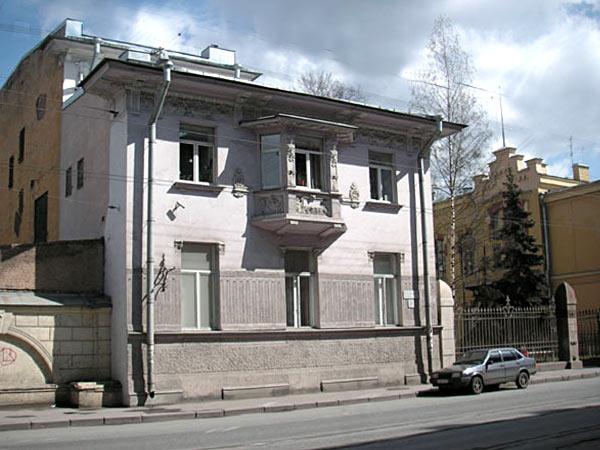
E. L. Nobel Mansion - M. L. Oleynikova Mansion

Lesnoy Ave., 21-1, Saint Petersburg, Russia, 194044

The mansion was built between 1902 and 1904 by architect Melzer Robert-Friedrich (Roman Fyodorovich) and military engineer Melzer Ernest Fyodorovich, and was rebuilt in 1910 by architect Lidval Fyodor Ivanovich.

Income House of Emmanuel Ludwigovich Nobel

Bolshoy Sampsoniyevsky Ave., 27, Saint Petersburg, Russia, 194044

The Income House of Emmanuel Ludwigovich Nobel is an architectural monument and is part of the Residential Complex for employees of Ludwig Emmanuelovich Nobel's factory. The house was built in 1910–1911. The large gray house in Art Nouveau style closes off the Residential Complex of the "Ludwig Nobel" factory from the side of Lesnoy Avenue.

Residential town of the "Ludwig Nobel" factory

Lesnoy Ave., 20 building 1, Saint Petersburg, Russia, 194044

The famous Nobel Town in Saint Petersburg was built for the workers of the "Ludwig Nobel" factory. Ludwig Nobel was the elder brother of Alfred Nobel, the founder of the Nobel Prize. The architects of the town's buildings were R. F. Meltzer, V. A. Shreter, and F. I. Lidval. The years of construction were 1893-1916.

The People's House of Emmanuel Nobel

Lesnoy Ave, 19, Saint Petersburg, Russia, 196642

The People's House or the Hall for Public Readings of Emmanuel Ludwigovich Nobel – a community center of the production-residential complex of the mechanical plant "Ludwig Nobel." This cultural and educational institution for all laborers and intellectual employees of the plant was established on the initiative and with the funds of the industrialist Emmanuel Nobel.

Nobel Family Mansion and the Management Office of the "Ludwig Nobel" Mechanical Plant

Pirogovskaya Embankment, 19, Saint Petersburg, Russia, 194044

The mansion from 1876 in the neoclassical style was built by the Swedish architect Karl Anderson. According to the design, the building was a two-story yellow mansion with red architectural details, modeled after an Italian Renaissance palazzo. The house served as a refuge for the large Nobel family and simultaneously as the office for the factory: the mechanical plant "Ludwig Nobel," which produced cannons and their carriages, underwater mines, and artillery shells. The enterprise utilized the inventions of Alfred Nobel.

The grave of the Nobili family at the Smolensk Lutheran Cemetery

4 Dekabristov Lane, Saint Petersburg, Russia, 199178

Swedish and Russian engineer, inventor, entrepreneur, and philanthropist, elder brother and business partner of the founder of the Nobel Prize, Alfred Nobel. Merchant of the 1st guild in Saint Petersburg. The first chairman of the Scandinavian charitable society in St. Petersburg. Member of the Russian Technical Society. Buried at the Smolensky Lutheran Cemetery in Saint Petersburg, plot: 56

Monument to Alfred Nobel - Tree of Life

Pinsky Lane, 1, Saint Petersburg, Russia, 197046

The sculptural composition represents a futuristic-fantastic iron tree, whose twisted branches symbolize a peaceful explosion (the invention of dynamite was intended for peaceful purposes – for mining, blasting, and earthworks).

The first house of the Nobel family in Saint Petersburg

20 Petrogradskaya Embankment, Saint Petersburg, Russia, 197046

It is believed that Emmanuel Nobel lived in this very house at 20 Petrogradskaya Embankment, near the factory he founded, together with his sons — including the later famous Alfred Nobel, the inventor of dynamite and founder of the Nobel Prize.

Mechanical Plant "Ludwig Nobel" ("Russian Diesel") the core of the Nobel empire in Russia

30 Bolshoy Sampsoniyevsky Ave, Saint Petersburg, Russia, 194044

The Ludwig Nobel Mechanical Plant, renamed "Russian Diesel" in 1919, was a machine-building factory in Saint Petersburg that specialized in the production of diesel engines in the 20th century. It was founded by Ludwig Nobel and managed by him, and later by his heirs.

Villa Petrolea - Nobel Brothers House Museum in Baku

9VHV+XGR, Baku, Azerbaijan

Villa Petrolea — a residential settlement built by the Nobel brothers at the end of the 19th century for the employees of their company on the border of the Black City in the suburbs of Baku. The name is also used in relation to the residence of the Nobel brothers located here.

Nobel Brothers Shipyard in Rybinsk

60 Pyatiletki St., Rybinsk, Yaroslavl Oblast, Russia, 152909

The enterprise was founded by the "Nobel Brothers Petroleum Production Partnership" ("Branobel"). To maintain the fleet in good condition, the management of the "Branobel" Partnership decided to build ship repair workshops in Rybinsk. It was here in 1904 that the installation of the first engineering structure in Russia for lifting and launching ships into the water – a slipway – began, and by 1907, a ship was lifted ashore for the first time.

The building of the former office of the Nobel Brothers Partnership in Perm

Sovetskaya St., 26, Perm, Perm Krai, Russia, 614045

The Perm oil storage was one of the largest in Russia. None of the Nobel brothers, famous worldwide, had ever been to Perm.

Nobel Museum in Rybinsk

Volzhskaya Embankment St., 53, Rybinsk, Yaroslavl Oblast, Russia, 152901

The Nobel Museum is a truly unique attraction in Rybinsk. It is hard to imagine that in a provincial town there is a memorial complex dedicated to one of the most famous figures in world science and entrepreneurship — Ludwig Nobel. But it is so. Indeed, since 2003, the city of Rybinsk has had a museum dedicated to the life and work of the world-famous Swedish family. The Nobel brothers deserve it: at the beginning of the 20th century, they made a significant contribution to the development of Rybinsk and the Russian Empire.

Monument to Ludwig Nobel and the Russian Nobel Prize

Bolshaya Kazanskaya St., 44, Rybinsk, Yaroslavl Oblast, Russia, 152901

The first monument in Russia to the industrialist, public figure, and philanthropist Ludwig Nobel was unveiled in Rybinsk on July 26. The monument was created by the Moscow sculptor Yaroslav Borodin. The sculptural composition installed in Rybinsk consists of a bronze bust of Ludwig Nobel on a column and two granite steles resembling the leaves of opening gates, with bronze bas-reliefs of Ludwig Nobel’s main inventions — diesel engines, tankers, and oil rigs. Everyone knows about the prestigious international Nobel Prize, established by Alfred Nobel according to his will. But few know that seven years before that, a Nobel Prize was also established in Russia — the Ludwig Nobel Prize, named after Alfred’s older brother. It was established in St. Petersburg in 1888 after his death by the "Partnership of the Nobel Brothers."

The Nobel Empire in Samara

84 Kuibysheva St., Samara, Samara Oblast, Russia, 443099

130 years ago, on July 13, 1883, Alexander Ivanovich Werner, the trusted representative of the Oil Production Partnership "Brothers Nobel," submitted a petition to the Samara City Administration requesting a site on the banks of the Volga River for the installation of oil tanks. This marked the beginning of the oil company's development of the Samara market.