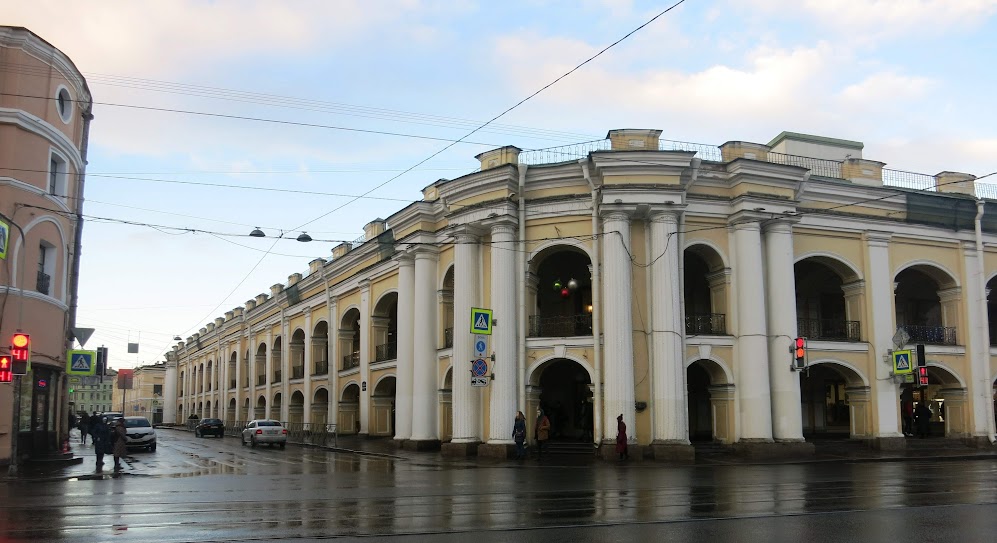

On October 26, 1965, during the reconstruction of the Gostiny Dvor in room No. 87 at the corner of Sadovaya and Lomonosovskaya lines of Gostiny Dvor, builders from the 33rd Directorate of the Repair Trust of Glavleningradstroy were working: Nadezhda Biryukova and Sofya Komova.
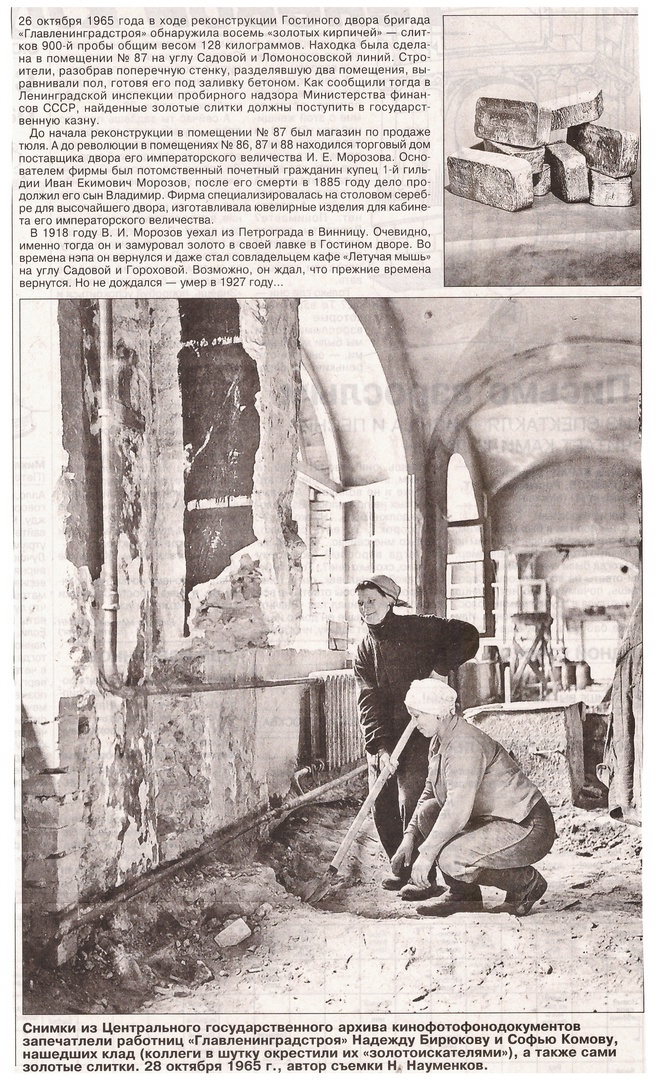
They dismantled a transverse wall that separated two rooms and began leveling the floor, preparing it for concrete pouring. Near the tiled stove, they discovered 8 non-standard, unusually heavy bricks. After cleaning them from dirt, they saw the shine of yellow metal.
Gennady Fedorovich Petrov writes in his 1966 book "Gostiny Dvor" that the workers cut off a small piece of metal and took it to a jewelry factory located in Gostiny Dvor, where it was found that the brick was made of 900-grade pure gold. After that, the floor at the discovery site was thoroughly examined, and seven more ingots were found. The total weight of the treasure was 128 kilograms of gold. None of the ingots bore the state hallmark, as required, which meant the ingots had been melted down by "artisan methods." The gold bricks "replenished the currency reserve of the USSR Ministry of Finance," and the workers who found them received the legally due reward.
In the book "The Great Gostiny Dvor in Petersburg" by the well-known writer and local historian Igor Alekseevich Bogdanov, the ending of the treasure story is described differently. The author cites the memories of a direct eyewitness of the 1965 events in Gostiny Dvor — Valery Vasilievich Balakhanov, who later became a history teacher and chairman of the "Historical and Research Society of Petersburg in the field of treasure hunting." In 1965, Valery Vasilievich, then a student, worked part-time in Gostiny Dvor and saw the workers find four (not eight) gold bricks. According to Balakhanov, a plumber named Uncle Vasya sawed off a piece from one of the bricks and ran to Rubinstein Street, where there was a precious metals collection point. From there, Uncle Vasya was sent to the Big House, where for three days they tried to extract from the poor man whether he had any more gold reserves. During these three days in the company of the secret police, the unlucky plumber had to pay 75 rubles. From the book by I. A. Bogdanov "The Great Gostiny Dvor in Petersburg." Series "Three Centuries of Petersburg."
So where did the gold bricks come from? Before the revolution, the premises where the treasure was found housed one of the largest jewelry stores of the trading house of Ivan Yekimovich Morozov.
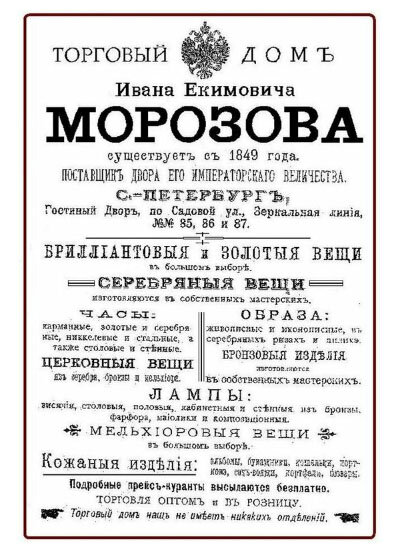
Ivan Yekimovich Morozov — a master goldsmith, hereditary honorary citizen and merchant of the 1st guild, Supplier to His Imperial Majesty, owner of his own jewelry workshop and several jewelry stores.
Morozov had much to be proud of. Their brand was even on the most expensive watches. The trading house’s assortment was huge. Listing it would take a couple of posts. At the top of this commercial "iceberg" were, of course, diamond items — earrings, rings, necklaces, cufflinks, chains for pocket watches, tie pins, diamond crosses. The golden "row" was also impressive in its luxury. Besides the usual jewelry, there were chains for lorgnettes, fans, and muffs, and even mirrors. As a reminder of a bygone era — golden thimbles, topaz signet rings in gold settings, gold glasses and pince-nez, and even gold pencils.
A special pride of the Trading House was the department of church utensils — walnut wood icon cases, pearl monstrances, gospels, icons, crosses. The workshop produced various badges for city heads, medals commemorating the reign of Emperor Alexander III with ribbons, many orders, stars. In short, the heir Morozov Jr. fully deployed his entrepreneurial talent.
Theatrical binoculars, barometers and thermometers, both table and wall-mounted, bronze chandeliers, candelabras for candles, writing sets, porcelain vases, mirrors, ladies’ and gentlemen’s silk umbrellas — the Morozovs provided the beautiful lifestyle of the capital’s residents at quite moderate prices. Moreover, even then the Morozovs offered home delivery! But jewelry and haberdashery were almost a hobby for the Morozovs. Only in weaving production at the factories, 14,000 workers were employed, with an average annual output of about 30,000,000 rubles.
After the death of I. E. Morozov, the business passed to his son Vladimir Ivanovich. As a full partner with his brother N. I. Morozov, he owned the jewelry firm and several shops in Gostiny Dvor (Nos. 85, 86, 87, and 34). In shop No. 87 at the corner of Sadovaya and Lomonosovskaya lines, the Morozov brothers arranged a hiding place for storing gold.
After the 1917 revolution, V. I. Morozov moved to Vinnytsia, and his shops were nationalized. Three years later, he returned to Petrograd and even became a co-owner of the café "The Bat," located at the corner of Sadovaya and Gorokhovaya streets. However, Vladimir Ivanovich never managed to reach the hiding place, and he took the secret of the gold bricks to his grave (Morozov died in 1927).
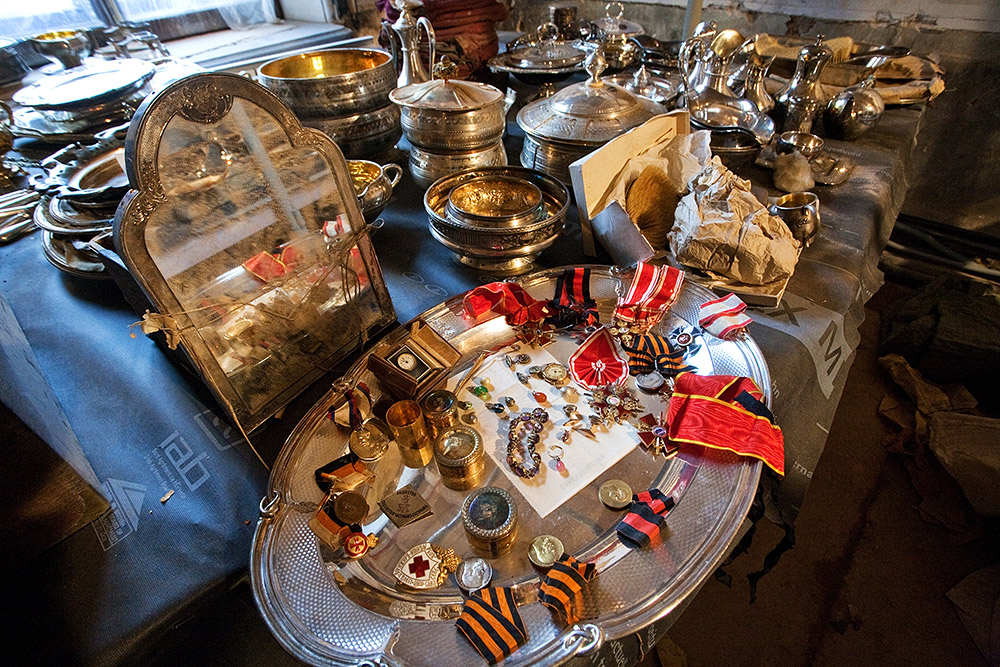
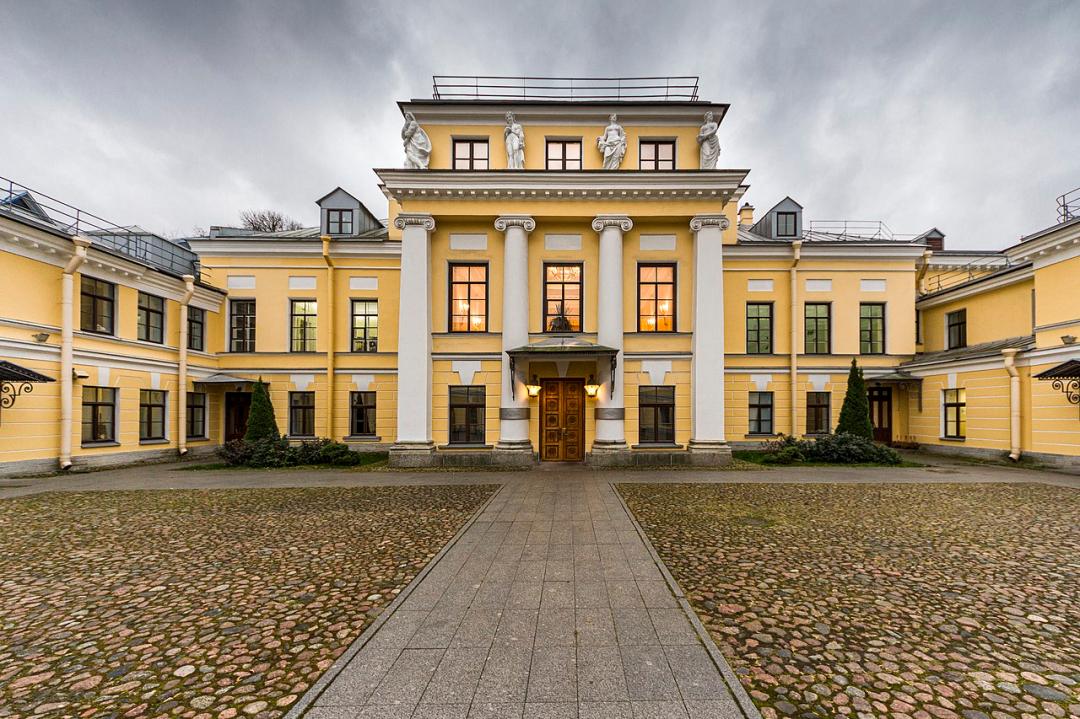
Until 2012, when a huge hiding place with silverware was discovered in the Naryshkin mansion on Tchaikovsky Street, the treasure from Gostiny Dvor was the largest found in Leningrad.
Sources:
https://dzen.ru/a/Yk7vfcPDjwYxYYgT
https://ruskontur.com/klad-v-leningradskom-gostinom-dvore/
https://pantv.livejournal.com/443457.html
Written by Jermaine
Discuss this with the author and others
No comments yet. Be the first to start the conversation.