

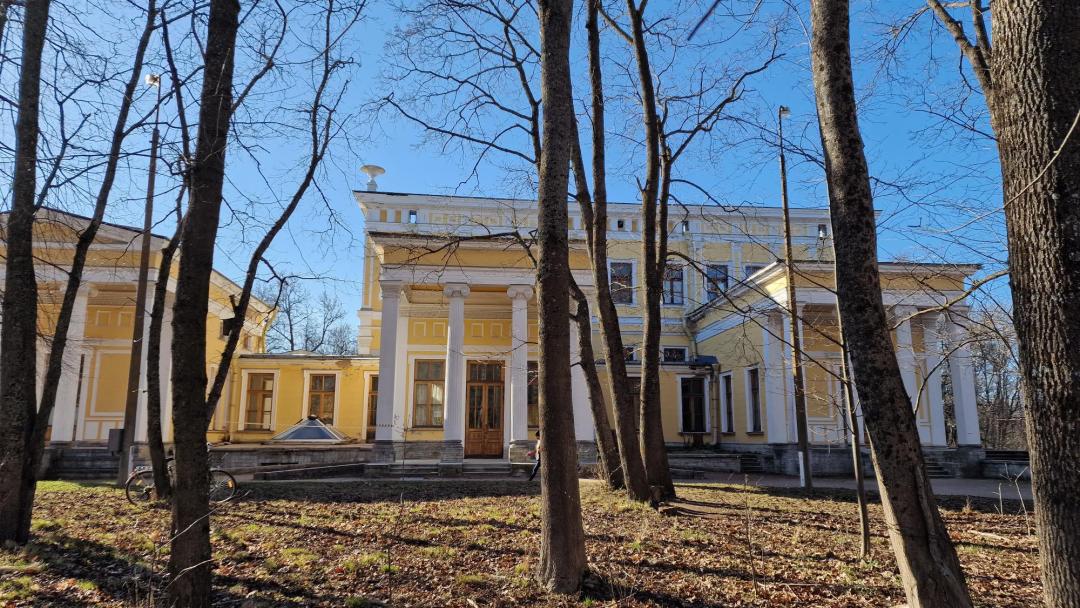
The Farmer's Palace is the only one in Russia created specifically for Alexander II. Later, the palace became the true family residence of the emperor. All renovations and reconstructions were carried out exclusively under his guidance.
Its history began in 1828–1831, when architect Menelas built a pavilion at the dairy farm for Grand Duke Alexander Nikolaevich. From 1838 to 1860, architect Andrey Stakenschneider was actively involved in reconstruction. The ordinary country house was transformed into a spacious summer palace specifically for Emperor Alexander II and his wife. All the facades harmoniously blend with the overall composition of the park ensemble and are designed in the Neo-Gothic style.
Over the next 20 years, the building was repeatedly rebuilt under the direction of architect Stakenschneider. The farm operations were moved to a new Farm building constructed between 1853 and 1855. The first reconstruction was related to the marriage in 1841 of Tsarevich Alexander to the Hessian-Darmstadt princess (Maria Alexandrovna). Alexander married Maria Alexandrovna in 1841 and ascended the throne as Alexander II in 1855. The building was expanded further due to the birth of children. By 1859, a complete reconstruction of the Farm building into the Farmer's Palace of Emperor Alexander II was carried out, timed to his wedding; the house was divided into male and female halves.
Ultimately, it transformed from a modest pavilion into a country palace in the Neo-Gothic style and began to serve as the summer country residence of Alexander II’s family. Near the Farmer's Palace, structures were built for the children’s play: a peasant hut, a small farm with a vegetable garden, a water mill, a fire tower, and a fortress with an earthen rampart. Interestingly, it was here, in the Farmer's Palace, that the decree on the abolition of serfdom was discussed. The palace also housed the first elevator in Russia, although it was manually operated.
A special coziness and elegance are conveyed in the rooms of Alexander II’s wife, Maria. The strictness and restraint of details are reflected in the emperor’s rooms. The Blue Cabinet will impress you with its grandeur. Here, Alexander received ministers, discussed the progress of military operations, held negotiations, and meetings. Notably, the ceiling stucco in this hall has been preserved in its original form.
Gothic motifs were used in the appearance of the palace’s facades and interiors. The large two-story building, complex in plan with cast-iron balconies, hardly resembles the former farm. The palace was surrounded by a magnificent garden. Many rooms have access to terraces or the garden. In front of the eastern facade of the palace, architect E. L. Han (1862) designed the Empress’s Own Garden, surrounded on three sides by a pergola. The fountain in the oval pool is decorated with a bronze sculpture "Night," cast from a mold of the marble original by French sculptor Joseph Pollé.
The interiors were laid with oak parquet, the walls painted in a "rustic" style, and furniture crafted by Gambs was present. Gothic ornamentation was used in the wood carving and ceiling stucco. The palace also housed Russia’s first elevator — a cabin manually raised by an elevator operator. Elements of the original decoration have been preserved inside. The Blue Cabinet of Alexander II is notable because the crucial draft law on the emancipation of the peasants from serfdom was prepared here. The palace contained a collection of paintings and engravings. Some interior items never left the palace. Just imagine, the marble bathtub in Empress Maria Alexandrovna’s dressing room has been there since 1856. Parts of the elevator mechanism, built in 1859, also remain unchanged. It is important to note that at that time, one of the first elevators appeared precisely in the Farmer's Palace. The elevator was operated manually by a special valet.
In the farm section of the palace, domestic animals were raised: bulls, cows, birds. The entire estate was managed by an English governess. In the imperial halls, not only did they rest and raise children, but important historical events were also decided. It was in the Farmer's Palace that Alexander II developed the Manifesto on the abolition of serfdom, signed in 1861.
Throughout the history of the summer residence, the children and grandchildren of Alexander II lived here, including Alexander III and the family of Nicholas II. It was in the Farmer's Palace that Princess Tatiana, daughter of the last emperor, was born.
After the emperor’s death and until the 1917 revolution, the Farmer's Palace was home to the adult children and grandchildren of Alexander II and Maria Alexandrovna: Emperors Alexander III and his son Nicholas II. Near the Farmer's Palace, Stakenschneider built a Children's Country House with peasant furnishings, a children's farm with a vegetable garden, a small water mill, a fire tower, and a fortress with an earthen rampart for the children’s games. Today, on the west facade side, the children's Fire Tower with a bell and a set of tools has been recreated.
A special coziness and elegance are conveyed in the rooms of Alexander II’s wife, Maria. The strictness and restraint of details are reflected in the emperor’s rooms. The Blue Cabinet will impress you with its grandeur. Here, Alexander received ministers, discussed the progress of military operations, held negotiations, and meetings. Notably, the ceiling stucco in this hall has been preserved in its original form.
After 1917, the palace housed a historical and everyday life museum, which was disbanded in 1932, and from 1926 it served as a recreation base for the NKVD.
In the post-revolutionary years, it was an NKVD recreation base. During the war, it housed the headquarters of the German army. The palace was partially damaged, but this did not prevent a dormitory for the Watch Factory from opening here in the 1950s, and from 1975 the building stood empty.
From 2003 to 2005, the palace was restored, but the nearly completed building suffered a fire on December 22, 2005. Ultimately, the Farmer's Palace exhibition as a museum was opened on June 19, 2010.
Sources:
https://www.citywalls.ru/house21379.html


Written by Jermaine
Discuss this with the author and others
No comments yet. Be the first to start the conversation.