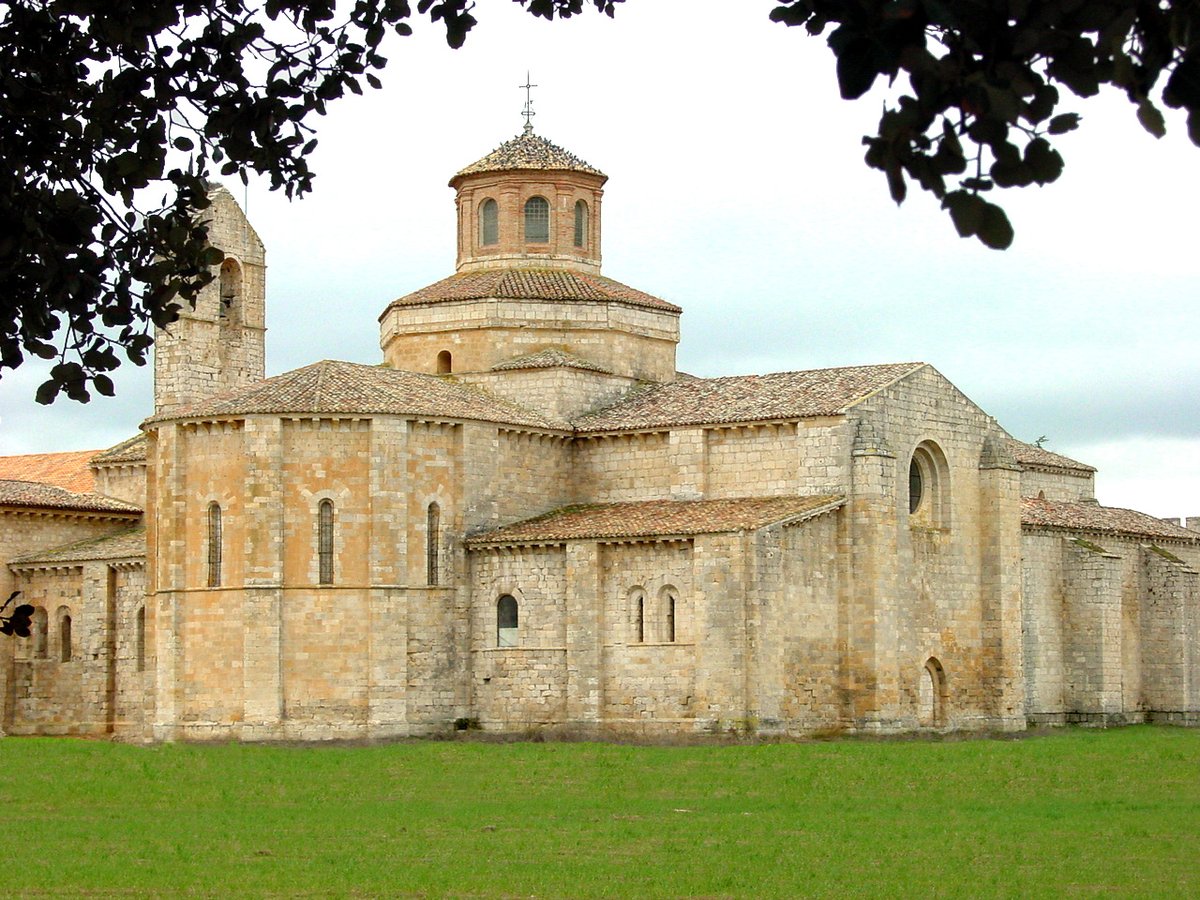

Valbuena Abbey, located in Valbuena de Duero, Valladolid Province, Castile-Leon, Spain, is a former Cistercian monastery founded in 1143 by Estefanía, daughter of Count Ermengol V of Urgell. The monastery settled from Berdoues Abbey in France. It flourished and was able to establish three daughter houses of its own: Rioseco Abbey, Bonaval Abbey, and Palazuelos Abbey. In the 14th century, a decline set in at Valbuena Abbey, as it remained a daughter house of Berdoues until 1430. It then became a daughter house of Poblet Abbey. The abbey was eventually dissolved under the anti-ecclesiastical Mendizábal government in 1835.
The church subsequently became a parish church and was later used as a Francoist concentration camp from April to May 1939. The conventual buildings passed into private ownership and were acquired by a Baron Carlos Kessel, and later by Juan Pardo. The monastery was declared a Monumento Nacional (Bien de Interés Cultural) in 1931. From 1954 to the end of the 1960s, the I.N.C. undertook numerous alterations and alterations to the building until it was acquired by the Archdiocese of Valladolid in July 1966 and renovated by Spanish architect Pablo Puente Aparicio in the 1990s. Finally, in March 2000, the Council of Castile and León awarded the monastery of Santa Maria de Valbuena the category of National Heritage.
Sources: Wikipedia, OpenStreetMap, Wikidata, Wikimedia Commons
Written by Nik Frost
Discuss this with the author and others
No comments yet. Be the first to start the conversation.