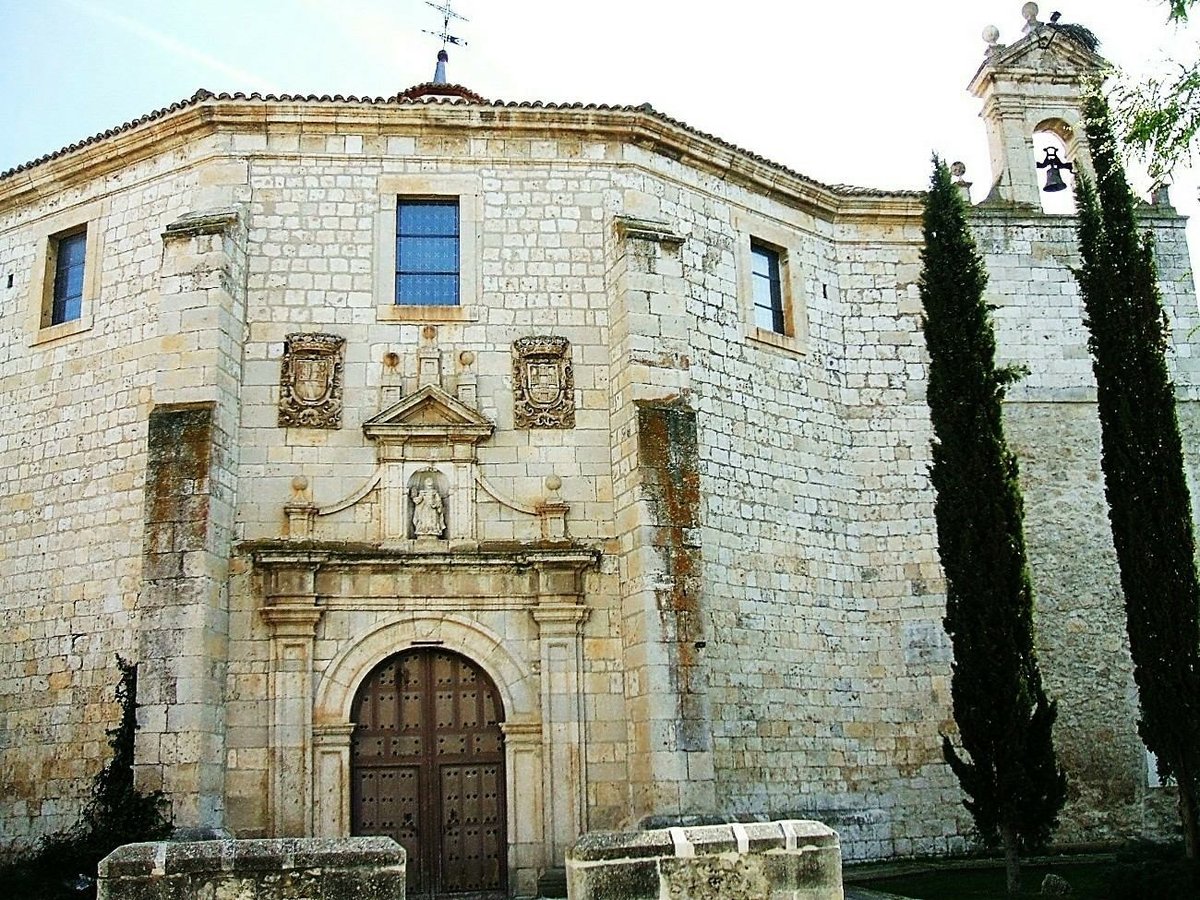

The **Convent of Santa Clara**, also known as the **Convent of Las Claras**, is a monastery of the Clarisas built in the 17th century, and located in the Castilian and Leonese town of Peñafiel, in Spain. The monastery was active until the year 2001, when the nuns sold the conventual facilities to a private individual. In the present day, a hospitality business operates there, while the church continues to be consecrated for worship.
The monastery was founded by Doña Isabel De La Cueva Y Castilla (died 1619), sister of Beltrán III De La Cueva Y Castilla, the VI duque of Alburquerque. The foundation document was granted in the Segovian town of Cuéllar on October 7, 1606. The conventual life continued until 2001. Two years later, in 2003, the Clarisas sold the conventual facilities for approximately 2 million euros to local entrepreneurial promoters, who after subjecting them to a deep rehabilitation and adaptation work, converted them into a modern hotel-spa, which was inaugurated in 2006.
The part most relevant and in better condition that has reached our days is the church. Following the model of the so-called centralized churches, it is an octagonal building covered by a hemispherical dome, creating a longitudinal symmetry axis between the main chapel and the choir. A semi-circular arch gives access to a small presbytery, formed by a rectangular plant with a barrel vault with lunettes. At the foot of the church, already in the enclosure area, is the choir, separated from the church by a grille.
In the church walls, the pilasters covering the angles of the octagon stand out, which end in capital acanthus leaves that support the cornice from which the hemispherical dome of the church vault rises. The church is decorated with beautiful stuccoes and small rectangular paintings with portraits of saints, made in the second half of the 17th century. The main altar is a Baroque work by Alonso Del Manzano, finished in 1703. The main altar's central figure is a 16th-century Christ Crucified.
The sculptor Juan De Ávila made the figures of San Francisco and San Bernadino De Siena on the main altar. An Annunciation of the same style is in the semicircular apex of the main altar. Four smaller Baroque altars decorate the perimeter walls, similar in style and age to the main altar. The altars on the Evangelist side are dedicated to San Antonio and Santa Clara. The altars on the Epistle side are dedicated to the Virgin Of Fátima and Santa Lucía.
A third retablo with a Gregorio Fernández sculpture of the Inmaculada used to exist between the last two altars, and it is now in the high choir. The entrance of the church, fairly simple, is worth noting, with a semi-circular arch, framed by two columns and a fronton with a central niche, crenellations, and capped ends. The coats of arms of the convent's patrons are on the upper part of the entrance wall.
Sources: Wikipedia, OpenStreetMap, Wikidata, Wikimedia Commons
Written by Nik Frost
Discuss this with the author and others
No comments yet. Be the first to start the conversation.