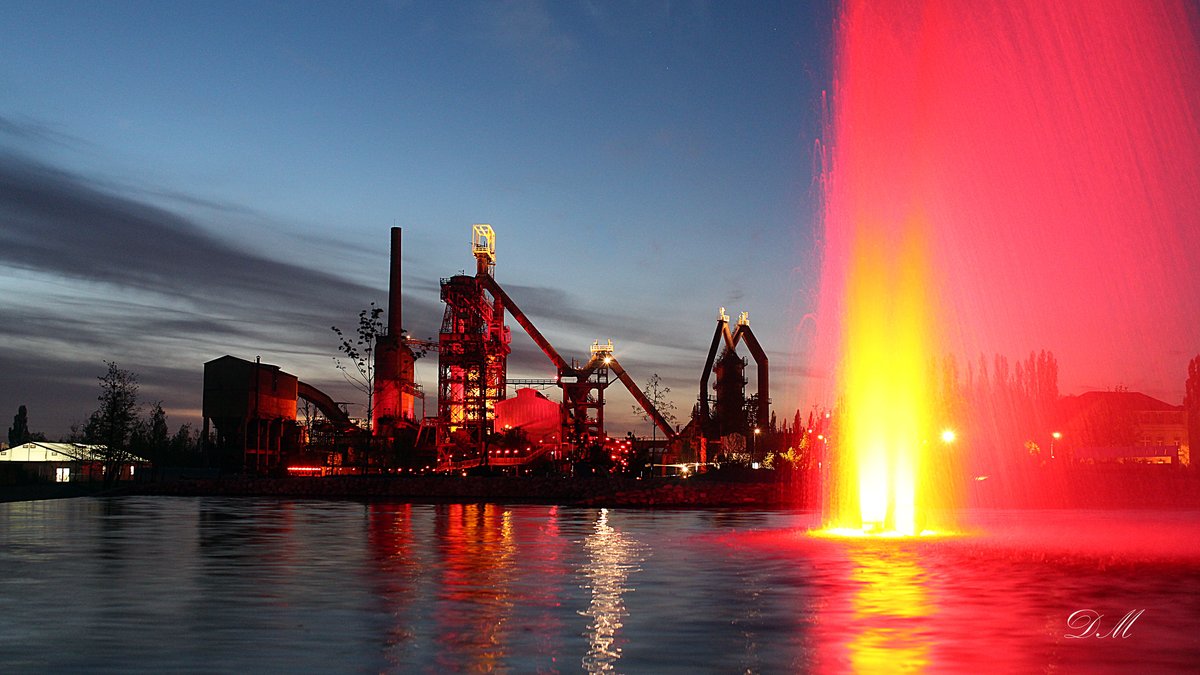

In Uckange, the U4 blast furnace stands as a relic of the Lorraine steel basin. It remains from the former steelworks, which was once part of a larger industrial complex. Following a change in ownership by the Forges et Aciéries du Nord et de Lorraine (FANL), the management reconstructed the offices, destroyed the archives, and transitioned from numeral to alphabetical numbering for the furnaces. Between 1928 and 1935, the 4 remaining blast furnaces were modernized, blast furnaces 5 and 6 were stopped and dismantled, and the factory acquired a configuration that would hardly change until its closure.
By the mid-20th century, the factory was a major center for casting iron production. It was a site of constant technical evolution, moving from the use of local minette ore to the adoption of fuel oil and crushed coal injection in the 1980s, and even experimenting with plasma torches. Despite these innovations and its role in concentrating casting iron production, the market declined, and Usinor-Sacilor announced the closure of the plant in 1991.
Today, the U4 is no longer a functioning machine but a protected historical site. It is integrated into a landscaped area known as the Jardin des Traces. Visitors can walk the grounds to see the remains of the furnace and its peripheral installations, such as the raw material management and gas purification systems, witnessing how a massive industrial operation has transitioned into a quiet public space.
Sources: Wikipedia, OpenStreetMap, Wikidata, Wikimedia Commons
Written by Nicolo Ciampini
Discuss this with the author and others
No comments yet. Be the first to start the conversation.