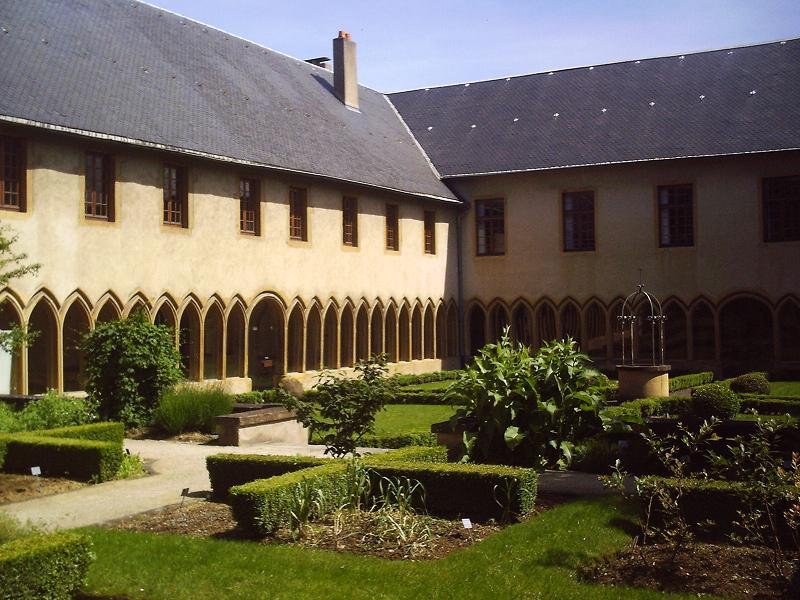

During the 13th and 14th centuries, the Cloître des Récollets was constructed in the Old Town of Metz. The Gothic galleries and the chapter house are notable for not being vaulted. Instead, they are ceilinged with wood, following a principle of use common in the civil architecture of that period. These structures are part of a site that has hosted various inhabitants, from the Cordeliers in 1230 to the Récollets from 1602 until the French Revolution.
The monastery contains several distinct historical features. In the gardens, one can find old columns with floral decorations, which likely come from an old chapel. Also embedded in the walls are a gisant and several tombstones. In 1975, a wall painting from the 1330s-40s was discovered in a niche of the western wall of the cloister. This painting was later enlarged to form the enfeu of Jean Braidy, who died in 1373.
Throughout the centuries, the site has served many functions. It was used as an orphanage in the 19th century and has served as the home of the European Institute of Ecology since 1972. Today, the municipal archives of Metz have been housed in the buildings since 2002. The facades, roofs, and galleries were classified as a historic monument in 1972.
Sources: Wikipedia, OpenStreetMap, Wikidata, Wikimedia Commons
Written by Nicolo Ciampini
Discuss this with the author and others
No comments yet. Be the first to start the conversation.