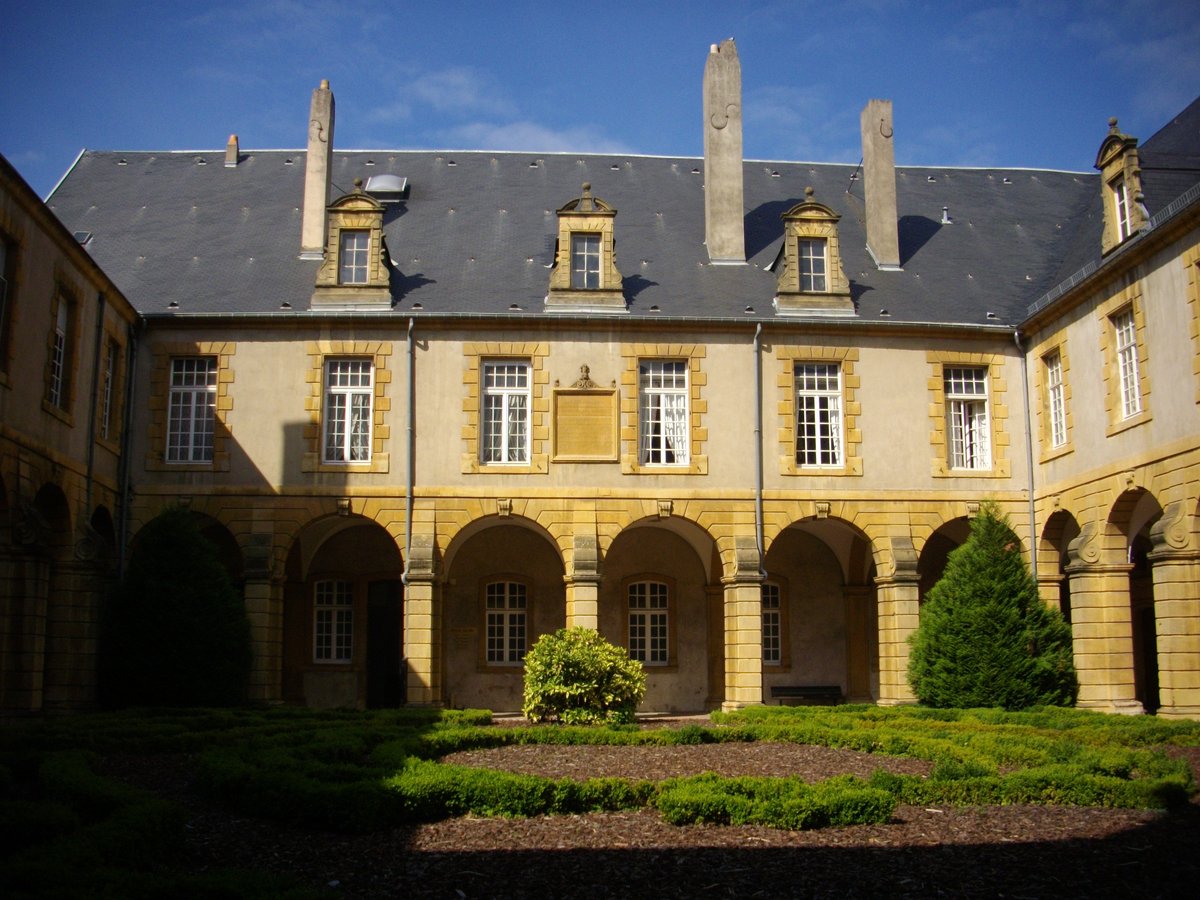

The Abbey of Saint-Arnould, residing in Metz since the 6th century, is a treasure trove of stories. One of the most fascinating finds is a Pietà carved around the 16th century, hidden away in one of its chapels. This sculpture, one of the most beautiful polychrome Pietà in the world, was hidden for nearly 250 years, unveiled only in 1990 during construction work.
The origins of the Abbey of Saint-Arnoud are a mystery. According to legend, it was founded in the 2nd century by Bishop Patient Metz as the Basilica of St. John Evangelist. Although no historical record exists before the 6th century, it was named the Church of the Holy Apostles in 715. It stood in front of medieval ramparts of the Hôpital Notre Dame de Bon Secours, near the Roman road leading to Toul and Lyon. The tale of the Abbey of Saint-Arnould being founded by Bishop Patient Metz in the 2nd century is a legend and not historically confirmed.
In 717, the Abbey took the name of St. Arnulf, due to the relics of Arnulf of Metz, Bishop of Metz, having been interred there in 641. Charlemagne made this abbey the burial place of his family: his wife Hildegarde, his sisters, his son, Emperor Louis the Pious, and Bishop Drogo were all buried here.
It was destroyed by the Normans in the 9th century when they plundered Metz. However, the abbey was rebuilt in the same location and, in 1049, saw the consecration of a more grandiose church, which suffered a fire in 1097.
In 942, Bishop Adalberon moved the monks from Abbey Gorze to Saint Arnould, under the direction of the abbot Heribert, to establish a Benedictine Abbey. From 996-997, Bishop Adalberon II entrusted William of Volpiano, as abbot, to continue this reform. Around the year 1000, the abbot appointed Guillaume Benoit, who had been his student at the Cathedral Benign Dijon. After William's death in 1015, Benoit himself became the abbot of St. Arnould. In the 9th century, relics of St. Gorgon, a 4th-century Roman martyr, were transferred to the abbey.
The siege of Metz by Charles V in 1552 led to the destruction of the abbey. The abbey was transferred to inside the walls of the Dominican convent of preachers, built in 1221. The church was rebuilt in the 17th century. These buildings can be seen today, in particular the cloister, the refectory, and the former sacristy.
During the French Revolution, the Abbey was confiscated as property of the state, the monks were expelled, and the imperial tombs were destroyed. Part of the tomb of Louis the Pious is conserved in the museum of Metz. After the Revolution, vineyards were planted on part of the site of the abbey.
However, hidden away from prying eyes, was the Pietà carved around 1520. This sculpture was hidden for nearly 250 years, unveiled only in 1990 during construction work. At the time of its discovery, it was originally dated around the 10th century, but more recent studies suggest a 16th-century date. It is one of the most beautiful polychrome Pietà known in the world.
Sources: Wikipedia, OpenStreetMap, Wikidata, Wikimedia Commons
Written by Nicolo Ciampini
Discuss this with the author and others
No comments yet. Be the first to start the conversation.