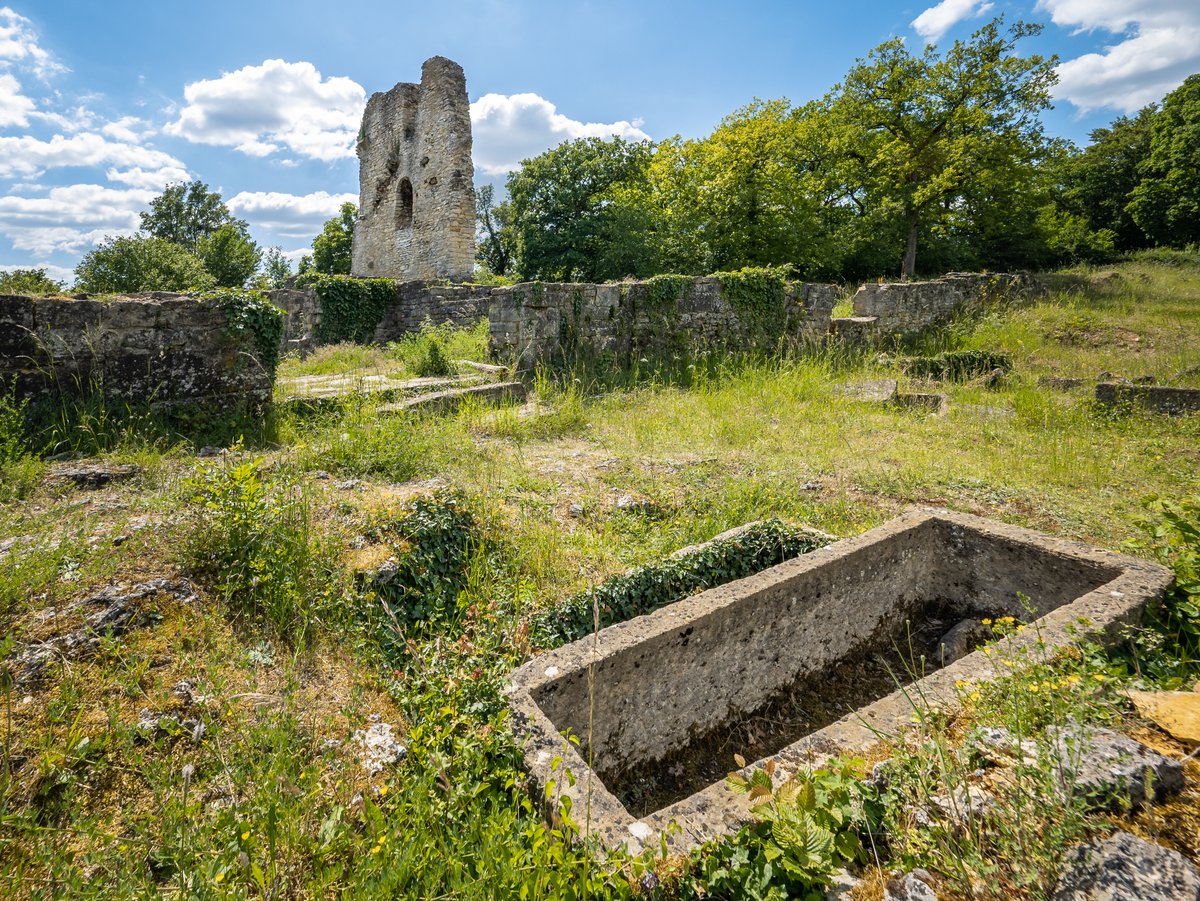

The archaeological site of Mont Saint-Germain is located on a rocky spur overlooking the Moselle valley, west of Metz. Standing at an altitude of 306 meters, the site features a defensive layout with a ditch and an earthen rampart. It has been occupied by humans since the 4th millennium BC, during the Middle and Final Neolithic periods.
During the Iron Age, the site became an important fortified Celtic settlement, known as an oppidum, near the headquarters of the Mediomatrici. Archaeological excavations at Châtel-Saint-Germain have revealed perennial Celtic occupation during the 2nd and 1st centuries BC, uncovering La Tène II metal bars and characteristic La Tène III pottery. This occupation continued through the Gallo-Roman period and into late antiquity.
In the late 6th and early 7th centuries, the site saw significant funerary activity associated with a Merovingian priory. The necropolis contains 8th and 9th-century burials, including box graves built with reused sarcophagus fragments and monolithic sarcophagi with cephalic cavities typical of the 9th century. By the 12th century, a fortified castle was constructed near the partially reconstructed priory, surrounded by scattered domestic and craft structures.
The castle was eventually captured and razed during the Guerre des Amis, a conflict between 1231 and 1234 involving the city of Metz, the Bishop of Metz, the Duke of Lorraine, and the Count of Bar. Today, the site is managed by the MHS as an archaeological site, preserving human layers from prehistory through the 16th century.
Sources: Wikipedia, OpenStreetMap, Wikidata, Wikimedia Commons
Written by Nicolo Ciampini
Discuss this with the author and others
No comments yet. Be the first to start the conversation.