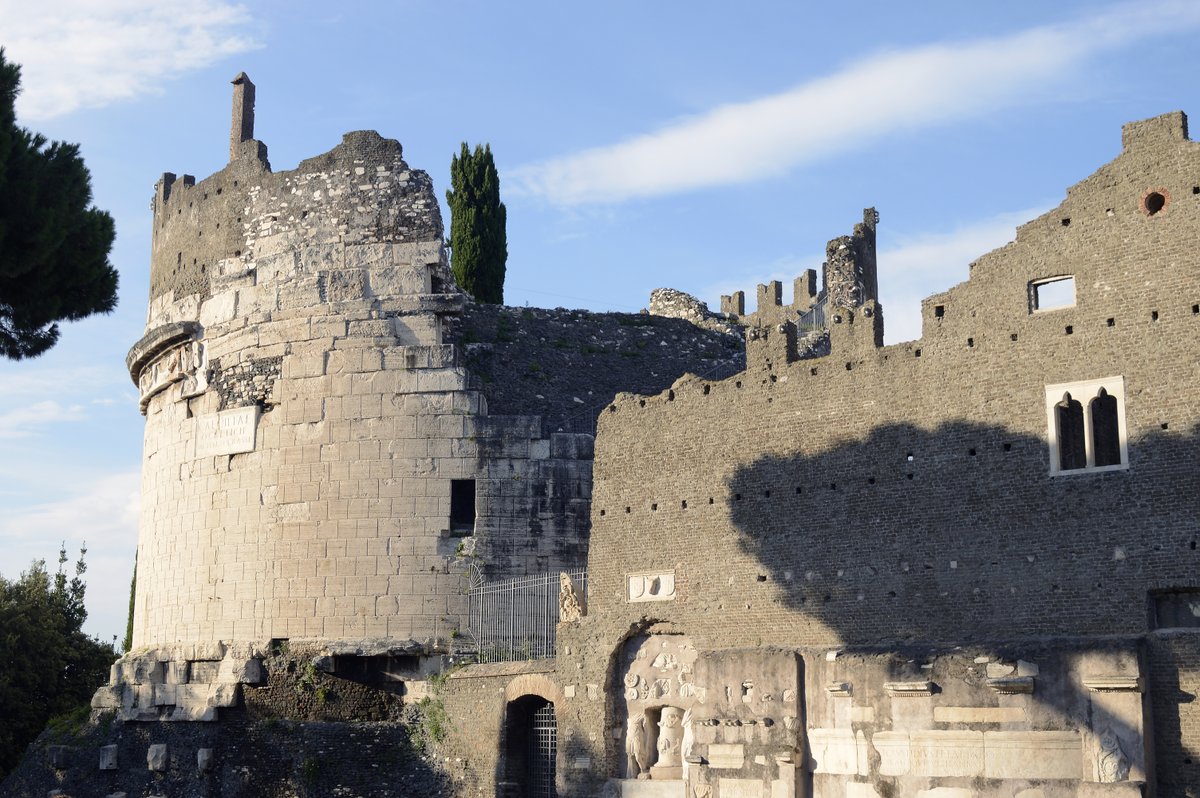

The Tomb of Caecilia Metella, located on the Via Appia Antica, is an ancient Roman landmark that has stood the test of time for over two thousand years. It was built in the 1st century BC to honor Caecilia Metella, the daughter of Quintus Caecilius Metellus Creticus, a powerful Roman consul, and the wife of Marcus Licinius Crassus, a prominent Roman statesman. The Tomb was probably constructed by her son, also named Marcus Licinius Crassus. It is one of the most well-known and well-preserved monuments along the Via Appia and is a popular tourist site. In 2013, it was the 22nd most visited site in Italy, attracting over 245,000 visitors. [1](https://cee.mit.edu/2050-year-old-roman-tomb-offers-insights-on-ancient-concrete-resilience/) [2](https://madainproject.com/tomb_of_caecilia_metella) [3](https://en.wikipedia.org/wiki/Tomb_of_Caecilia_Metella)
The Tomb of Caecilia Metella consists of a cylindrical drum, or rotunda, atop a square podium, with the Caetani Castle attached at the rear. The square podium stands at 8.3 meters tall, and the cylindrical drum stands at 12 meters. The foundation of the Tomb rests partially on tuff rock and partially on lava rock, which is part of an ancient lava flow from the Alban Hills, dating back 260,000 years. The core of the podium was cast in several layers of concrete, ranging from 0.7 to 0.85 meters thick, and is believed to have been reinforced with travertine facing-blocks. The rotunda was constructed in the same way. The walls of the towers are 24 feet thick, while the adjoining Caetani Castle was built using a thin wall of tufa.
The interior of the Tomb is divided into four sections: the cella, the upper and lower corridors, and the west compartment. The cella is a tall, circular shaft, rising through the center of both the podium and the rotunda, and is believed to have been used for funerary purposes. The shaft varies in diameter from 6.6 meters at the bottom to 5.6 meters at the top. An oculus, or circular opening, allows light to enter the cella. There are over 143 cutouts, or putlog holes, in the walls of the cella, which were used in the construction process. The upper corridors are believed to serve as the main entrance to the cella. [1](https://cee.mit.edu/2050-year-old-roman-tomb-offers-insights-on-ancient-concrete-resilience/) [2](https://madainproject.com/tomb_of_caecilia_metella)
The Tomb of Caecilia Metella was originally topped with an earthen mound, but this has been replaced by medieval battlements that were added during the Middle Ages. The Tomb and the adjacent Caetani Castle were both used as fortresses during this period. The Castle, which was built by the Caetani family between 1302 and 1303, includes stables, houses, warehouses, the church of St. Nicholas, and the palace of the Caetani. The construction of the Castle replaced a preceding 11th-century building. The Caetani family used the Castle to collect exorbitant tolls, and it was eventually passed to the Savelli and the Orsini. The Roman Senate acquired the Castle in the 15th century. The Tomb and the Castle were both abandoned in 1485 and were preserved during the Renaissance and the Romantic periods. [2](https://madainproject.com/caetani_castle) [3](https://it.wikipedia.org/wiki/Castrum_Caetani)
The Tomb of Caecilia Metella is a testament to the ingenuity and architectural prowess of the ancient Romans, and the recent research on its concrete construction methods offers valuable insights for modern construction. The Tomb stands as a reminder of the long history of the Via Appia Antica, and its preservation and study will ensure that its legacy continues for future generations.
Sources: [1] 2050-year-old Roman tomb offers insights on ancient concrete resilience. [2] Tomb of Caecilia Metella - Madain Project (en) [3] Tomb of Caecilia Metella - Wikipedia
Sources: Wikipedia, OpenStreetMap, Wikidata, Wikimedia Commons
Written by Nicolo Ciampini
Discuss this with the author and others
No comments yet. Be the first to start the conversation.