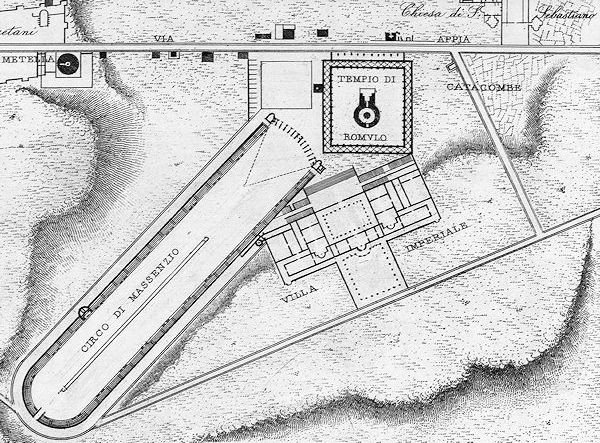

The Villa of Maxentius, located on the Via Appia Antica in Rome, was built by the Roman emperor Maxentius. The complex consists of three main buildings: the palace, the circus of Maxentius, and the dynastic mausoleum, designed as an inseparable architectural unit to honor the emperor. Situated between the second and third miles of the ancient Appian Way, the site features two nymphaeums facing the Appian Way, which are dated to the Julio-Claudian era.
In the 2nd century, the estate underwent a radical transformation under Herodes Atticus. Later, in the early 4th century, Maxentius built the villa, the circus, and the family mausoleum on the property. It is noted that his son, Valerius Romulus, who died as an adolescent, was perhaps first placed in this mausoleum. The defeat of Maxentius by Constantine likely led to the early abandonment of the site. The property passed to the Patrimonium Appiae, and by 850, the circus, called Girulum, was mentioned in a land-transaction document between ecclesiastical entities.
After passing through the counts of Tusculum, the Cenci, and the Mattei in the 16th century, a new rustic building was attached to the pronaos of the mausoleum in the mid-18th century. The rest of the old complex was almost completely buried at that time. Today, the Circus of Maxentius remains the only Roman circus still well preserved in all its architectural components. The dynastic mausoleum, also known as the Tomb of Romulus, is located inside a four-sided portico aligned with the ancient Appian Way.
The excavation history began in 1825 when Giovanni Torlonia acquired the property and commissioned systematic excavations, with designs suggested by Antonio Nibby. Nibby observed that the inscription walls and marble slabs were of mediocre quality and dated back to the 4th century, noting the building had never been restored in ancient times. The Municipality of Rome expropriated the complex in 1943. During the 1960 Rome Olympic Games, the entire circus was excavated, followed by further consolidation and excavations in 1975–77, 1979, and the early 2000s.
Sources: Wikipedia, OpenStreetMap, Wikidata, Wikimedia Commons
Written by Nicolo Ciampini
Discuss this with the author and others
No comments yet. Be the first to start the conversation.