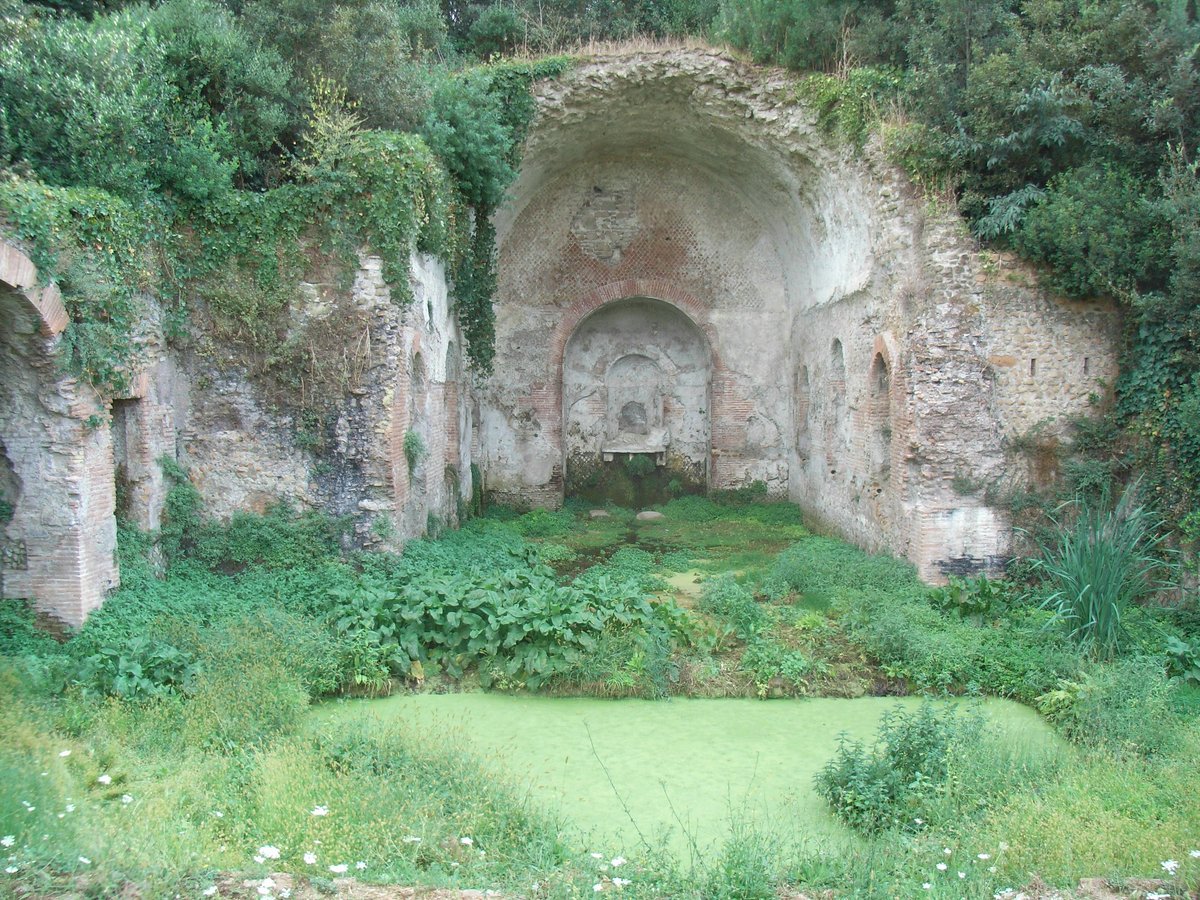

Egeria was a nymph in mythology, who served as a counselor, lover, and later wife to a king. According to legend, when the king died, Egeria turned into tears, creating a spring that became her sacred place. The nymphaeum, located in Parco regionale dell'Appia antica, between via Appia and via Latina, in the Caffarella valley along the Almone river, was among the oldest and most important of the ancient period.
The water from the spring was destined for the exclusive use of the Vestal Virgins. In the 2nd century AD, when Erode Attico renovated a nearby inherited villa, the natural cave was converted into a closed structure covered by vaults with an apsidal structure. Inside a niche, a statue of Egeria was placed; the internal surfaces were decorated with green and white marble coverings on the walls and green porphyry on the floor with mosaic inserts.
The original spring, one of the dozen that flow into the Almone river, was channeled into several large basins, one of which was known as Lacus Salutaris. Today, the nymphaeum remains visitable within the Parco della Caffarella. Water flows from the rear side, under a now headless semi-reclined statue of the god Almone.
Sources: Wikipedia, OpenStreetMap, Wikidata, Wikimedia Commons

Written by Nicolo Ciampini
Discuss this with the author and others
No comments yet. Be the first to start the conversation.