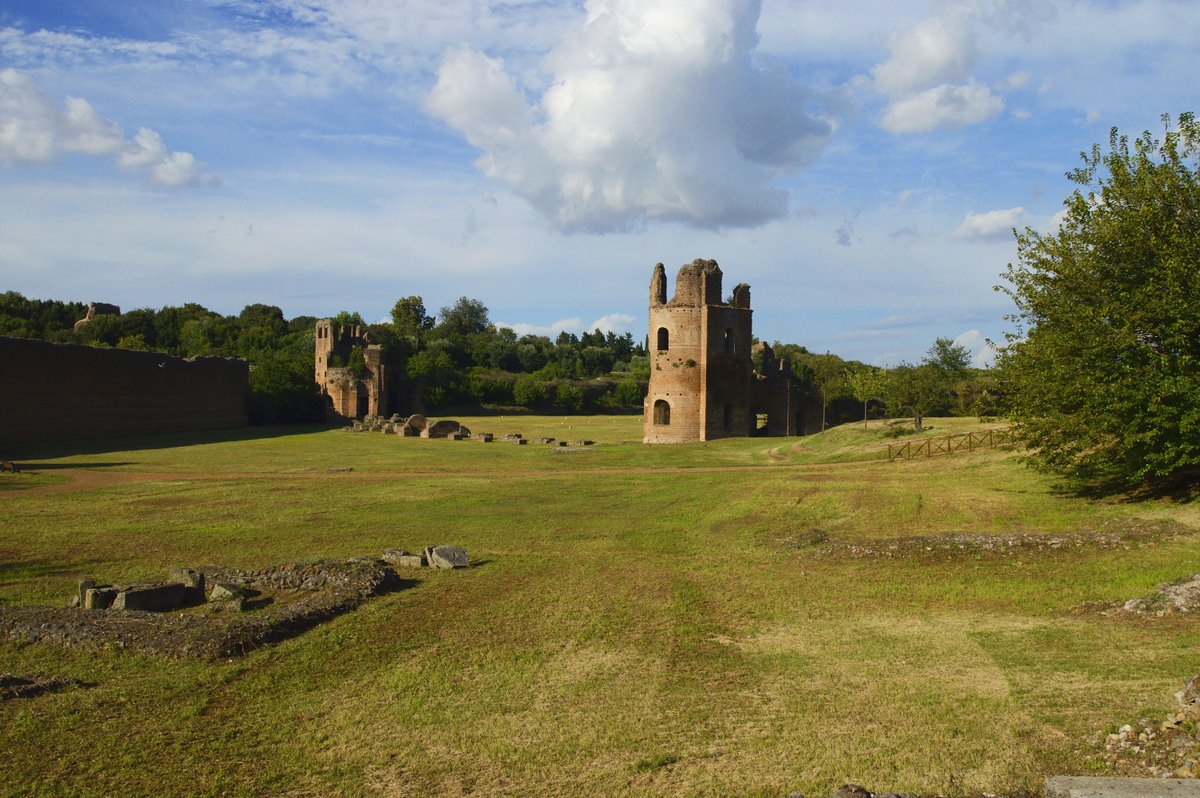

hidden beneath the city lies the second largest chariot race track to Rome's own Circus Maximus, the Circus of Maxentius. Constructed by Emperor Maxentius around AD 306-312, this architectural marvel was a tribute to his son's inaugural games. A bit of a skewball, Maxentius integrated the nearby tomb of Caecilia Metella into the Maxentian scheme. After Maxentius' mysterious departure in AD 312, the chariot race track remained unchanged, making it a time capsule for us to explore today.
The track, faced with opus vittatum, stretches a remarkable 503 meters, a testament to the grandeur of Roman engineering. The starting gates for the chariots were housed within two still towering structures. The outer walls were designed to accommodate the twists and turns of the chariots, while the spina, an impressive 1000 Roman feet long, divides the track. The Obelisk of Domitian, moved from the Isaeum as a token of respect for Maxentius' son, was once the centerpiece of the spina, though it lies in pieces today.
Today, all that remains of the complex's past glory is the apse of the basilical audience hall, a lone relic visible through the dense foliage that cloaks the rest of the Villa of Maxentius. Archaeological digs hint that the tracks were already sanded over in antiquity, allowing nature to reclaim the complex.
Sources: Wikipedia, OpenStreetMap, Wikidata, Wikimedia Commons
Written by Nicolo Ciampini
Discuss this with the author and others
No comments yet. Be the first to start the conversation.