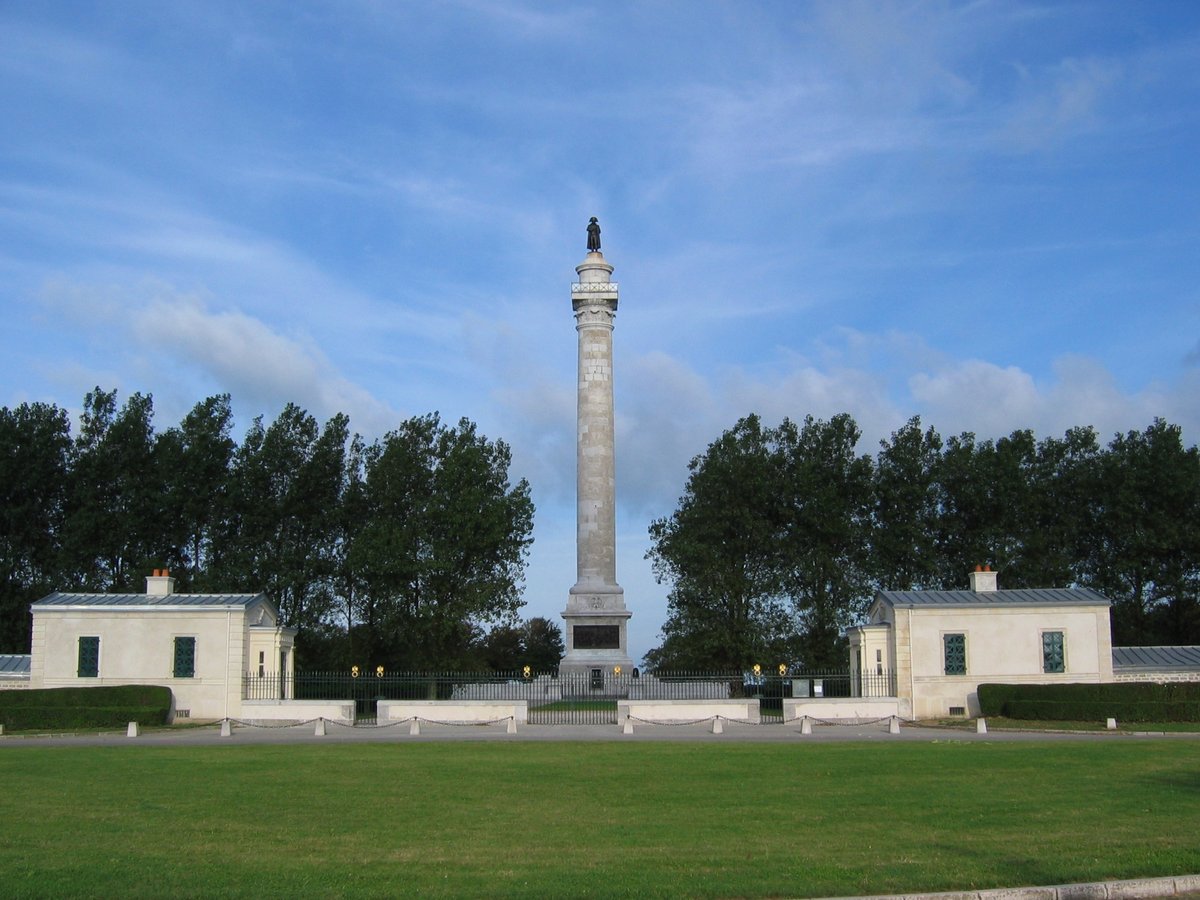

The Column of the Grande Armée (French - Colonne de la grande Armée or Colonne Napoléon) is a 53 metre high Corinthian order triumphal column on the Rue Napoléon in Wimille, near Boulogne-sur-Mer, France. Modeled on Trajan's Column and other triumphal columns in Rome, it was intended to commemorate a successful invasion of England that never occurred. The project began in 1804 when the town of Boulogne bought the estate of the widow Delahodde-Fourcroy to provide a site for the monument. The army, flotilla, soldiers, sailors and sous-officiers all contributed a half-day's pay to the project once a month, while officers gave a full day's pay.
In 1804, the first stone was placed amidst great festivities using local Marquis marble. Work became slow and erratic after the invasion force became the Grande Armée in August 1804. By 1811, the building site had to close because the project ran out of funds and was 140,000 francs in debt. Work stopped completely in 1814 when Napoleon fell, and the planned statues and bas-reliefs were broken up and melted down. Construction restarted in 1819 after new credits were granted, and the column was eventually completed in 1841.
Today, the column commemorates the first distribution of the Imperial Légion d'honneur at the camp de Boulogne by Napoleon to the soldiers of the Army of England. A large statue of Napoleon in his coronation costume was placed on top of the column on 15 August 1841 in the presence of 50,000 people. Although it was initially intended to be 50 metres high, the column reached its current height of 53 metres with 263 steps.
Sources: Wikipedia, OpenStreetMap, Wikidata, Wikimedia Commons
Written by Nicolo Ciampini
Discuss this with the author and others
No comments yet. Be the first to start the conversation.