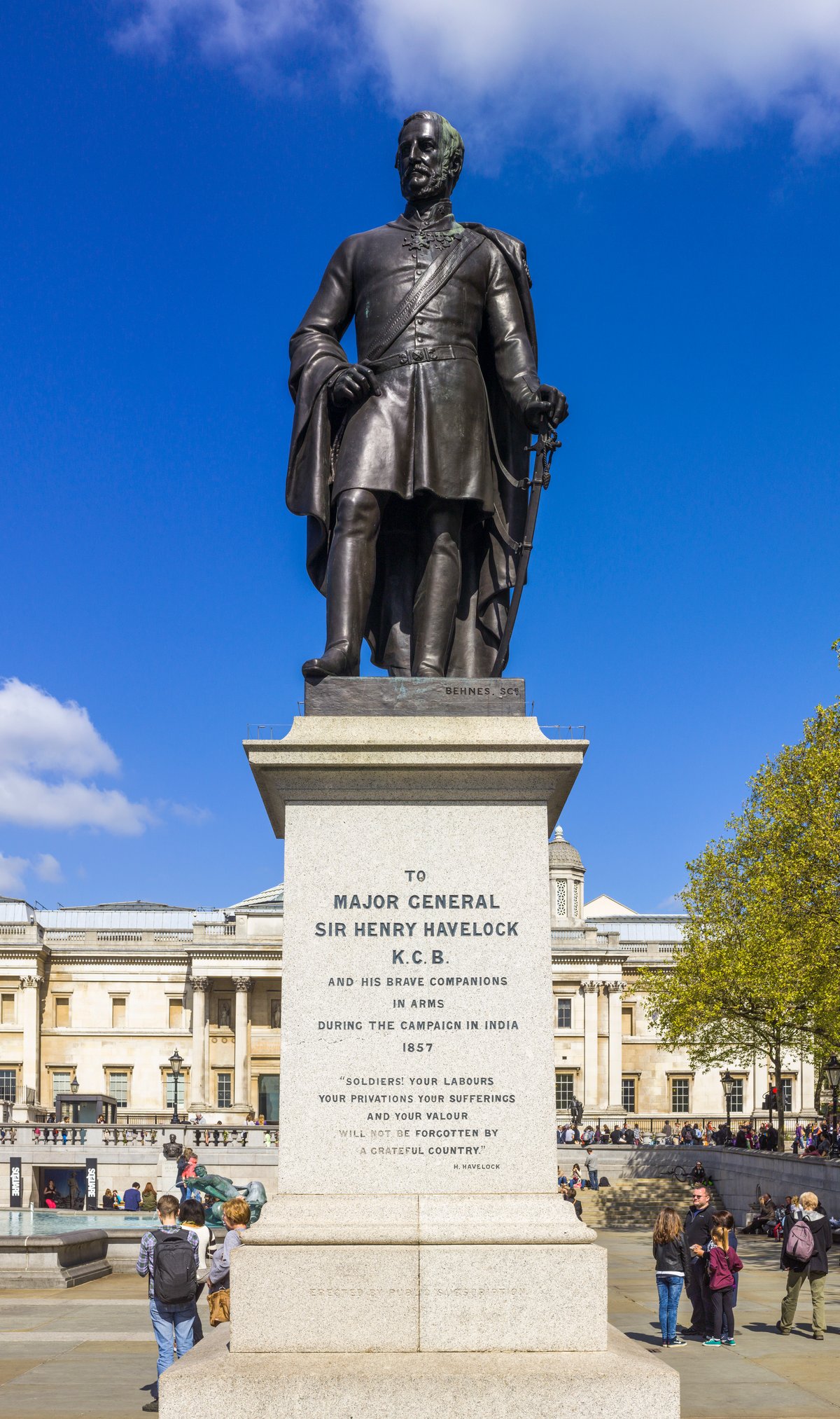
Henry Havelock stands in Trafalgar Square, one of four statue plinths occupying the open expanse. But this veteran of war served neither at sea nor on land, but in India. This is the story of a soldier whose battles in the controversial Indian Mutiny have left a lasting tribute in stone in the heart of London.
Havelock was born in 1795 and was among the British troops who fought in the First Anglo-Burmese War in the 1820s. His most notable actions came during the Indian Mutiny in 1857, where he recaptured Cawnpore and Lucknow. He died later in 1857, from dysentery.
The bronze statue of Havelock by the sculptor William Behnes, stands in Trafalgar Square in London, United Kingdom. It occupies one of the four plinths in Trafalgar Square, the one to the southeast of Nelson’s Column. The statue was erected by public subscription in 1861, on a granite plinth, matching the statue of General Charles James Napier erected to the west in 1855–1856. A copy in Mowbray Park in Sunderland was also erected by public subscription and unveiled in 1861.
In 1936, it was suggested that the statues of Generals Havelock and Napier in Trafalgar Square should be replaced by statues of Admirals Beatty and Jellicoe, the naval commanders at the Battle of Jutland in 1916, but a place was eventually found for bronze busts of the Edwardian admirals (and later for Admiral Cunningham) against the north wall of the square, without removing the statues of the Victorian generals from their plinths.
Trafalgar Square is itself Grade I listed.
Sources: Wikipedia, OpenStreetMap, Wikidata, Wikimedia Commons
Written by Nicolo Ciampini
Discuss this with the author and others
No comments yet. Be the first to start the conversation.