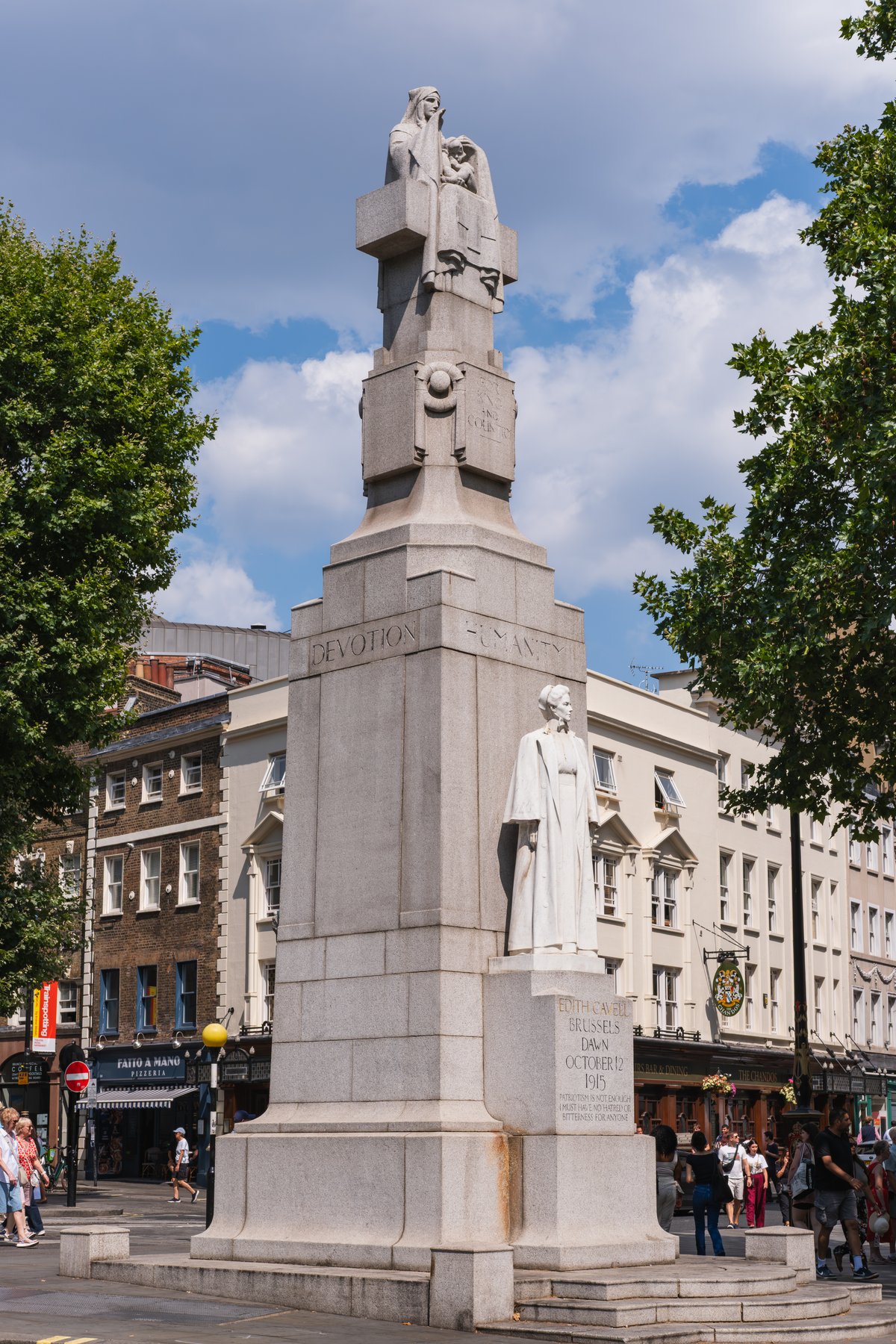

In 1914, British nurse Edith Cavell was the matron at the Berkendael Medical Institute in Brussels. When the First World War broke out, she treated soldiers from both sides without distinction and assisted approximately 200 Allied soldiers in escaping from German-occupied Belgium. She was arrested in August 1915, found guilty of treason, and shot by a German firing squad on 12 October 1915. Although her sister initially suggested no monuments be built, a committee raised funds for a public memorial in London.
Sculptor Sir George Frampton designed a Modernist memorial consisting of a 10-foot high statue of Cavell in her nurse's uniform, carved from white Carrara marble. The statue stands on a grey Cornish granite pedestal in front of a larger 40-foot high granite pylon weighing 175 tons. The top of this block is carved into a cross and a statue of a mother and child. The memorial is elevated on three steps and is located in St Martin's Place, adjacent to the first headquarters of the British Red Cross.
The memorial features several inscriptions. The face of the granite block behind the statue bears the word "Humanity", while other faces are inscribed with "Devotion", "Fortitude", and "Sacrifice". The rear face features a carving of a lion crushing a serpent with the words "Faithful until death". On the pedestal beneath the statue, an inscription notes her execution date and includes the lines "Patriotism is not enough - I must have no hatred or bitterness for anyone", which were added in 1924 at the request of the National Council of Women.
Sources: Wikipedia, OpenStreetMap, Wikidata, Wikimedia Commons

Written by Nicolo Ciampini
Discuss this with the author and others
No comments yet. Be the first to start the conversation.