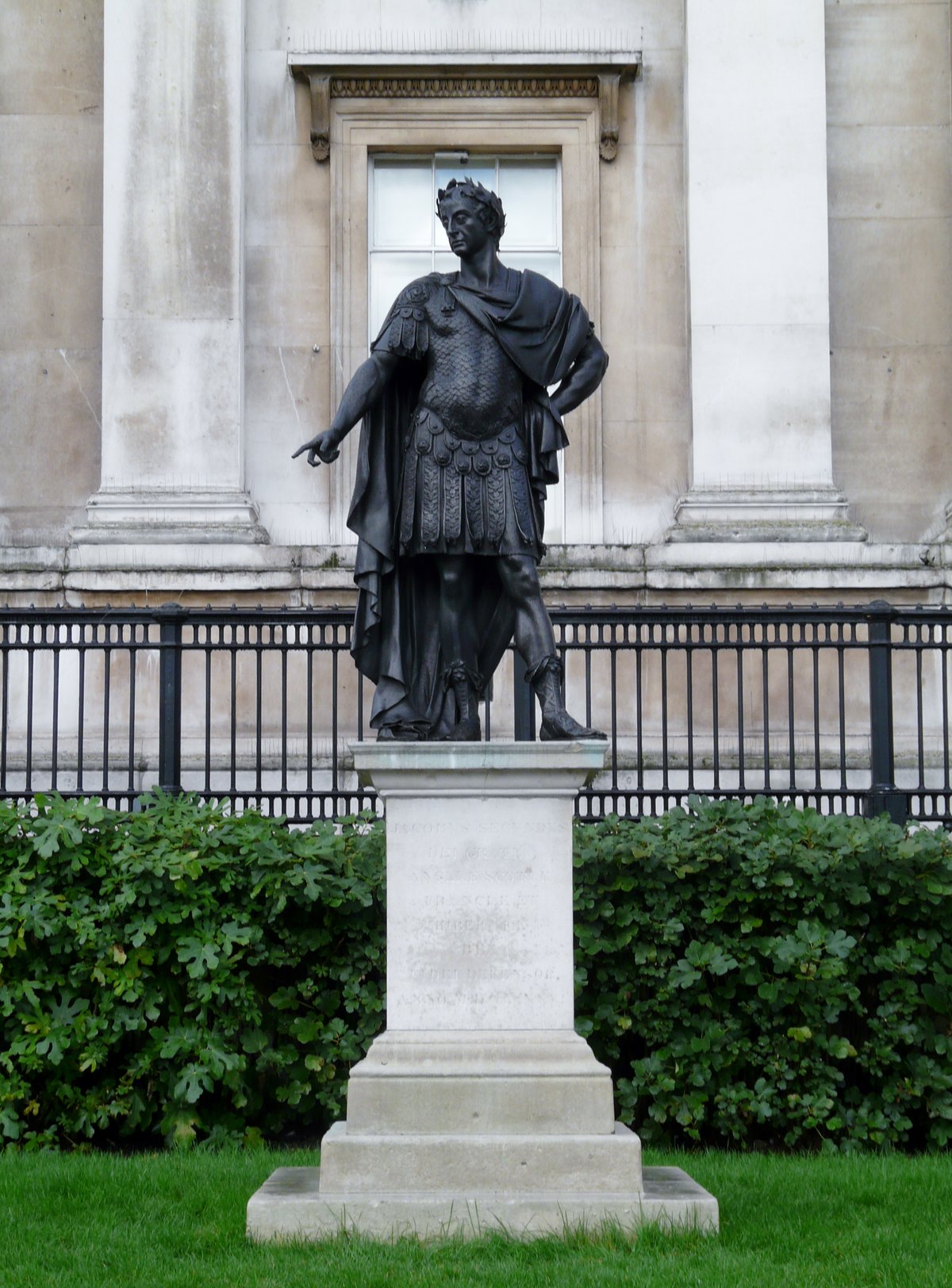
The statue of James II is a bronze sculpture, depicting him as a Roman emperor. Located in the front garden of the National Gallery in Trafalgar Square, London, the statue was produced by the workshop of Grinling Gibbons. However, modern scholarship suggests it was most likely created by the Flemish sculptors Peter van Dievoet and Laurens van der Meulen, rather than by Gibbons himself. The statue was commissioned in the 1670s and '80s, and was originally placed in the grounds of the old Palace of Whitehall in 1686, only two years before James II was deposed. It has been relocated several times since then.
The statue is one of three commissioned by the royal servant Tobias Rustat from Grinling Gibbons's workshop. The others are an equestrian statue of James's brother and predecessor Charles II in Windsor Castle and a standing figure at the Royal Hospital in Chelsea. The statue of James II was originally intended to be a pendant piece with the standing Charles II. It was produced at a reported cost of £300 (equivalent to about £42,000 at 2014 prices).
The statue is executed in bronze and depicts James II standing in a contrapposto pose, pointing downwards in 'great ease of attitude and a certain serenity of air'. It formally held a baton in its right hand, though this is now missing. The face is said to be an excellent depiction of the king. Unusually for the time, the sculptor sought a degree of fidelity to original classical styles; James is depicted wearing a laurel wreath on top of short hair, whereas other imperial-style statues of both Charles II and James II depicted the two kings with an anachronistic combination of Roman armour and a 17th-century periwig.
The plinth is inscribed with the legend JACOBUS SECUNDUS/ DEI GRATIA/ ANGLIÆ SCOTIÆ/ FRANCIÆ ET/ HIBERNIÆ/ REX/ FIDEI DEFENSOR/ ANNO M.D.C.LXXXVI, which translates to: 'James II, by the grace of God, King of England, Scotland, France and Ireland. Defender of the Faith. 1686.'
Sources: Wikipedia, OpenStreetMap, Wikidata, Wikimedia Commons
Written by Nicolo Ciampini
Discuss this with the author and others
No comments yet. Be the first to start the conversation.