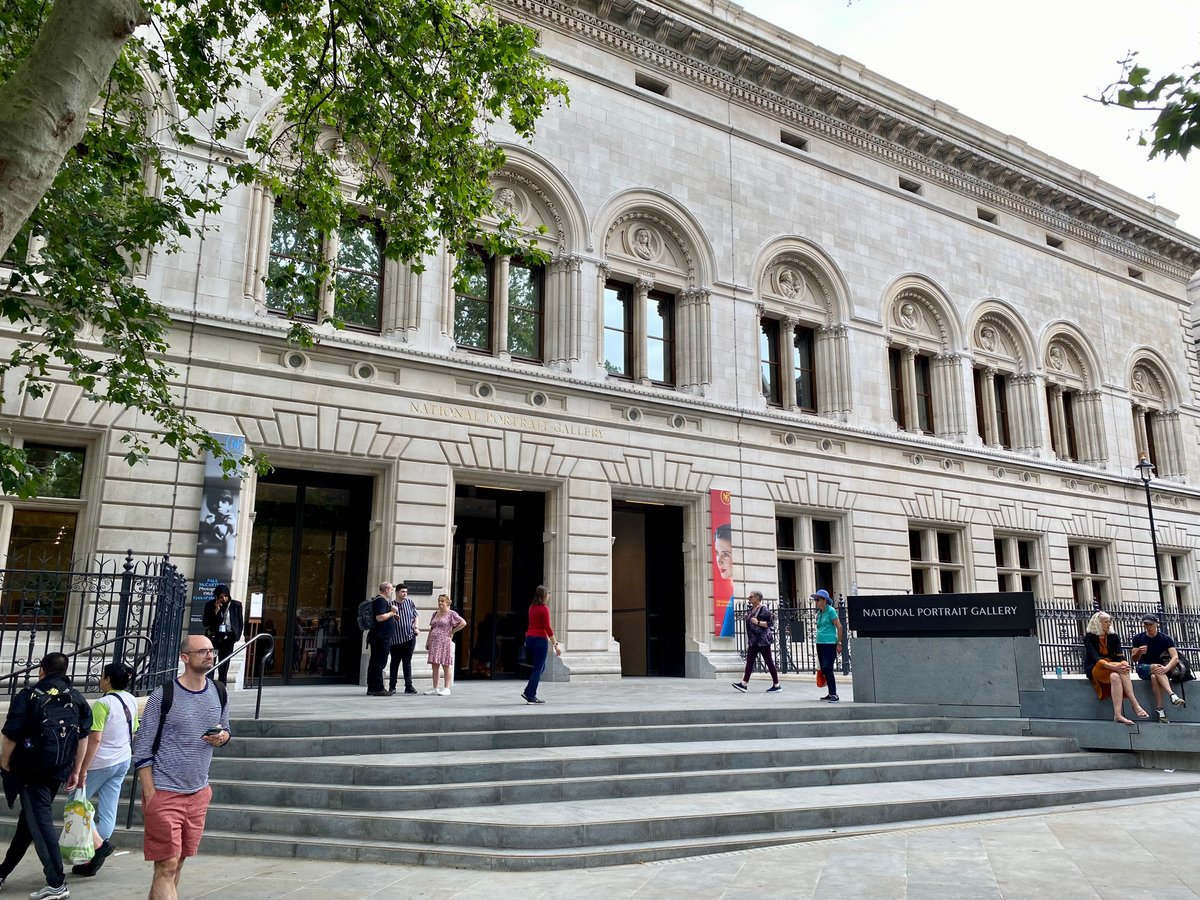

The National Portrait Gallery (NPG) is an art gallery in London that houses a collection of portraits of historically important and famous British people. When it opened in 1856, it was arguably the first national public gallery in the world that was dedicated to portraits. The gallery moved in 1896 to its current site at St Martin's Place, off Trafalgar Square, and adjoining the National Gallery.
The gallery moved to its current site because previous locations were unsuitable. The Bethnal Green Museum site, for example, was too far from the West End and suffered from condensation and a lack of waterproofing. The new buildings, faced in Portland stone, were constructed by Shillitoe & Son and opened on 4 April 1896.
The gallery houses portraits selected on the basis of the significance of the sitter, not that of the artist. The collection includes photographs and caricatures as well as paintings, drawings and sculpture. One of its best-known images is the Chandos portrait, the most famous portrait of William Shakespeare, although there is some uncertainty about whether the painting actually is of the playwright. The collection also includes self-portraits by William Hogarth and Sir Joshua Reynolds, as well as an anamorphic portrait by William Scrots and a sculpture of Queen Victoria and Prince Albert in medieval costume.
In February 1909, a murder-suicide took place in a gallery known as the "Arctic Room". In an apparently planned attack, 70-year-old John Tempest Dawson shot his 58-year-old wife, Nannie Caskie, from behind with a revolver, then shot himself in the mouth. Both were American nationals who had lived in Hove for around 10 years. Evidence at the inquest suggested that Dawson was suffering from a persecutory delusion.
Sources: Wikipedia, OpenStreetMap, Wikidata, Wikimedia Commons

Written by Nicolo Ciampini
Discuss this with the author and others
No comments yet. Be the first to start the conversation.