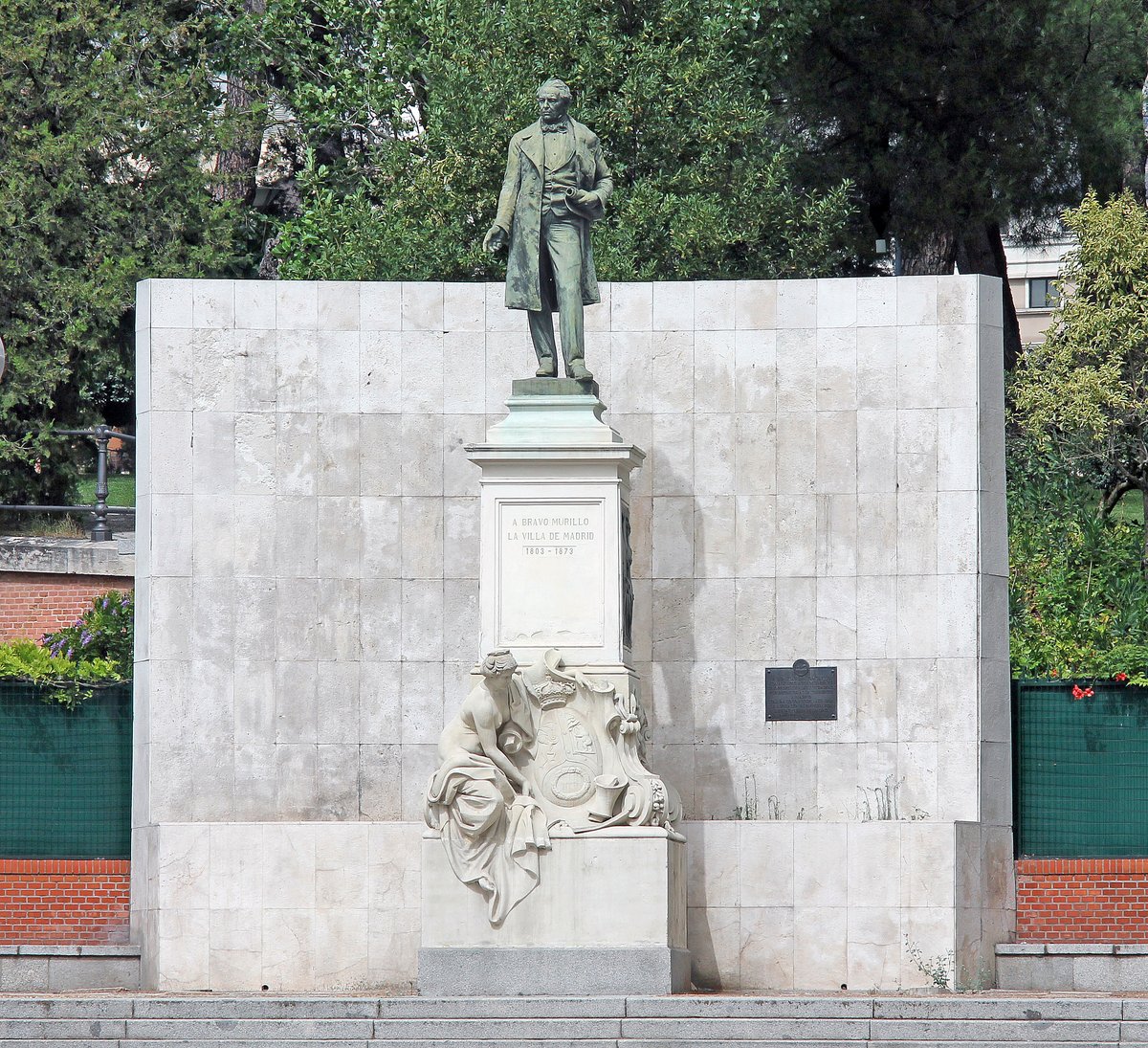

Why does a bronze figure get a street and a monument? Because Juan Bravo Murillo was the promoter of the Canal de Isabel II. He is commemorated in a public art piece located at the meeting of the streets of Bravo Murillo and José Abascal in Madrid.
Miguel Ángel Trilles was the artist who created this piece to mark the coming of age of King Alfonso XIII in 1902. The ceremony suffered delays due to bad weather. The original version of the monument stood eight metres tall and sat on a marble and stone plinth. It featured an allegorical female figure embodying the town of Madrid holding the municipal coat of arms, while two lateral bronze reliefs on the plinth represented Commerce and Industry.
In 1961, the city decided to revamp the glorieta de Bilbao. The monument was moved to its current location next to the main headquarters of the Canal de Isabel II at the request of the company. When it was unveiled for a second time on 17 December 1963, it had lost the original plinth in the process. The inscription was changed first to the dedication dates and eventually to Bravo Murillo's lifetime of 1803–1873.
Today, you can see the standing bronze figure at the corner of Bravo Murillo and José Abascal. Behind the statue stands a detached limestone wall dedicated to Bravo Murillo, which was funded by the Association of Plumbing Employers of Madrid (ASEFOSAM).
Sources: Wikipedia, OpenStreetMap, Wikidata, Wikimedia Commons
Written by Nicolo Ciampini
Discuss this with the author and others
No comments yet. Be the first to start the conversation.