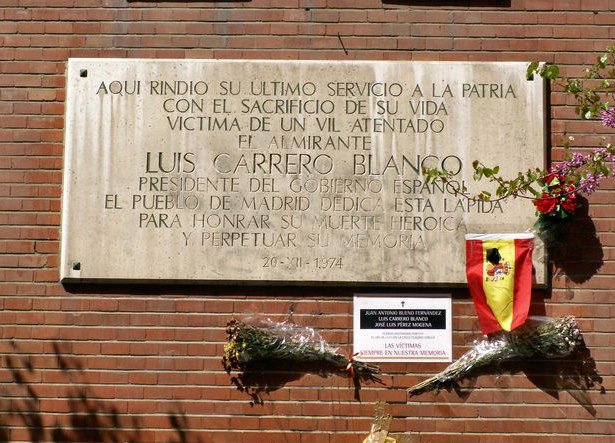

On 20 December 1973, an explosion on a Madrid street was more than it appeared at first. The attack targeted Luis Carrero Blanco, a key figure in the Francoist regime. Known as Operation Ogro or Ogro Operazioa (Operation Ogre), the attack was carried out by the Basque separatist group ETA. The death of Carrero Blanco had numerous political implications. The physical health of dictator Francisco Franco had declined significantly by the end of 1973, and his death marked the onset of the final crisis of the Francoist regime.
Following Carrero Blanco’s death, the most conservative sector of the Francoist State tried to influence Franco to choose an ultraconservative as Prime Minister. However, Franco ultimately chose Carlos Arias Navarro, who was initially announced with the promise of a partial relaxation of the most rigid aspects of the Francoist State but quickly retreated under pressure from the most conservative sector. ETHad dug a tunnel under the street, telling the landlord that they were student sculptors to hide their true purpose.
The tunnel was packed with 80 kg (180 lb) of Goma-2 that had been stolen from a government depot. On December 20 at 9:36 am, a three-man ETA commando unit disguised as electricians detonated the explosives by command wire as Carrero Blanco’s car passed. The blast sent Blanco and his car 20 meters (66 ft) into the air and over the five-story church, landing on the second-floor terrace of the opposite side. Carrero Blanco survived the blast but died at 10:15 am in hospital.
His bodyguard and driver died shortly afterwards. ETA consolidated its place as a relevant armed group and would evolve to become one of the main opponents of Francoism.
Sources: Wikipedia, OpenStreetMap, Wikidata, Wikimedia Commons
Written by Nik Frost
Discuss this with the author and others
No comments yet. Be the first to start the conversation.