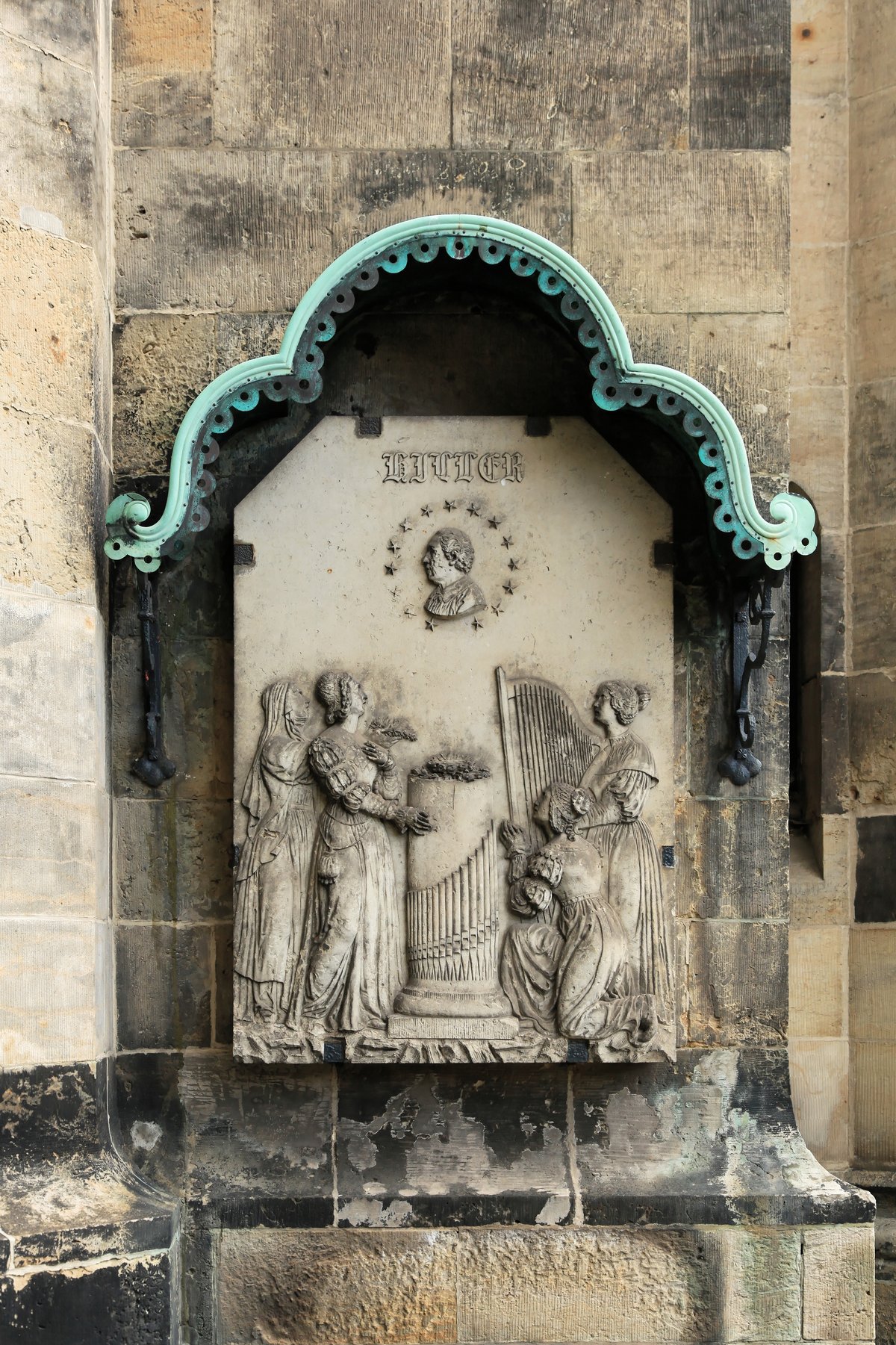
On the northwest side of the Thomaskirche, a sandstone relief watches the passage of time. It is a fragment of a larger history, a 1.57-meter-high tablet crowned with a three-lobed copper roof. At its top, the name of Johann Adam Hiller appears in large Fraktur letters, his portrait framed by a wreath of stars. Below, four women with upward-looking gazes form the heart of the scene. One plays a harp, another woman in the relief is shown kneeling, and a third wears a religious habit. They gather around a stump of a column, draped in organ pipes and garlands of ivy, alder, and flowers.
This is not a generic tribute to a great composer. It is a debt of gratitude. The women in the stone represent four sisters who arrived in Leipzig from Beraun in Bohemia in 1776. They came with their mother, a widow named Podleska, for mass. It was there that Hiller first heard the singing of the twelve-year-old Thekla. He was struck by her voice and took all four daughters into his singing school, which he had established in the city in 1771.
Under his guidance, the girls became professional singers. Thekla became the most successful of the four. She worked at the court theater in Mitau in Courland in 1783 and eventually moved to Prague to teach. One of her sisters took a different path, entering a convent to become a nun. Though Hiller died in 1804, the sisters did not forget the man who gave them their craft. They remained his students in spirit, eventually reaching out to have his memory secured in stone.
They commissioned the painter Veit Hanns Schnorr von Carolsfeld to design a monument. The sisters provided 500 Talers to ensure the work was done. Schnorr produced two distinct design drawings, and the final sculpture was executed by his students, Friedrich Funk and Johann Christoph Wingrich. The original monument was built in 1831 and 1832, standing on a three-stepped base on a flat hill west of the Thomaskirche. It was the first memorial for a musician in Leipzig.
For decades, the monument stood in the promenade area, bearing an inscription on its eastern face that thanked their fatherly benefactor. However, the city's urban plans changed in 1888. During a redesign of the promenade, the original structure disappeared. The relief plate survived the demolition, but it remained displaced until the beginning of the 20th century when it was moved to its current home on the wall of the Thomaskirche.
Today, the relief serves as a quiet record of a specific musical lineage. It marks the intersection of a master's pedagogy and four daughters' devotion. You can still see the specific details of the copper roof and the texture of the sandstone, holding a story of voices that once filled the streets of old Leipzig.
Sources: Wikipedia, OpenStreetMap, Wikidata, Wikimedia Commons


Written by Aurora
Discuss this with the author and others
No comments yet. Be the first to start the conversation.