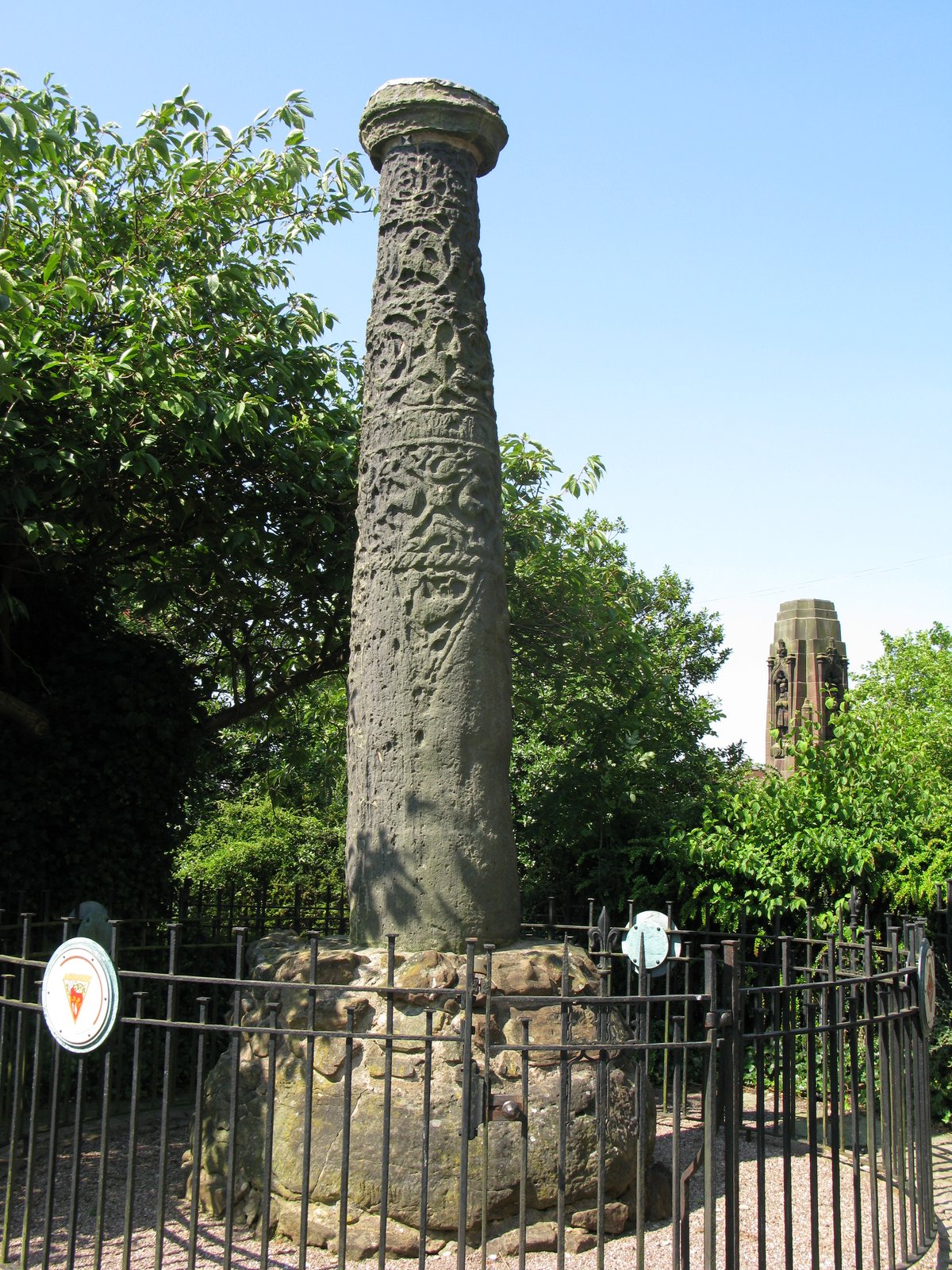
The Wolverhampton Pillar is the shaft of an Anglo-Saxon high cross, dating from the ninth or tenth centuries AD. It is a scheduled monument still standing in its original location, in what is now the churchyard of St Peter's Collegiate Church, in Wolverhampton, England. Its decoration is of an extremely rare type, and has survived the effects of weathering comparatively well. It consists of seven bands, depicting vine scrolls, various animals, acanthus, and lattice-work.
Kendrick (1938) considered the decoration to be unique; the only surviving example in England which demonstrated the southern continental Baroque style. If the pillar was quarried from the nearby Roman city of Viriconium, as some speculate, it would have been quarried c. 100-150 AD. An excavation by Michael M. Rix in 1949 revealed that the pillar is still standing on its original Saxon foundation, consisting of a stepped base approximately 2.4m in diameter, located one metre below the present ground level. At some later date, the base of the pillar has been propped up with mortared rubble.
Sources: Wikipedia, OpenStreetMap, Wikidata, Wikimedia Commons
Written by Nicolo Ciampini
Discuss this with the author and others
No comments yet. Be the first to start the conversation.