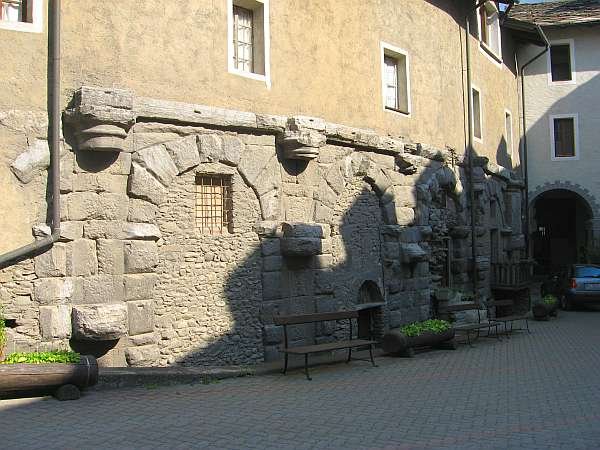

The small town of Aoste, founded by the Romans in 25 BC, has a hidden gem beneath its medieval architecture. The Roman amphitheatre, located in the convent known today as San Giuseppe, was built lower than ground level, with the lower part of the cavea attached to a terrapien and the upper part supported by two orders of 60 arches and interspaced semicolumns of Tuscan order. The arches were made of bardiglio, a local marble used in other important Roman monuments in Aosta, such as the Porta Praetoria or the forum. It is unclear if the amphitheatre was built after the rest of the town or at a later time. The adjacent convent, founded in 1247, was built over the amphitheatre, with eight outer arches from the second order of the Roman amphitheatre incorporated into the convent’s walls.
Sources: Wikipedia, OpenStreetMap, Wikidata, Wikimedia Commons
Written by Nicolo Ciampini
Discuss this with the author and others
No comments yet. Be the first to start the conversation.