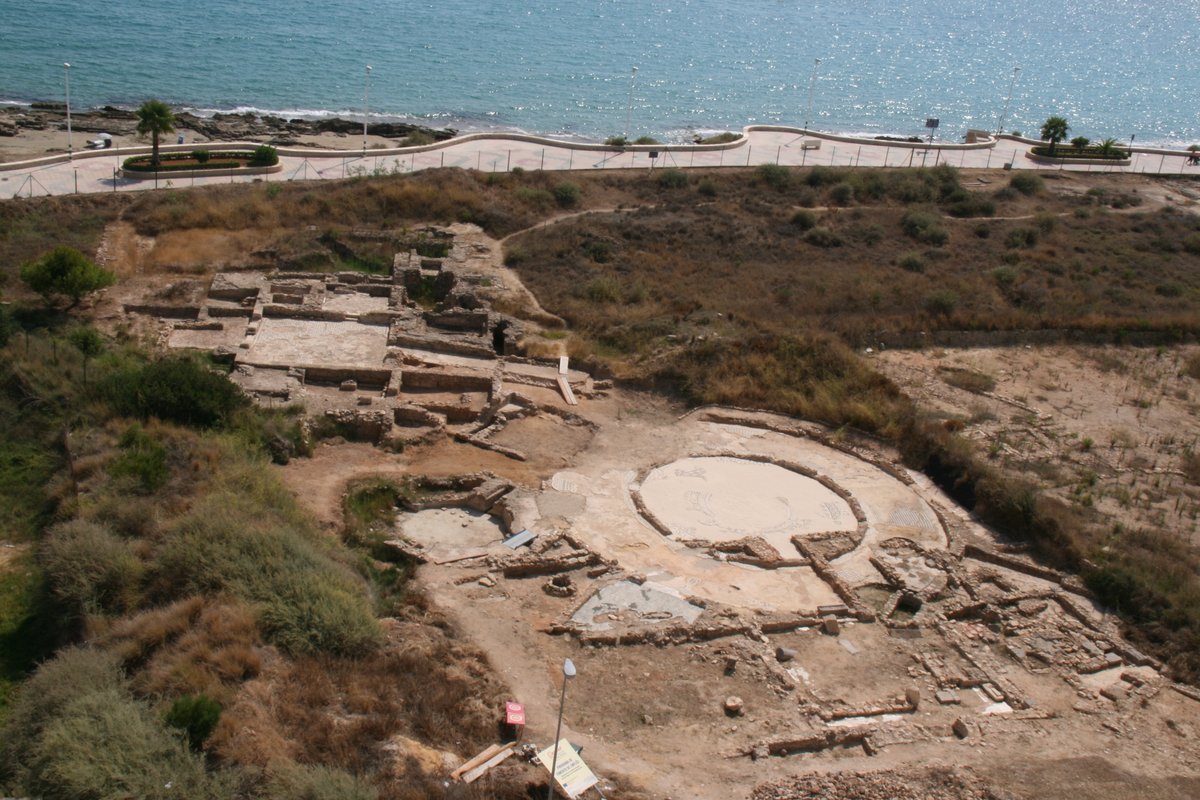

Banys de la Reina, a small coastal town in the Marina Alta region of Spain, hides a secret in plain sight - an entire Roman palatial complex tucked away in its hills. Rich in marble and mosaics, the complex is a testament to the high power of the individual who once owned it. The town overlooks the Mediterranean Sea, and the complex, located in Banys de la Reina, shows every sign of wealth and luxury. This hidden gem has a long and complex history of discovery, abandonment, and rediscovery.
The complex was first found in the early 17th century by Gaspar Escolano, but it was not fully excavated until the 18th and 21st centuries, with Antoni Josep Cavanilles excavating it in the 18th century and Manuel Pellicer Català excavating it in the 20th century. The complex is made up of eight rooms, a courtyard, and a passageway, all carved into the rock of the hillside. Its entrance is guarded by a pair of imposing stone lions. Inside, the complex features numerous mosaics, some of which depict scenes from Roman mythology.
The walls are adorned with intricate frescoes, and the floors are paved with beautiful marble. The complex also features a series of shallow pools, carved into the rock, which were used for fishing. The complex is surrounded by a number of other structures, including some smaller buildings and a number of cisterns, used to store water. There are also a number of graves nearby, suggesting that the complex may have been used as a burial site. Today, the complex is being preserved and studied, and it is hoped that one day it will be open to the public.
Sources: Wikipedia, OpenStreetMap, Wikidata, Wikimedia Commons
Written by Nicolo Ciampini
Discuss this with the author and others
No comments yet. Be the first to start the conversation.