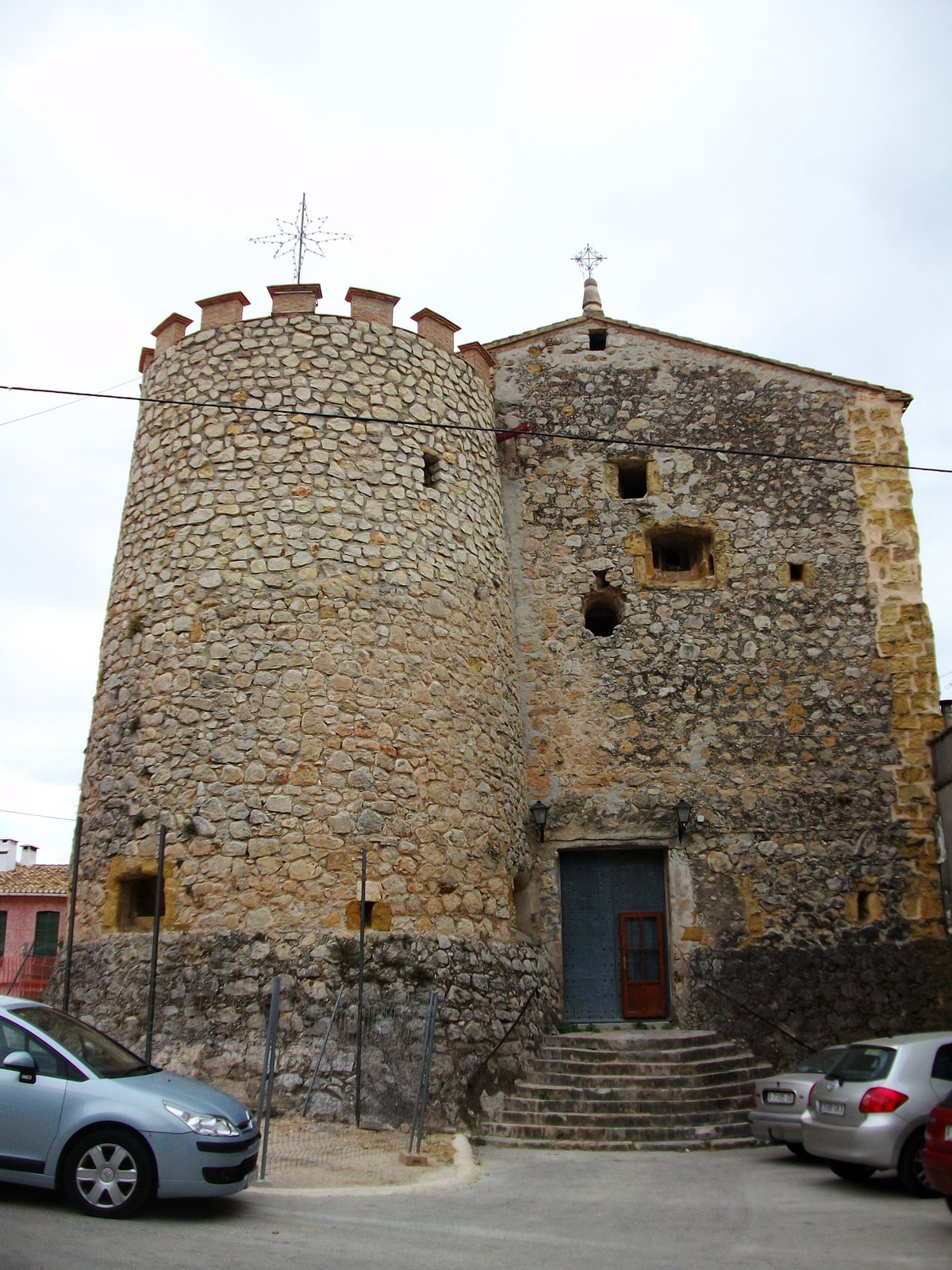

The Església de Sant Miquel Arcàngel de Murla, now a church, has an interesting and complex past. Originally, it was part of the Castell de Pop, an ancient castle of Islamic origin built on Roman ruins. During the final Muslim period, Castell de Pop belonged to Al-Azraq. In 1258, the Count of Oliva, the lord of Murla, became the lord of Castell de Pop. Ramon de Villanova was the lord of Castell de Pop from 1296 to 1323. In 1323, Jaume II gave Castell de Pop and its surroundings to his son, the infant Pere.
In 1328, the infant Pere sold Castell de Pop and its vall to Maria Bordar, the widow of Ramon de Villanova, and her son Vitalón. It was during this period that the church was burned and rebuilt. The current church, fortified and ready for artillery, has towers characteristic of its once castle origins. While Castell de Pop was initially a part of the church, it was separated and constructed as a fortress. The 'castell de Pop' located in the Puig D'Orba was the original castle of Murla before the fortress of the alqueria was built.
The 'castell de Pop' located in the Puig D'Orba is now known as Castellet or castell d'Orba. The reign of Al-Azraq, the Cid Campador's Easter visit, and the existence of several alqueries expanses the story beyond the immediate location.
Sources: Wikipedia, OpenStreetMap, Wikidata, Wikimedia Commons
Written by Nicolo Ciampini
Discuss this with the author and others
No comments yet. Be the first to start the conversation.