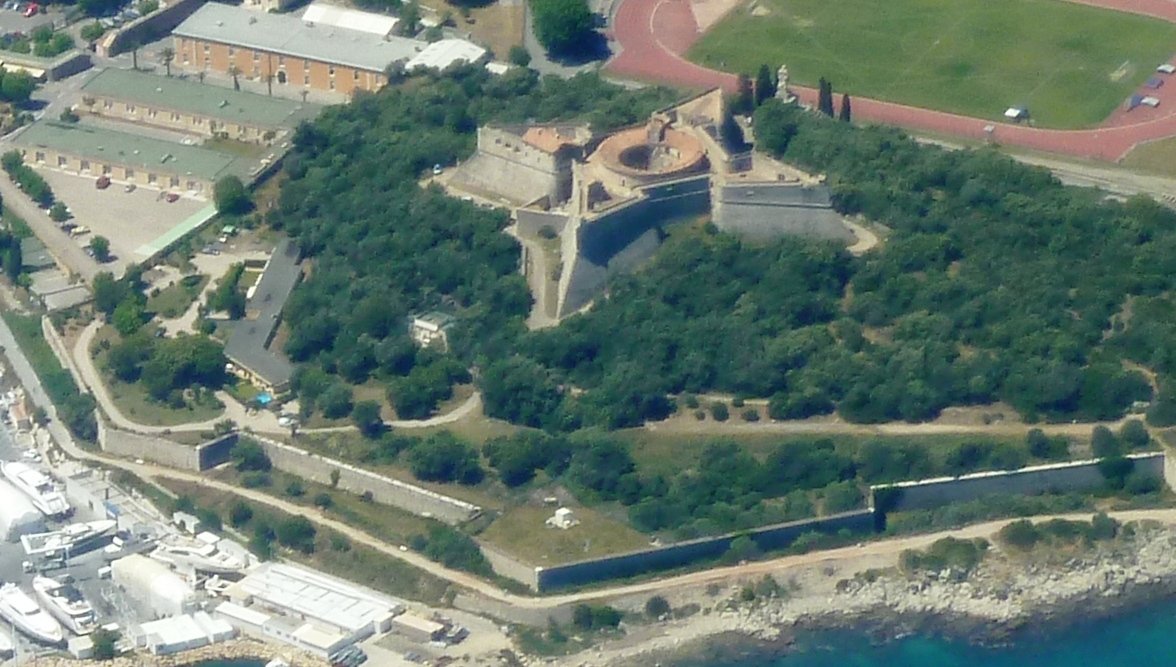

King Henry II ordered the construction of Fort Carré in the 16th century because the border with the Duchy of Savoy was a tense zone. The fort was built on a promontory 26 meters above sea level to provide a vantage point to monitor the neighboring territory. The first official mention of the fort is found in 1552 in the archives of the city of Antibes, which ordered that compensation be paid to a man whose house was accidentally damaged by a cannonball fired from the fort.
The design is a star-shaped fort with four arrow-head shaped bastions. In 1591, during the wars of religion, Duke Charles-Emmanuel I of Savoy took the stronghold of Antibes without a fight. The French army, launched by Henri IV to reconquer Provence, laid siege to Antibes and its fort in 1592, where the Duke of Épernon retook the town and the fort. This remains the only known military capture of Fort Carré. It stood firm against Austro-Sardinian artillery and the English fleet during the War of the Austrian Succession from 1746 to 1747. The fort even served as a place of detention for Napoleon Bonaparte in July 1794, who was held there for ten days as a Jacobin sympathizer before his friend, Antoine Christophe Saliceti, secured his release.
In 1815, after Napoleon was defeated at the Battle of Waterloo, the Fort Carré was occupied without a fight by Austro-Sardinian forces. The reason for this peaceful surrender is not known. The Austro-Sardinians used their position in the fort to bomb Antibes in order to get the Antibois to open the city gates, but the residents refused.
Today, the fort still bears the name of the Tour Saint-Laurent, the central tower which replaced a chapel destroyed to make way for the military building. The entrance is through a triangular work pierced by a heavy wooden door, from where a narrow bridge leads into the fort via the flank of one of the bastions. The ramparts walkways are 43 meters above sea level.
Sources: Wikipedia, OpenStreetMap, Wikidata, Wikimedia Commons

Written by Nicolo Ciampini
Discuss this with the author and others
No comments yet. Be the first to start the conversation.