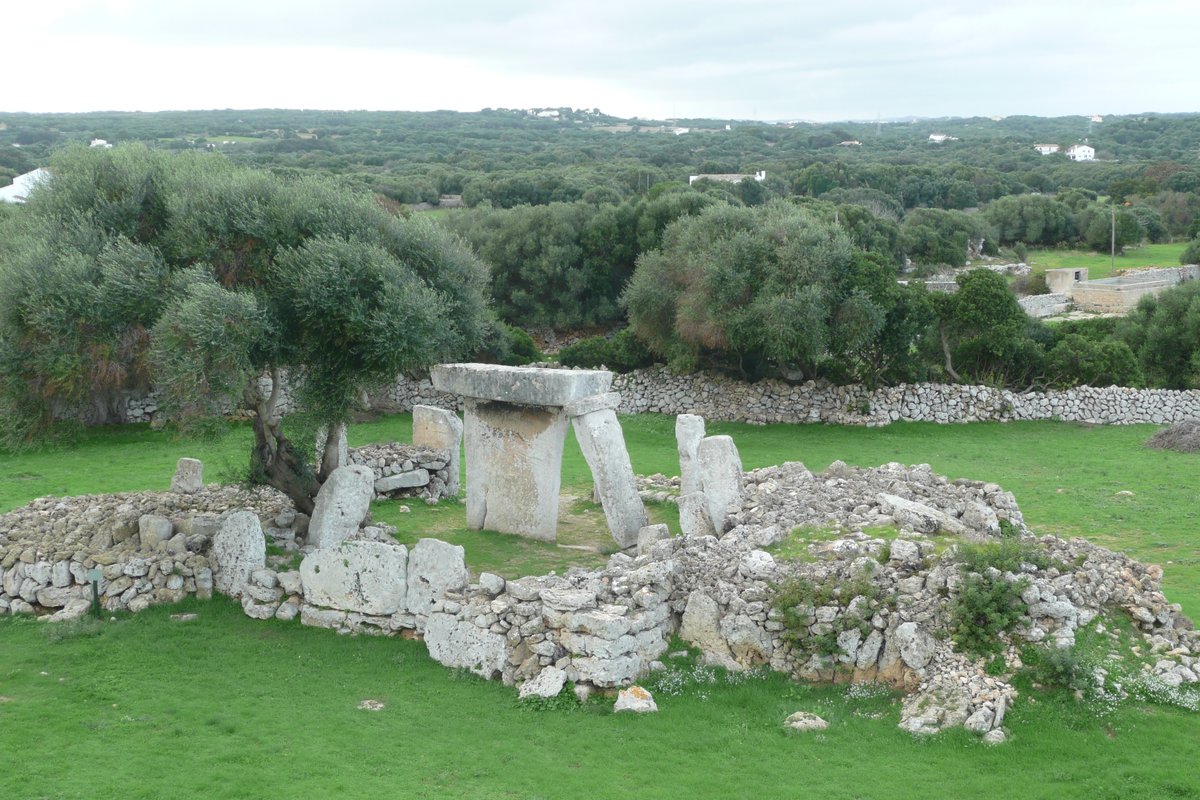

Talatí de Dalt is an archaeological site located in Menorca, Spain, approximately four kilometers from Mahón. It is a talaiot settlement dating back to prehistoric times, though it holds vestiges from later periods as well. Excavations by the Museum of Menorca were conducted between 1997 and 2001. Within the site, a cistern from the 19th century can be found near the entrance, which was used for watering livestock. Two natural caves nearby may have been used for funerary purposes before the establishment of the talaiot nucleus.
One house talaiòtica and a talaiot can still be observed, with adosaments and remains of a door of access to the internal chamber. The talaiot could have been part of the defensive system of the village, and a partially fallen pillar nearby was once part of the internal structure of a talaiòtic house with a central courtyard. The main attraction of the site is the recinte de taula, which is unique for having one of the perimeter pillars partially fallen.
Near the taula is the santuari, built during the 6th and 5th centuries BC. It was a sacred space used for ritual purposes, where fires were lit, ceremonial meals were held, and offerings were made to ensure the fertility of the land and main sources of subsistence. The santuari was in use for ritual purposes until the Roman era. A large talaiot, serving as a watchtower and control point, was built around 800-900 BC, though the internal structure is unknown as no archaeological excavation has since been conducted.
The excavated area of the village corresponds to a zone of talaiòtic houses, with three rooms with columns and stone slabs forming a roof still visible in the excavated area. These spaces were associated with internal courtyards and spaces suitable for domestic tasks, and talaiòtic houses typically had a circular plan with an approximate area of about 140 square meters. Remains of the wall that once enclosed the village can also be observed, and it is possible that this wall also formed part of the walls of several talaiòtic houses.
Sources: Wikipedia, OpenStreetMap, Wikidata, Wikimedia Commons
Written by Nicolo Ciampini
Discuss this with the author and others
No comments yet. Be the first to start the conversation.