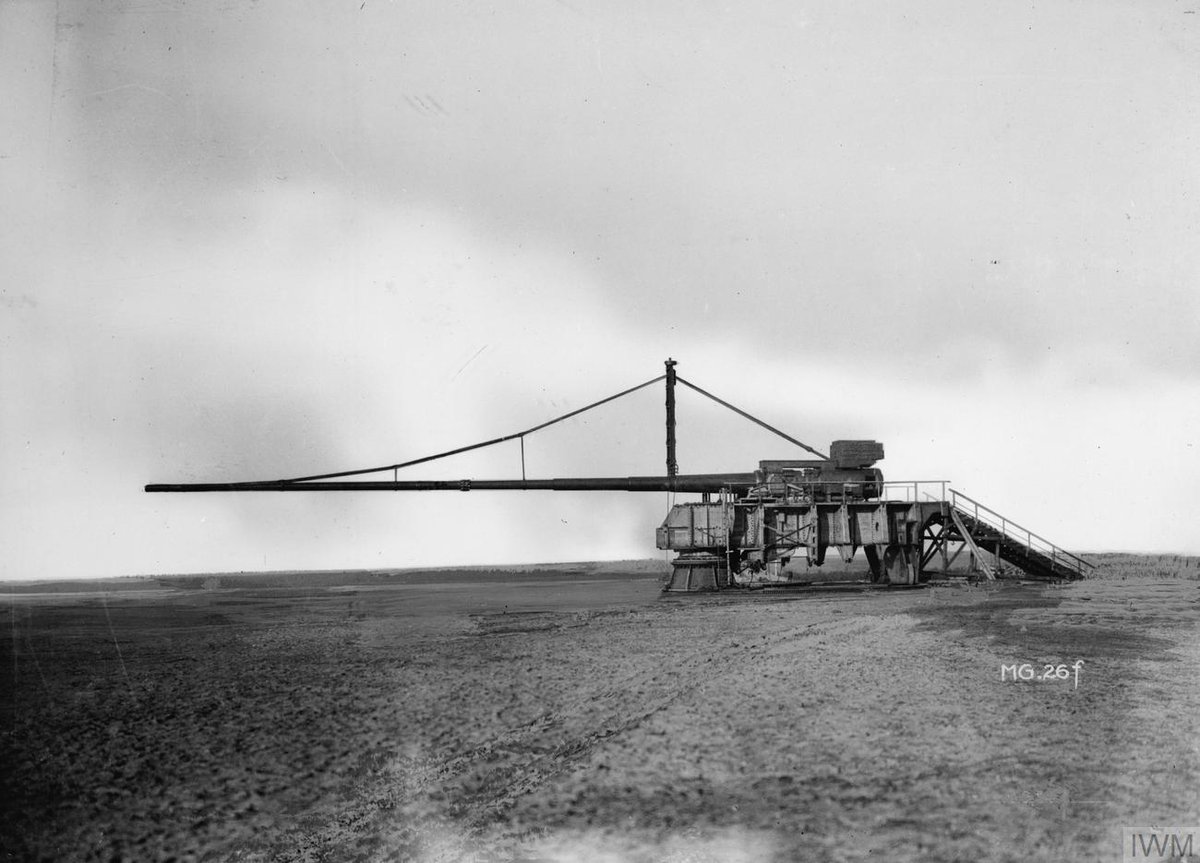

The Paris Gun (German: Paris-Geschütz / Pariser Kanone) was a type of German long-range siege gun, used to bombard Paris during World War I. When the Parisians heard the strange loud bangs, they mistakenly thought it was a Zeppelin. However, they were wrong. What really bombarded Paris was the Paris Gun, also known as the 'Kaiser Wilhelm Gun', which was a psychological weapon aimed at attacking the morale of the Parisians, not destroying the city.
Although the famous Krupp-family artillery makers produced the Paris Guns, they were not a great success: the payload was small, the barrel required frequent replacement, and the guns' accuracy was good enough for only city-sized targets. The Paris Gun was surrounded by several batteries of standard army artillery. The Paris Gun was fired from a north-south axis from Crépy-en-Laon. Professor von Eberhardt made the calculations for the Paris Gun's firing.
The gun was capable of firing a 106-kilogram (234 lb) shell to a range of 130 kilometres (81 mi) and a maximum altitude of 42.3 km (26.3 mi) - the greatest height reached by a human-made projectile until the first successful V-2 flight test in October 1942. At the start of its 182-second flight, each shell from the Paris Gun reached a speed of 1,640 m/s (5,904 km/h; 5,381 ft/s; 3,669 mph). The Paris Gun's barrel was 37 meters (121 feet) long. The barrel extension was intended to improve accuracy and reduce dispersion.
The Paris Gun barrel was braced and mounted on a special rail-transportable carriage. The Crépy Paris Gun was manned by a crew of 80 Imperial Navy sailors, led by Vice-Admiral Maximilian Rogge.
Sources: Wikipedia, OpenStreetMap, Wikidata, Wikimedia Commons
Written by Nicolo Ciampini
Discuss this with the author and others
No comments yet. Be the first to start the conversation.