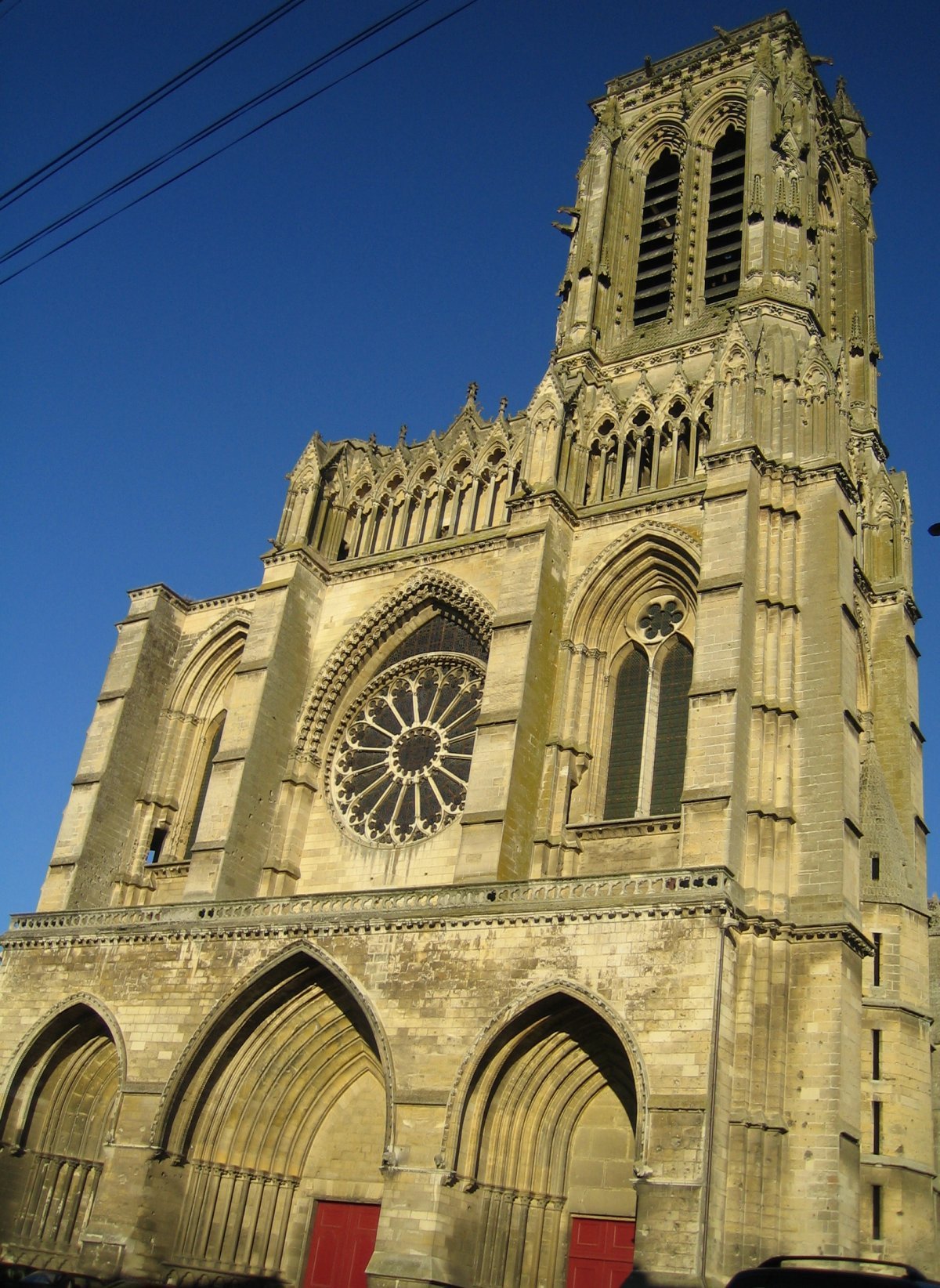

Why does Soissons Cathedral look like it was interrupted mid-sentence? Well, it was. While the single western tower stands at 66 metres - matching the height of Notre-Dame de Paris - a matching tower on the other side was originally planned but never built. In 1414, the Burgundians besieged the city and allowed the inhabitants of Soissons to seize stones from the construction site to repair their damaged houses. As a result, the south tower was never completed, and the cathedral was permanently deprived of its north tower due to insufficient funding.
Construction began in 1176. The cathedral was constructed rather quickly in a Gothic architecture style based on Chartres Cathedral, with the completion of the choir and clerestory in 1211, followed by the nave two hundred years later. The building survived Huguenot vandals in the 1500s, who destroyed pieces of furniture, stained glass, and statues, but it could not escape the French Revolution. In 1796, the cathedral was closed and stripped of its decorations, eventually being used as an army clothing store before being returned to religious use in 1799.
The 19th century brought more drama. A nearby gunpowder factory explosion in 1815 caused further damage to the stained glass windows. To save what was left, much of the remaining original stained glass panels were auctioned and sold to collectors. Now, some of these panels are in museums around the world, such as the Metropolitan Museum of Art in New York City and the Isabella Stewart Gardner Museum in Boston. The cathedral was badly damaged again during World War I, with artillery shelling destroying the tower and roof, before major reconstruction was completed in 1940.
Today, the cathedral remains the seat of the Bishop of Soissons, Laon, and Saint-Quentin. You can still see the 13th-century stained glass in the choir and a tapestry from the 15th century depicting the life of the martyrs Gervasius and Protasius. A painting by Rubens hangs in the northern transept, alongside another by Philippe de Champaigne. The southern transept remains the oldest portion of the edifice, unique for being divided inside into four levels rather than three.
Sources: Wikipedia, OpenStreetMap, Wikidata, Wikimedia Commons
Written by Nicolo Ciampini
Discuss this with the author and others
No comments yet. Be the first to start the conversation.