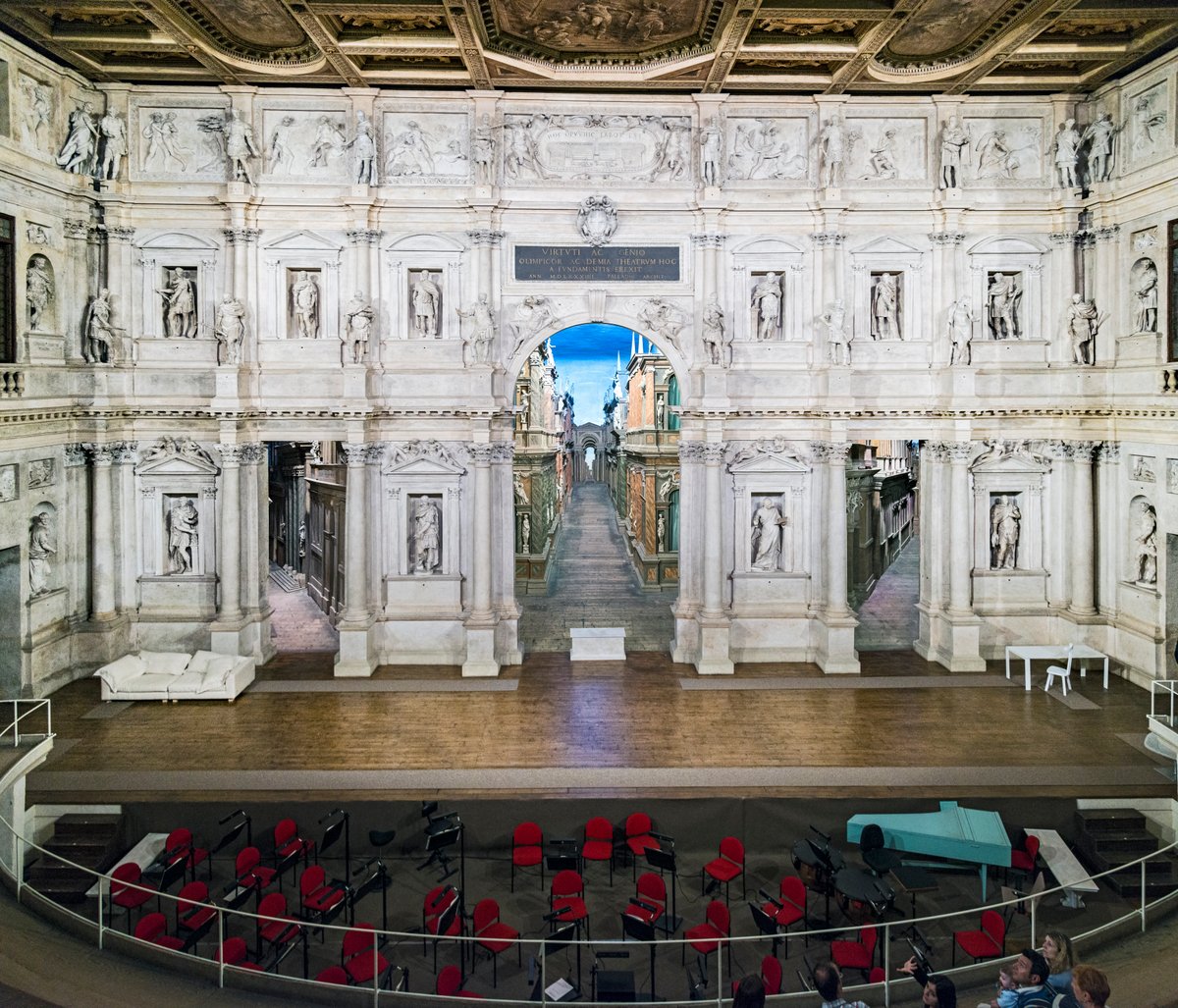

The Teatro Olimpico, or Olympic Theatre, in Vicenza, Italy, was the final design by the Italian Renaissance architect Andrea Palladio and was not completed until after his death. The trompe-l'œil onstage scenery, designed by Vincenzo Scamozzi to give the appearance of long streets receding to a distant horizon, was installed in 1585 for the first performance held in the theatre, and is the oldest surviving stage set still in existence. The full Roman-style scaenae frons back screen across the stage is made from wood and stucco imitating marble. The theatre was the home of the Accademia Olimpica, which was founded there in 1555. Since 1994 the Teatro Olimpico, together with other Palladian buildings in and around Vicenza, has been part of the UNESCO World Heritage Site 'City of Vicenza and the Palladian Villas of the Veneto'.
The seven long streets in the Teatro Olimpico are trompe-l'œil false perspectives that provide the illusion of looking down the streets of a city from classical antiquity. The sets in the Olympic Theatre recede only a few meters. The Olympic Theatre's stage set was the first practical introduction of perspective views into Renaissance theatre. The Olympic Theatre was inaugurated on 3 March 1585, and the initial production was Sophocles' Oedipus Rex, with music by Andrea Gabrielli.
Sources: Wikipedia, OpenStreetMap, Wikidata, Wikimedia Commons
Written by Nicolo Ciampini
Discuss this with the author and others
No comments yet. Be the first to start the conversation.