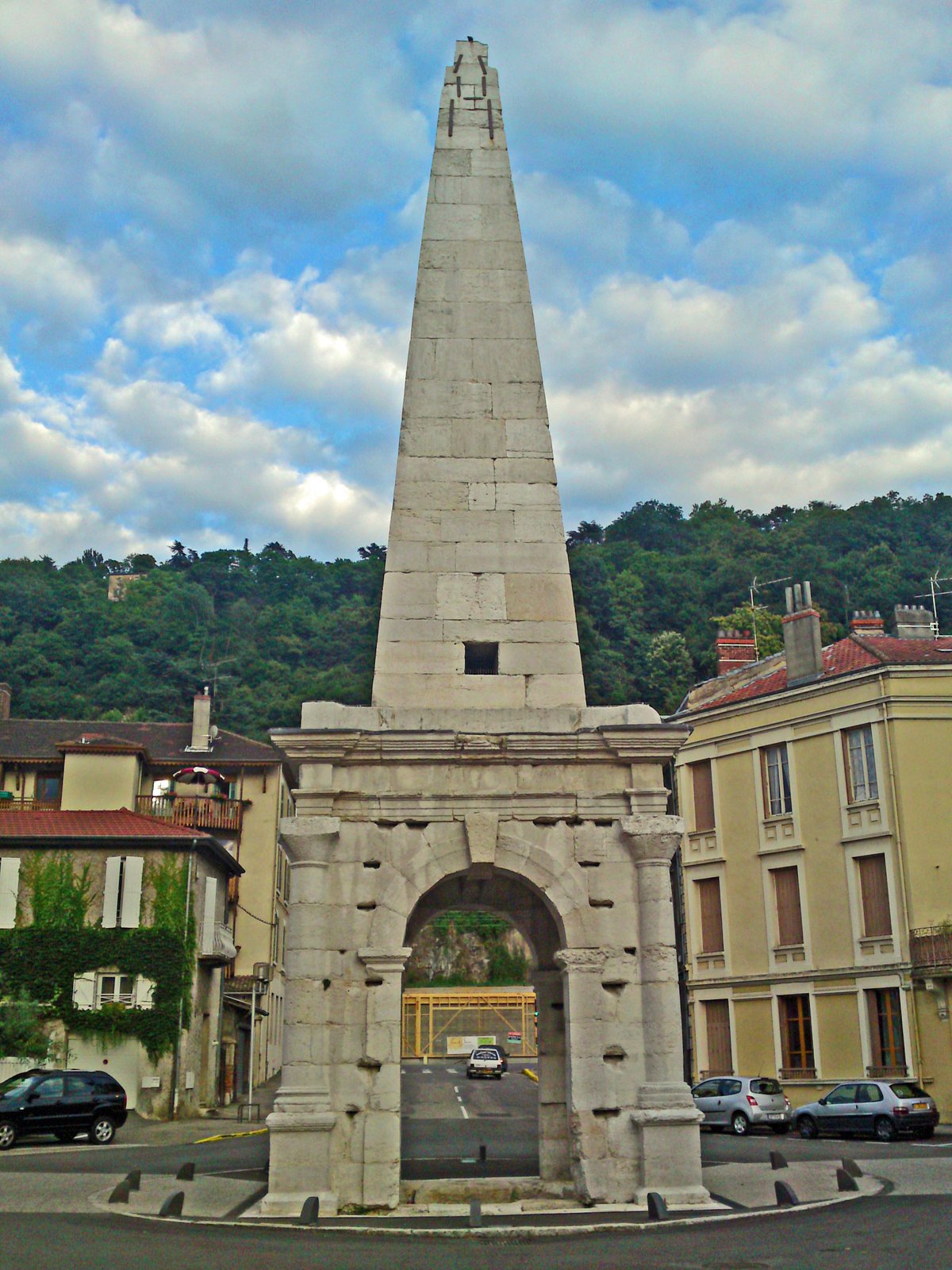

The Roman circus of Vienne, located in the city of Vienne (Isère), France, houses the Pyramid of Vienne, an unique reminder of its kind, standing today. Constructed around the end of the 2nd century, it was initially known through excavations dating back to the 19th century. Classified as a historical monument in 1852, it stands as a testament to the ingenuity and cultural diversity of the ancient Romans. The pyramid, originally built above a tetrapylon, is currently conserved in situ, in the middle of the spina, the central wall of the circus.
Its total height, including the base and the obelisk, is approximately 23 metres. The circus served for chariot races, with horses, in pairs or groups of four, running around while a signal indicated the number of laps. Estimated to be around 450 meters long and 118 meters wide, it was once one of the largest and most impressive structures of its kind in the Empire. The spina (the lowest of all known in the Empire), is believed to have been adorned with basins and fountains.
Modifications may have been made in the 4th century when the city changed status, with the circus possibly continuing to be used while nearby docks and residential areas were abandoned.
Sources: Wikipedia, OpenStreetMap, Wikidata, Wikimedia Commons
Written by Nicolo Ciampini
Discuss this with the author and others
No comments yet. Be the first to start the conversation.