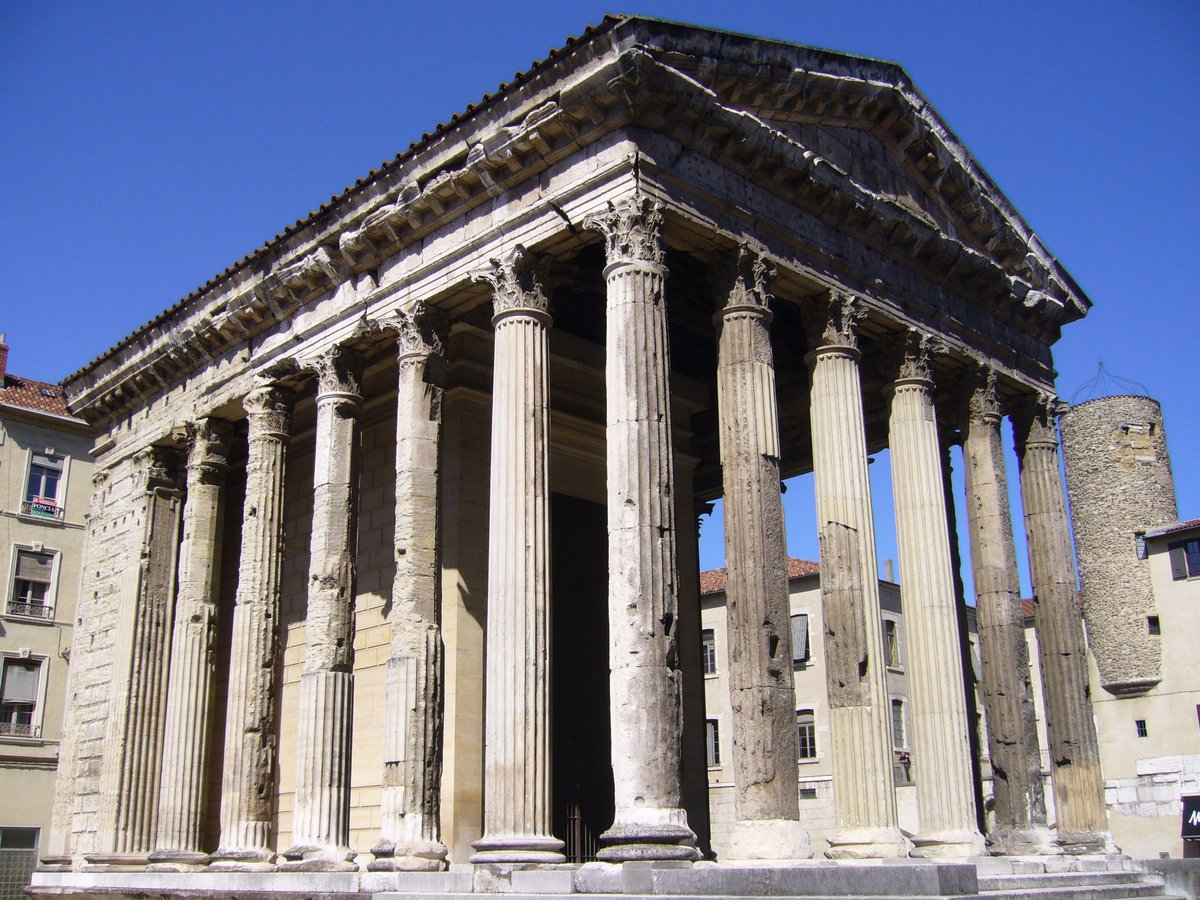

The Temple of Augustus and Livia, nestled in the heart of modern Vienne, France, hides a rich history spanning over two millennia. Built at the beginning of the 1st century, this Roman peripteral sine postico hexastyle Corinthian temple was a testament to the glory and power of Rome. However, over the centuries, the temple faced multiple transformations, becoming a church, a courthouse, and a library, before returning to its original form.
The temple was unique among the Roman temples, as it was the only one dedicated to the imperial cult to honor Emperor Augustus and his wife Livia. It had two states of construction. The original building, built in southern stone, was partially preserved, with large walls to the west, corner pilasters, returns with pilasters, and columns. The first state is dated last quarter of the 1st century BC, with similar buildings found in Nîmes, Vernègues, and Narbonnaise.
After the fall of the Western Roman Empire and the Christianization of Gaul, the temple became the parish church of Sainte-Marie-la-Vieille. Over time, it went through several transformations, until the French Revolution. From 1792, the church became the temple of Reason, then the commercial court of Vienne, then the museum and the library of Vienne (until 1852), and finally, after 28 years of work, the building regained its original aspect of Roman temple. Today, the temple is the subject of a classification under the historical monuments by the List of 1840.
Sources: Wikipedia, OpenStreetMap, Wikidata, Wikimedia Commons
Written by Nicolo Ciampini
Discuss this with the author and others
No comments yet. Be the first to start the conversation.