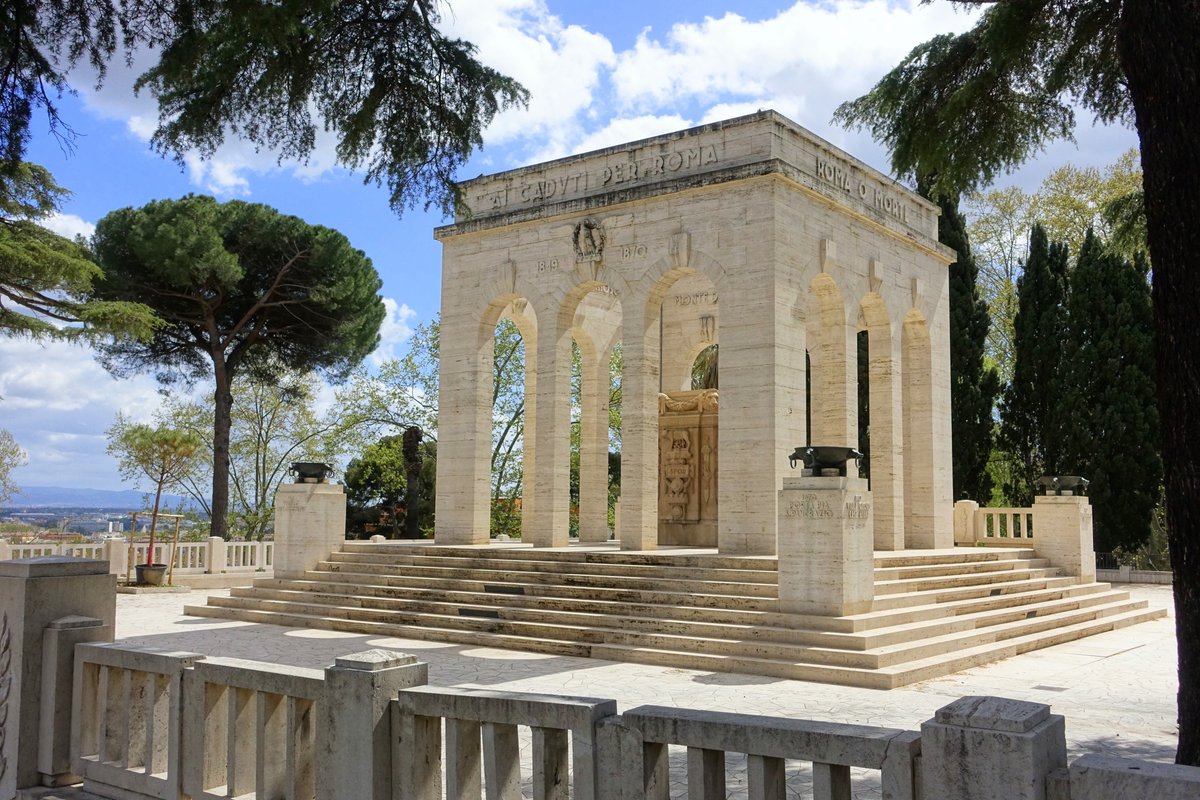

The Mausoleo Ossario Garibaldino serves as a monumental ossuary for over 1,600 heroes who fell during the battles for the city from 1849 to 1870. While the current structure was completed in 1941, the initiative to honor the fallen began in 1879. Menotti Garibaldi and his father sought to provide a dignified memorial, leading to a law approved in 1879 to collect the remains of those who died defending the city in 1849 or during its liberation in 1870.
To populate the site, authorities conducted searches for remains across several locations, including the Campo Verano, the city walls, and vineyards between San Pancrazio and Porta Maggiore. The first burials occurred in 1879, with others following in 1884. The current monument was designed by architect Giovanni Jacobucci under the regime of the 1930s and was inaugurated on November 3, 1941, following two years of construction.
Inside the crypt, the atmosphere is defined by a golden mosaic ceiling and a central pillar decorated with palms and alabaster crosses. The walls are lined with 36 loculi containing plaques for over 1,600 fallen soldiers. At the back stands a porphyry sarcophagus holding the remains of Goffredo Mameli, the author of the Italian national anthem, who was killed at the age of 22 on this hill in 1849.
Visitors can enter through a bronze portal decorated with motifs inspired by antiquity. The structure features an altar made from a single block of red granite from Baveno, carved with allegorical figures like the Capitoline wolf. The facade bears the inscription "Ai caduti per Roma 1849-1870" and the motto "Roma o morte," marking the site as a sanctuary for those who fought for the nation.
Sources: Wikipedia, OpenStreetMap, Wikidata, Wikimedia Commons


Written by Nicolo Ciampini
Discuss this with the author and others
No comments yet. Be the first to start the conversation.