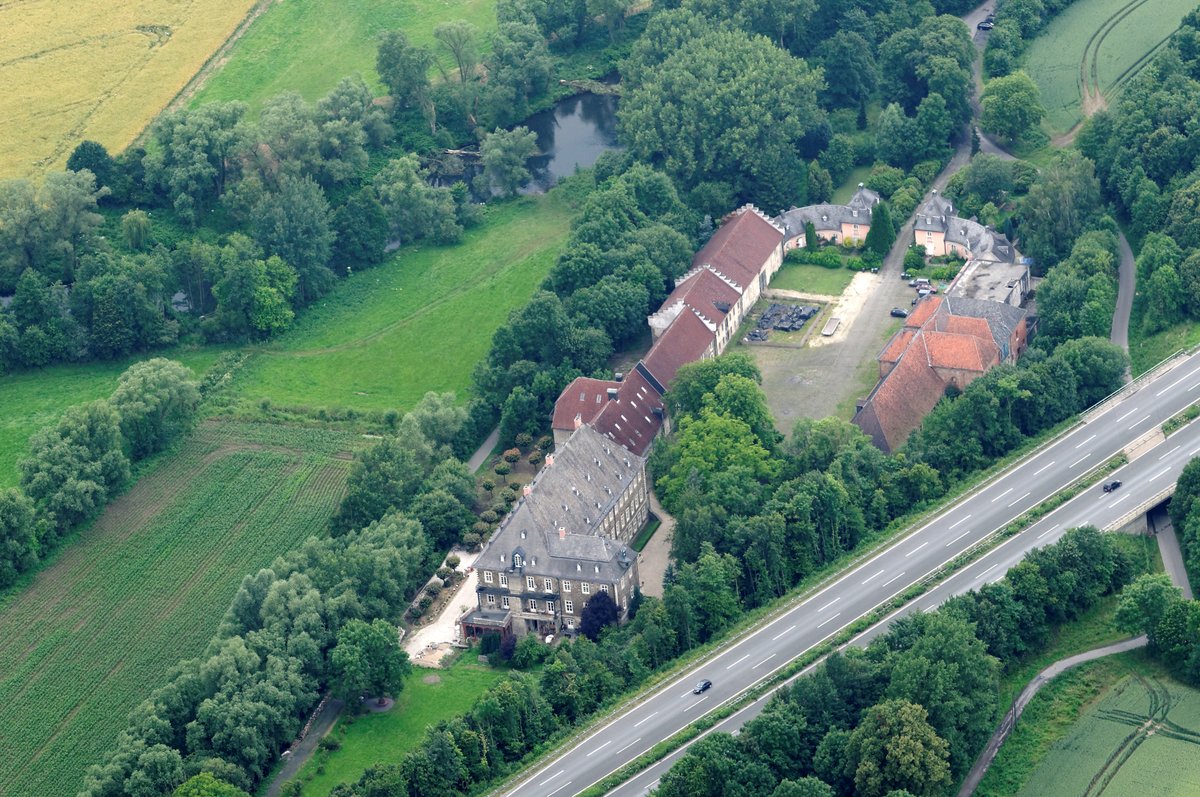
A Baroque bridge from 1698 spans toward the wappen-crowned entrance of Haus Füchten. This manor sits upon a hillside in Ense, a quiet Sauerland stretch east of the Ruhr. While stone and stucco reflect 18th-century refinement, the earth remembers a much older fortification. A castle stood here before it was systematically dismantled to permit private country estates.
Records from 1298 first name this site curtis de Vuchtene, a fief granted to knight Goswin von Soest. For centuries, medieval structures defined the landscape until 1700. Then, Caspar Diedrich von Droste zu Erwitte ordered the old castle destroyed to manifest a new vision. He built a manor on the slope, moving from the riverbank. In 1726, Ernst Dietrich Anton von Droste zu Füchten added a chapel wing, creating the sprawling footprint seen today.
The house transitioned from nobility to social utility during the 19th century. In 1834, Josef Caspar von Mellin acquired the property. A man of charity, Mellin founded a foundation to govern the house after his and his wife's deaths in 1860. The foundation turned the manor into an agricultural school. For several decades, halls echoed with voices of poor boys and orphans who studied to become farmers. This education ended in 1903 because local transport connections were too poor to sustain it.
Nature and infrastructure later reshaped the borders. In the mid-1980s, the foundation sold the property to a private owner. Shortly after, the construction of the A 445 motorway in 1987 sliced through the land, removing old trees and carving through moats. Despite these modern scars, the interior remains a sanctuary of ornamentation. A double-flight open staircase leads to the great hall, where walls feature figural and ornamental stucco work.
Even as the world changed, the house kept its ritual. For roughly 150 years, the Füchtener Prozession from Bremen has traveled to the house annually. Today, the manor balances history as a place of study and a site of worship. The chapel remains open for weddings and religious services, while the great hall hosts concerts. From the 1698 bridge, one sees layers of the medieval site, Baroque residence, 19th-century schoolhouse, and modern landscape.
Sources: Wikipedia, OpenStreetMap, Wikidata, Wikimedia Commons




Written by Aurora
Discuss this with the author and others
No comments yet. Be the first to start the conversation.