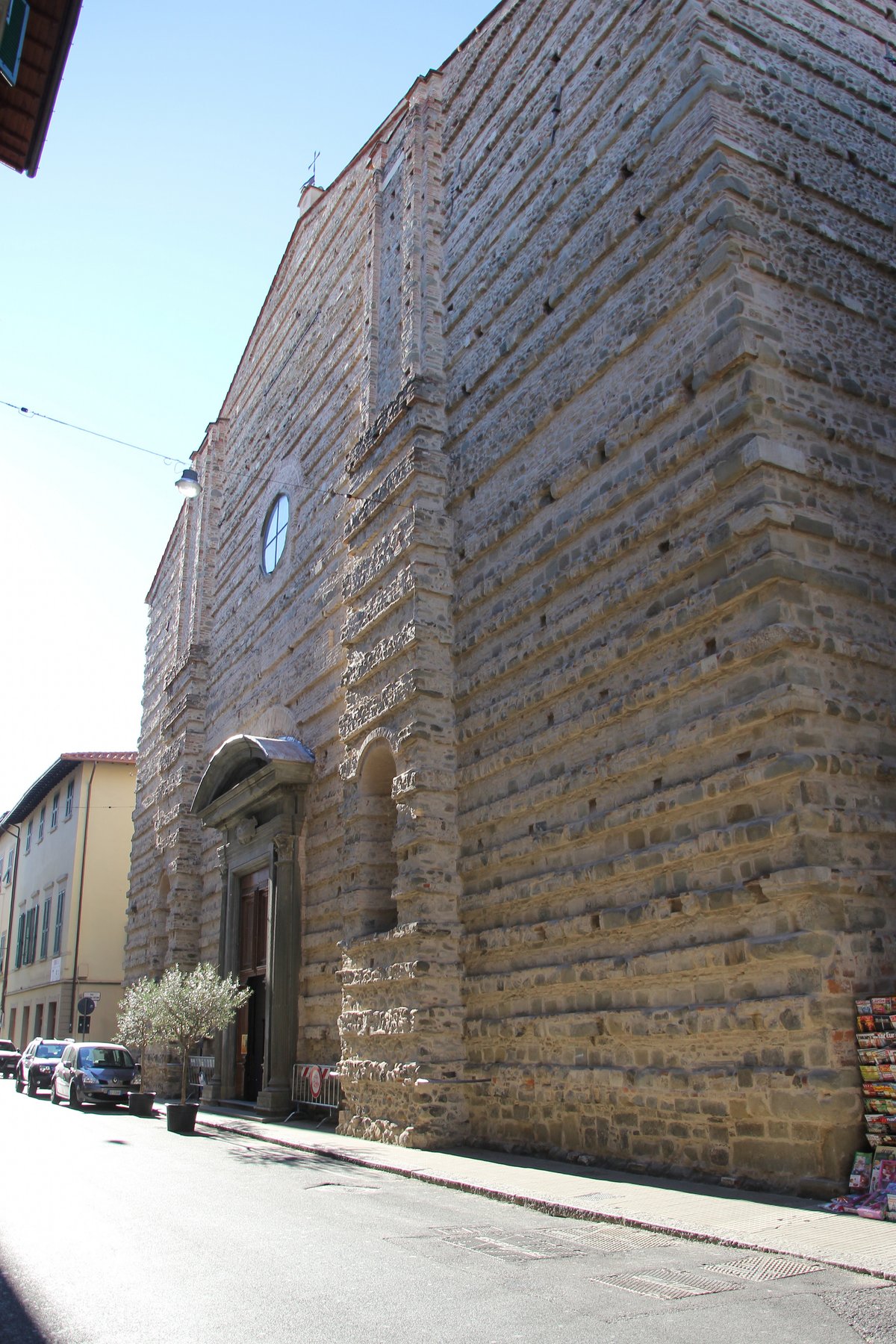

The Basilica of Our Lady of Humility, or Basilica della Madonna dell'Umiltà, is a Renaissance-style Roman Catholic church in Pistoia, Italy. This towering symbol of Pistoia, standing at 59 meters tall, is reminiscent of Brunelleschi's dome for the Cathedral of Florence. However, its construction wasn’t an ordinary task. It was a response to a perceived divine intervention, a miracle, that took place in 1490. According to legend, blood was seen dripping from a 14th-century fresco of the Madonna, which was interpreted as a sign that the Virgin Mary suffered from the bloodshed in the region.
The miracle was confirmed by the Bishop of Pistoia, Niccolò Pandolfini, and the important families of the city decided to build the sanctuary to honor the Virgin Mary. The fresco is attributed to Bartolomeo Cristiani, a local painter from Pistoia. Initially, Giuliano da Sangallo was commissioned to design the church, but he left Tuscany, and the design was completed by Ventura Vitoni, who began construction of the octagonal church in 1495 and work continued until his death in 1522.
In 1563, the Grand Duke Cosimo I Medici entrusted completion to Giorgio Vasari, who elaborated the tall dome. The main altar was designed in 1579. The church was consecrated in 1582. The facade remains incomplete. The 59-meter-high dome was completed in 1569, but its completion had been an arduous and prolonged task, and soon after, cracks appeared in the structure, requiring Vasari to add chains to gird the structure. However, for centuries, problems continued, requiring further refurbishments well into the 21st century.
In 1931, Pope Pius XI elevated the church to the status of minor basilica. An inventory in 1821 listed the church as containing the following works: Construction of the Temple by Giovanni Domenico Piastrini (Four canvases in atrium) 'Cain damned by God' by Niccola Monti (atrium) Other canvases in atrium by Vincenzo Meucci and Gricci Fiorentino (Giuseppe Gricci? Tomb of bishop Giuseppe Ippoliti sculpted by Francesco Carradori Saint Jacob canvas attributed to Gerino da Pistoia 'Rest in Egypt' by Lazzaro Baldi (Alluminati altar) 'Adoration of the Magi' by Francesco Vanni (Panciatichi altar) 'Adoration of the shepherds' by Pietro Sorri (Panciatichi altar) 'Assumption of the Virgin' attributed to Francesco Morandini (il Poppi) (Rospigliosi altar) The Rospigliosi altar is attributed to Giovanni Battista Naldini.
Sources: Wikipedia, OpenStreetMap, Wikidata, Wikimedia Commons
Written by Nicolo Ciampini
Discuss this with the author and others
No comments yet. Be the first to start the conversation.