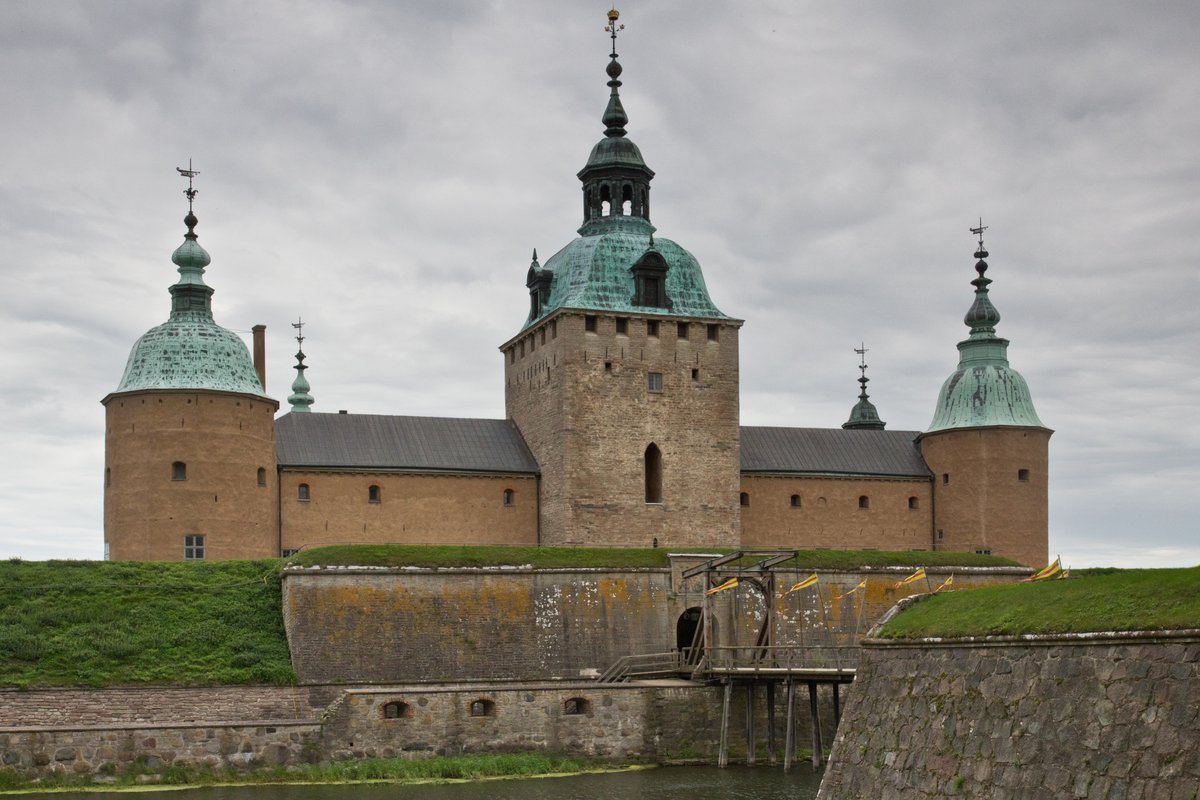

Kalmar Castle, a symbol of Sweden's rich history, rises tall in Småland since the 12th century. Known as 'Rikets nyckel' ('the Key to the Kingdom'), it was first established as a defensive round tower. In 1397, the Kalmar Union, a significant political alliance uniting Denmark, Norway, and Sweden (then including Finland) under Queen Margaret I of Denmark, was forged at Kalmar Castle. During the Swedish rebellion against Denmark in 1520, Anna Eriksdotter (Bielke), who took control of the fortress upon her spouse's death, defended it valiantly against the Danish forces.
Later, in the 16th century, the fortress was transformed into a Renaissance castle under the reign of King Gustav I and his son Johan III. Although 'Kuretornet' was the only tower left unmodified during this period, all other towers were reshaped, and the castle was given a uniform height with lead-covered roofs and squared windows. Painted white with red-covered roofs, the interior renovations soon followed, including the remodeling of several rooms like the old throne room, the chequer hall, and the grey hall.
The new throne hall also underwent renovation, adorned with 2,200 gold-painted leaves. Today, Kalmar Castle remains one of Sweden's best-preserved Renaissance Castles, open for public visitation.
Sources: Wikipedia, OpenStreetMap, Wikidata, Wikimedia Commons
Written by Nik Frost
Discuss this with the author and others
No comments yet. Be the first to start the conversation.