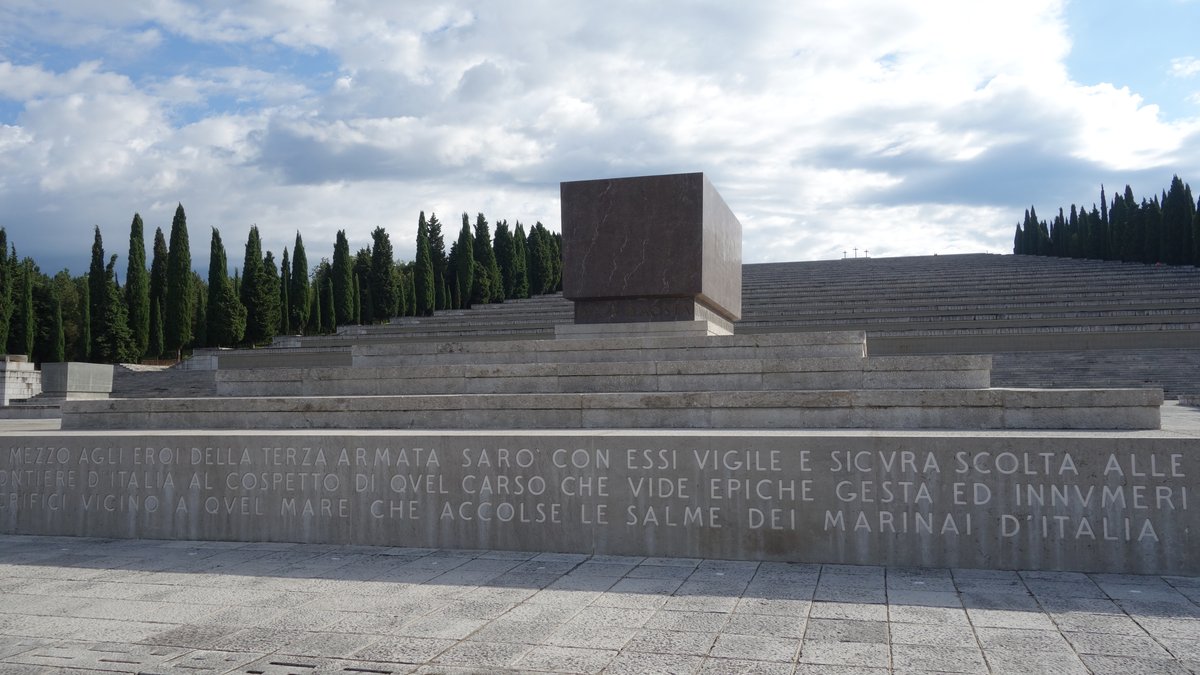

The Redipuglia War Memorial, a hilltop colossus in the Friuli-Venezia Giulia region of northeastern Italy, stands as the largest war memorial in Italy and one of the largest in the world. This shrine holds the remains of 100,187 Italian soldiers who perished between 1915 and 1917 during the twelve battles on the Karst and Isonzo front during World War I. The memorial, designed by architect Giovanni Greppi, was somberly unveiled in 1938, with Benito Mussolini and 50,000 soldiers in attendance - old comrades who had fought on the Isonzo front herself.
Originally, the site served as the war cemetery of the Italian Third Army, but now, it houses the remains of over 30,000 soldiers.
The shrine, built on the slope of the hill, features 22 horizontal stone platforms, each making its way up step by step. These platforms hold the remains of 39,857 identified soldiers, neatly arranged in alphabetical order. Above each nameplate, the top frieze reads 'Presente' (Present) in repetition. Atop the last platforms stands a votive chapel, separated by two large mass graves containing the remains of 60,330 unknown soldiers.
The chapel and two adjacent rooms showcase personal belongings of both Italian and Austro-Hungarian soldiers. At the monument's base, six sepulchres house the remains of Prince Emanuele Filiberto, Duke of Aosta (the commander of the Third Army, who passed away in 1931 and requested to be buried among his men) and five generals who were killed in action. The path leading up to the monument is the Via Eroica, flanked by 38 bronze plaques with the names of 38 locations on the Karst plateau where the bloodiest fighting occurred.
Sources: Wikipedia, OpenStreetMap, Wikidata, Wikimedia Commons
Written by Nicolo Ciampini
Discuss this with the author and others
No comments yet. Be the first to start the conversation.