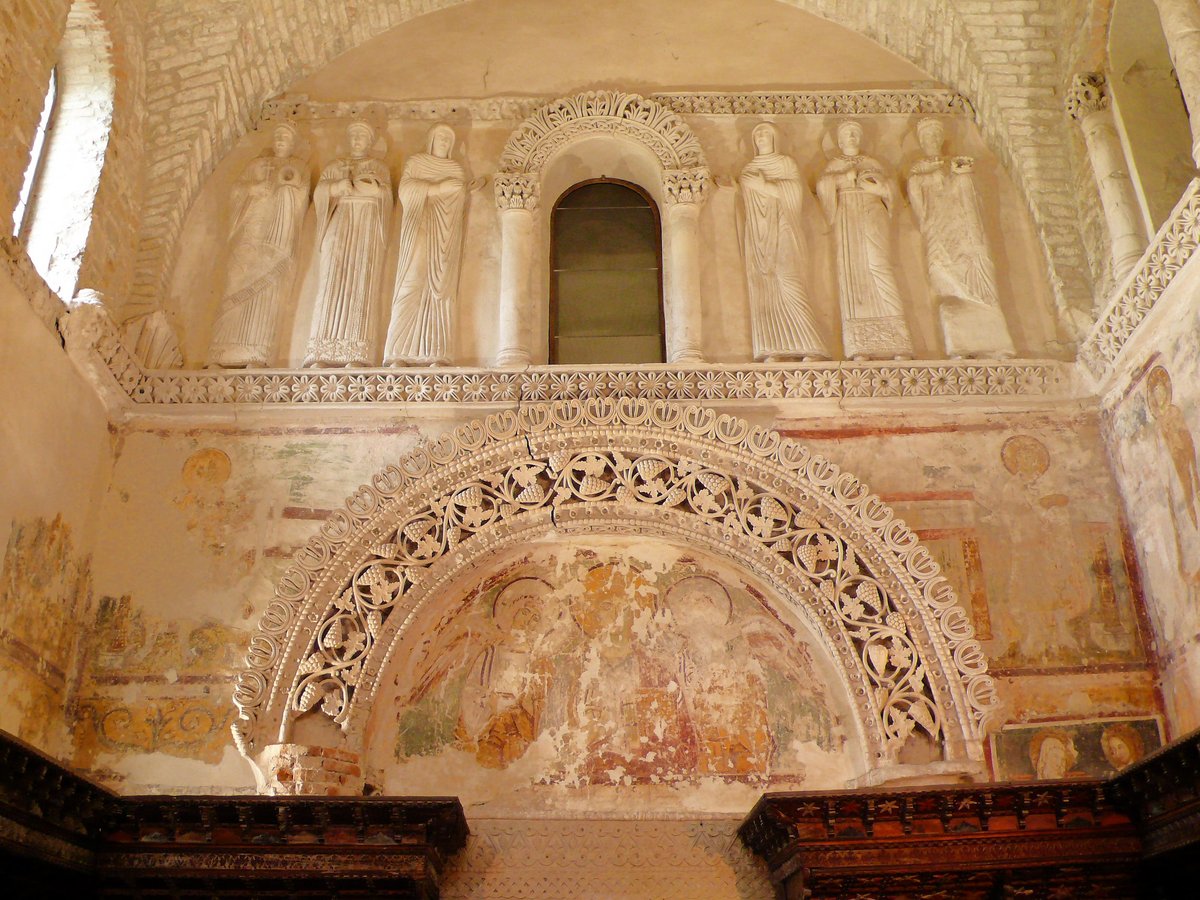

The Oratorio di Santa Maria, previously called the Tempietto longobardo, is located in Valle on the north-eastern frontier at Cividale del Friuli. Erected in the 8th century under the rule of the Lombards, it is the most important and best preserved example of Lombard architecture. The building resembles styles found in Ottonian, Roman, Lombardy and Carolingian art.
This structure served as a Palatine Chapel for Lombard Dukes and the king's functionaries. It stands as one of the few architectural examples of a positive relationship between Europe and Arab-Muslim countries, visible through the techniques utilized and the stucco decorations. While the structure started much earlier, many of the decorations, statues and stuccos might have been constructed as late as the 11th and 12th centuries.
The exterior is plain, but the interior is a complex 3 to 5 ratio composed of a square-plan, single chamber with a spacious cross-vault, divided by pairs of columns in three parts covered in barrel vaults. The space is dense with rich decoration, including stuccos and fresco wall-paintings that depict the Blessing of Christ amongst the Archangels Michael, Gabriel and other male saints.
The walls are filled with floral stucco decorations done in high-relief, bi-colored floors, marble wall revetments, mosaics, and sculptures done in stone. A curious aspect is the frieze which includes six remaining important stucco figures of unidentified women that were potentially saints or royal patrons. These figures are stylized with dramatic folds in their garments and slightly elongated forms, reminiscent of Byzantine models.
As a UNESCO Cultural heritage site, this archaeological site is part of the seven sites within the Longobards in Italy: Places of Power (568-774 A.D.).
Sources: Wikipedia, OpenStreetMap, Wikidata, Wikimedia Commons
Written by Nicolo Ciampini
Discuss this with the author and others
No comments yet. Be the first to start the conversation.