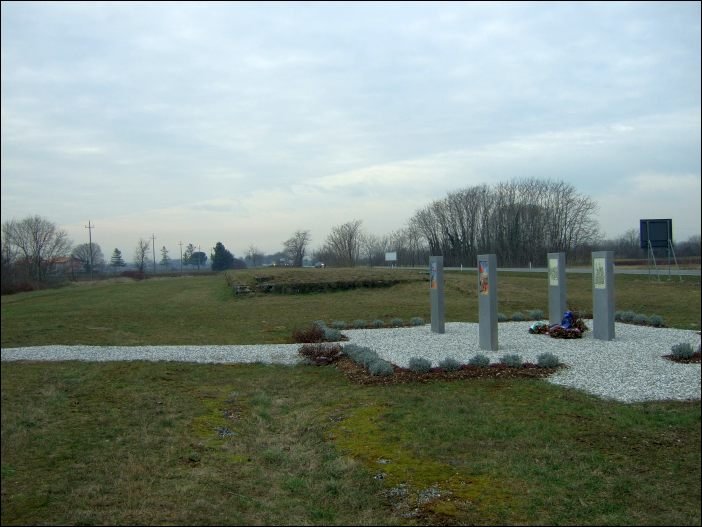
In the sixteenth century, the town of Gonars in the Friuli Venezia Giulia region of Italy, was a bustling center of culture and commerce. But during World War II, the town became the site of a much darker chapter in its history: the establishment of the Gonars concentration camp. Established on February 23, 1942, this camp was one of several Italian concentration camps, intended for the internment of ethnic Slovenians and Croatians. Many prisoners were transferred to this camp from the Rab concentration camp.
The first transport of 5,343 prisoners, 1,643 of whom were children, arrived two days after the camp's establishment, from the Province of Ljubljana and from two other Italian concentration camps. The camp was disbanded on September 8, 1943, immediately after the Italian armistice. Only in 1973 was a memorial created at the town's cemetery, where the remains of 453 Slovenian and Croatian victims were transferred into its two underground crypts. It is believed that at least 50 additional persons died in the camp due to starvation and torture, and at least 93 children were killed at the camp, including those that had been transferred from the Rab concentration camp to Gonars.
The camp operated as a sub-camp of the Italian concentration camps during the reign of Mario Roatta, who implemented his ethnic cleansing policy against ethnic Slovenes from the Italian-annexed Province of Ljubljana and Croats from Gorski Kotar, in line with the racist 1920s speech by Benito Mussolini, along with other Italian war crimes committed on the Italian-annexed territories of Yugoslavia:
“When dealing with such a race as Slavic – inferior and barbarian – we must not pursue the carrot, but the stick policy. We should not be afraid of new victims. The Italian border should run across the Brenner Pass, Monte Nevoso and the Dinaric Alps. I would say we can easily sacrifice 500,000 barbaric Slavs for 50,000 Italians.”
Note that the camp was not the only concentration camp in Italy, but it is worth mentioning some notable individuals who were interned here.
=== Slovenes === Viktor Antolin, professor of philosophy (student/journalist at the time) France Balantič, poet France Bučar, lawyer, writer, and statesman in post-1991 Slovenia Lojze Bukovac, recipient of the Commemorative Medal of the Partisans of 1941, a writer Alojz Gradnik, poet Bogo Grafenauer, historian Zora Konjajev, pediatrician Boris Kraigher, politician Vasilij Melik, historian Frane Milčinski (pen name Ježek), a poet, actor, children's writer, and director Odon Peterka, poet Jakob Savinšek, sculptor and poet Bojan Štih, literary critic, essayist, and stage director Bogdana Stritar, opera singer Aleš Strojnik, engineer and educator Nada Vidmar, opera singer Nande Vidmar, painter Anton Vratuša, politician Vitomil Zupan, writer Tone Čufar, writer
== Sources == Alessandra Kersevan (2008): Lager italiani. Pulizia etnica e campi di concentramento fascisti per civili jugoslavi 1941–1943. Editore Nutrimenti Alessandra Kersevan (2003): Un campo di concentramento fascista. Gonars 1942–1943, Kappa Vu Edizioni, Udine. Nadja Pahor Verri (1996): Oltre il filo: storia del campo di internamento di Gonars, 1941–1943, Arti Grafiche Friulane, Udine. Luca Baldissara, Paolo Pezzino (2004): Crimini e memorie di guerra: violenze contro le popolazioni e politiche del ricordo, L'Ancora del Mediterraneo. ISBN 978-88-8325-135-1
== Further reading ==
Sources: Wikipedia, OpenStreetMap, Wikidata, Wikimedia Commons
Written by Nicolo Ciampini
Discuss this with the author and others
No comments yet. Be the first to start the conversation.